Hi, what do you want to do?






Curated OER
Introducing the Concept: Rates
Sixth graders explore rates as a specific type of ratio, using visual examples of unit rates and unit prices to increase comprehension. They also practice solving problems that are modeled by the instructor. The well-scripted lesson is...

EngageNY
Comparison Shopping—Unit Price and Related Measurement Conversions II
Which rate is greater and by how much? Pupils continue to compare rates to solve problems in the 20th portion of a 29-part series. Rates are presented in a variety of representations either using the same representation or different...

Curated OER
Is Bigger Always Better?
Explore rational numbers with the young mathematicians in your class. They will investigate decimals, fractions, and percents before ordering and comparing rational numbers. This multi-day unit includes differentiation activities and...

Curated OER
Investigation - The Local Bagel Shop
Sixth graders investigate unit pricing to find which cup of coffee is a better buy. They use ratio and proportions to solve problems involving a change of scale in drawings, maps, recipes, etc. Students determine the unit cost of items...

Curated OER
How Much Is A Gallon?
By engaging in real life examples, learners practice measurement and conversion skills. They review a chart comparing pints, quarts, and gallons. Then, they complete a worksheet involving prices per unit. For example, they calculate how...

Curated OER
What's the Price?
Fourth graders learn about price and comparative shopping. In this price and comparative shopping lesson, 4th graders read Amy Axelrod's, Pigs Go To Market: Fun with Math and Shopping. They use the book to investigate the meaning of...

Curated OER
Shopping the Sunday Circular
Pupils demonstrate an understanding of price-per-unit mathematics. In this computation activity, learners accurately figure the unit price of grocery items. They create a chart and record the item, the price, the size and the cost per item.

Curated OER
Economic Recovery? a Comparison of Indicators for Utah And the United States Since March 2001
Students discuss key business and consumer indicators that are used to measure the health of the economy. They compare the economic recovery (from the 2001 recession) of Utah and the United States. They discuss the benefits and...

Curated OER
Comparing Candy Bars
Eighth graders identify that a ratio is a comparison of two numbers and that a proportion is an equation that equates two ratios. They identify the extremes and means of proportions, as well as the product of the extremes equals the...

Curated OER
Inflation
Students compare prices then and now. They use the calculated rate of inflation to figure out the equivalent prices today for items sold at the fair and money earned in 1864. They calculate the actual value of a bowl of soup, a dinner,...

Curated OER
The Price Is Right - Grocery Store Prices
Eighth graders use the unit price to compare which local grocery store has the best prices. Assign students to work with a partner and a role. One person is the recorder and the other is the mathematician.

Curated OER
A Basket of Bangles: How a Business Begins
Students consider concepts of banking introduced in the story, "Basket of Bangles." In this banking lesson plan, students identify key terms through recall questions interspersed in the story. Using five handouts and a game, students...

Curated OER
Hitting the Roof
Students examine the state of the British housing market. For this current events lesson, students visit selected websites to study Gordon Brown's plan for eco-towns, how to borrow money to buy homes, and what the home prices are in...

Curated OER
The Economy of the 1920s v. The Economy of the 1930s
In this U.S. economics of the 1920s and 1930s worksheet, students read a passage and then complete a graphic organizer comparing the credit, wages, employment, sales, stock market, and banks in the 2 decades.

Curated OER
How Can Business Profit from Tariffs? p1
Students investigate the impact of tariffs on businesses and consumers during the 1880s by looking at a political cartoon, solving a short math problem and comparing protectionism in the 1980's to protectionism in the 1880's.

Illustrative Mathematics
Illustrative Mathematics: 8.ee Peaches and Plums
In this task, 8th graders are shown graphs of two linear functions and are asked to compare the costs per pound of two fruits without knowing their actual prices. To do this, they need to think about slope and unit rates. Aligns with...
Illustrative Mathematics
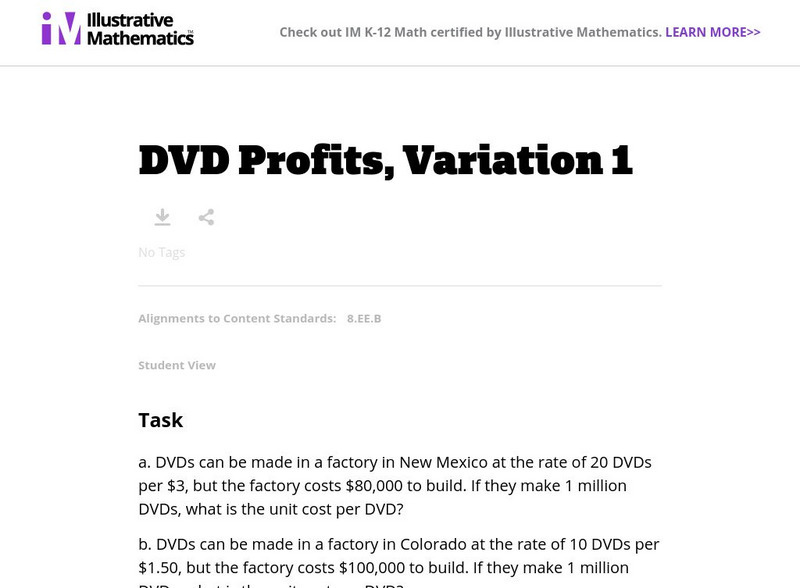
Illustrative Mathematics: 8.ee Dvd Profits, Variation 1
Eighth graders examine the costs of producing DVDs, taking into account the cost of building a factory. They need to look at units costs for DVDs, fixed prices, and building costs. They are asked to compare the costs for producing them...