Hi, what do you want to do?






Professor Dave Explains
Classification of Stars: Spectral Analysis and the H-R Diagram
So we have made it through the dark ages, and are now a few hundred million years into the lifetime of the universe. There are plenty of stars all over the place, but are they all the same? How can we classify stars? Let's go through the...

Crash Course
Exploring the Universe: Crash Course Big History #2
According to Carl Sagan, we are all made of star particles. The second video in a series of 16 explains what happened after the big bang. It discusses cosmic background radiation, chemistry, galaxies, heavy elements, and the creation of...

TED-Ed
Periodic Videos
From hydrogen to ununoctium, this collection of videos has everything you need to begin teaching about the periodic table. Offering descriptions of each element and interesting experiments...

TED-Ed
What Makes Neon Signs Glow? A 360° Animation
Why are neon signs so bright and colorful? Scholars discover how artists create neon signs and find out that neon is not the only gas they use in their production. Next, they explore the history of neon signs and how their development...

American Chemical Society
Are We Running out of Helium?
Helium is a favorite element of young children everywhere! A video lesson from a larger series examines the properties of helium and why they may contribute to its eventual extinction. The lesson also explores possible industrial...

PBS
The Sun's Energy
How does the sun produce so much energy without blowing up? Viewers discover the delicate balance of inward and outward forces within the sun through a short video. The lesson includes discussion questions and is part of a larger sun...

PBS
The Anatomy of the Sun
Welcome to Sun 101! What better way to gain an understanding of our star than to learn about its anatomy? Physical science scholars peer inside to discover the inner workings of the sun through a video and discussion questions. The...

Periodic Videos
Helium (Version 1)
Helium is the second most common element in the universe, yet we are running out of helium on Earth. A video on this important element includes common reactions, uses, and concerns that scholars need to know to understand helium.

THNKR
Bill Nye: Is Jupiter Like A Piece Of The Sun?
Jupiter and the sun are more alike than you might think. Examine the elements that make up these two heavenly bodies as part of the Fuse THNKR "Why with Nye!" playlist. Bill Nye explains the composition of the sun and Jupiter, then...

MinuteEarth
Our Atmosphere is Escaping!
Our atmosphere keeps us from the extreme temperatures experienced on the moon. The video explains that our atmosphere actually leaks. It describes exactly which molecules escape and the multiple factors that contribute.

Veritasium
Where Does The Sun Get Its Energy?
How does the sun give us light and heat? Discover what's really going on inside the centerpiece of our solar system in a brief video. The content includes common misconceptions about the sun's source of energy, how the simple elements...

Crash Course
A Brief History of the Universe
No one was actually there to see the birth of the universe, but years of collaboration between physicists and mathematicians allow us to glimpse all but a fraction of a second of it. A narrated journey shows the phase changes...

Crash Course
Low Mass Stars
What happens when stars run out of fuel? Pupils learn the incredible sequence of events that occur as a star nears its end. The video compares and contrasts the events in low- and high-mass stars, detailing the cycle of fusion, energy...

Fuse School
Structure and Composition of the Earth
Why is Earth different from other planets? What makes it so special, anyway? It's only fitting to delve into how the "parent" rock was formed in the first installment of a seven-part series about rocks and rock formation. Amateur...

Fuse School
Collecting and Identifying Gases
How do you catch something that can't be seen, has no odor, and makes no sound? Discover the common methods of gas collection in this first of a ten-part video series. Learners see how the properties of density and solubility are...

SciShow
Helium
The helium in a balloon comes from the radioactive decay of the elements thorium and uranium. Video two in this series of 48 explores the element helium. The narrator discusses how humans use it, where it is found, how the United States...

SciShow
Baumgartner's Super Sonic Dive
Felix Baumgartner jumped to Earth from a helium balloon in 2012, setting five world records in the process. The video answers the most commonly asked questions about this amazing feat that may not be quite what people advertised it...

DoodleScience
Life Cycle of Stars
Introduce your young astronomers to the life cycle of stars, from protostar to either white dwarf or black hole, with a short video that provides a brief overview of the process.

Crash Course Kids
Glow On
Why do stars appear to glow? And why is it that some stars seem brighter than others? This is the focus of a video that explains how stars get their glow and how apparent brightness is determined by distance, rather than size.

Khan Academy
Cosmic Background Radiation, Scale of the Universe, Cosmology and Astronomy
An informative video explains the density of particles immediately after the Big Bang, as well as the concept that whenever a particle was released, it would merge with another particle. Sal develops the concept of being able to receive...
University of Nottingham
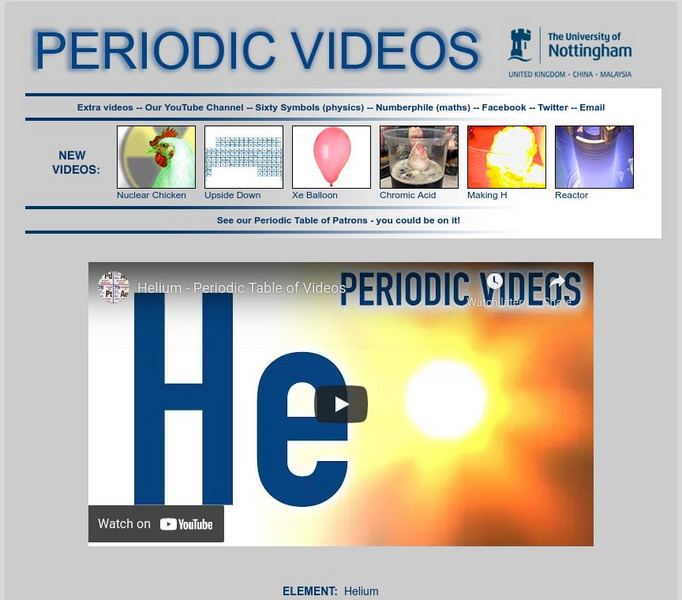
University of Nottingham: Periodic Table of Videos: Helium
A video that describes the properties of helium, a nonreactive gas, that allows it to alter your voice, be used in magnets, and refrigeration. Video also includes a demonstration of what happens to a helium balloon when it encounters...

Science Friday Initiative
Science Friday: Helium Shortage
A discussion of what has caused the global helium shortage, and what the future holds for helium supplies. Aired Oct. 12, 2007 [11:09]

Minute Earth
Minute Earth: Our Atmosphere Is Escaping!
Find out why the two lightest elements are the only two gases that escape Earth's atmosphere. [2:17]

Other
#Ask Mit: Why Are Gas Giants Round?
Find out professor Anna Frebel's answer to the question, "How come our gas giants stay in a sphere, instead of the gas just floating around everywhere in space?" [3:29]