Hi, what do you want to do?






Astrum
Our Solar System's Moons: Triton
Everything you could want to know about Neptune's largest moon, Triton. NASA Voyager 2 images of Triton explained.
Visual Learning Systems
The Outer Planets: Neptune and Beyond
Students are taken on an exciting animated trip to the outer reaches of our solar system. Images from NASA and the Hubble space Telescope illustrate the Giant Red Spot on Jupiter, Saturns' beautiful rings, the tilted rings of Uranus, and...
Little Smart Planet
Learning about Planets
Let's watch the video to review all the vocabulary about the planets and the Solar System.
Kids Learning Videos
Planets in our Solar System for Kids | Kids Learning Videos
Planets in our Solar System: Planets for Children and kids
This video will is full of fun facts about the different planets in our solar system. It's a great video for students learning about astronomy in our solar system. Learn...
This video will is full of fun facts about the different planets in our solar system. It's a great video for students learning about astronomy in our solar system. Learn...
Kids Learning Videos
The Planets! Facts About Our Solar System for Kids
Learn about the planets in our solar system! This video proves some fun facts about each planet that children will love. Preschoolers and toddlers can enjoy pictures and video of the planets while learning about these...
Fun Kids
Learn About the Solar System
Do you know the name of the planets in the solar system? Learn about planets and the solar system with this fun kids video.
Little Smart Planet
Solar System and Planets
Do you want to know what our Solar System is composed of? Get on our spaceship and explore the universe

SciShow
Why Is Neptune so Blue? and 3 Other Mysteries an Orbiter Could Solve
Neptune appears as a beautiful blue color, but why? Some scientists suggested the methane in the atmosphere gives it that color, but Uranus contains more methane than Neptune. The mystery, along with three others, requires an orbiter to...

SciShow
What Knocked Over Uranus? And Two Other Mysteries
It's no secret that most of the galaxy is a mystery. Data suggests that the known exoplanets may be most similar to our own neighborhood planet Uranus. Unfortunately, scientists know little about Uranus. The video lesson presenter...

PBS
The Sun and Planets
Do other planets experience night, day, and the seasons like humans do here on Earth? Examine planetary motion using real images of the planets through a simulation from PBS's Space lesson series. After observing the motion of each...

SciShow
Triton: The Celestial 'Cantaloupe'
Where can we find sources of water in our solar system? It seems Neptune's moon may be an option. A video lesson explores the characteristics of Neptune's largest moon Triton. There are many unique features that may surprise your classes...

SciShow
Exploring Uranus and Neptune
Could humans survive on Uranus or Neptune? As an installment of a larger solar system series, the video lesson continues in its description of planets in our solar system. A thorough analysis of the two planets describes the physical...

Kurzgesagt – In a Nutshell
How to Catch a Dwarf Planet—Triton
Neptune has more than its share of moons with 14, although Triton takes the prize for the largest. Study the origin and behavior of Neptune's moons with a video lesson from the Kurzgesagt playlist.

Crash Course
Uranus and Neptune
Either way you pronounce it, Uranus is one cool planet! An ice giant, to be exact, just like its neighbor, Neptune. Travel to the far reaches of our solar system in a video filled with amazing images and interesting facts. The...

SciShow Kids
Explore the Solar System: The Gas Giants
Take a trip to space's gas giants, also known as the outer planets—Jupiter, Saturn, Uranus, and Neptune—with an interesting video equipped with a spirited host, a cartoon sidekick, and bright, colorful graphics.

SciShow Kids
Let's Make the Solar System
Get crafty with the help of pictures and a real-time demonstration from a video that details the step-by-step process in creating a paper solar system.

Crash Course Kids
Gas Giants Weather
Jupiter, Saturn, Uranus, and Neptune make up the outer planets. How extreme is the weather on these planets? This is the focus of a video that explains how the gas giants have "crazy storms," strong winds, methane rain, and very cold...

Crash Course Kids
Seeing Stars
What are all those shiny things we see in the sky at night? It could be a star, planet, or asteroid! This is the focus of a video that helps viewers distinguish between these three objects in the sky.

Curated OER
Neptune
Travel to deep space and view the icy blue planet, Neptune. You'll learn about Neptune's rings, its great dark spot, size, and surface. Great graphics and real images make this a perfect clip for learners in grades 3-6.

NASA
Nasa: Galleries: Video: What Is a Planet?
Explanation of the characteristics an object must have to be considered a planet. [7:53]
PBS
Pbs Learning Media: Crash Course Astronomy: Uranus & Neptune
We complete our planetary tour with a review of the ice giants Uranus and Neptune. Both have small rocky cores, thick mantles of ammonia, water, and methane, and atmospheres that make them look greenish and blue. Uranus has a truly weird...
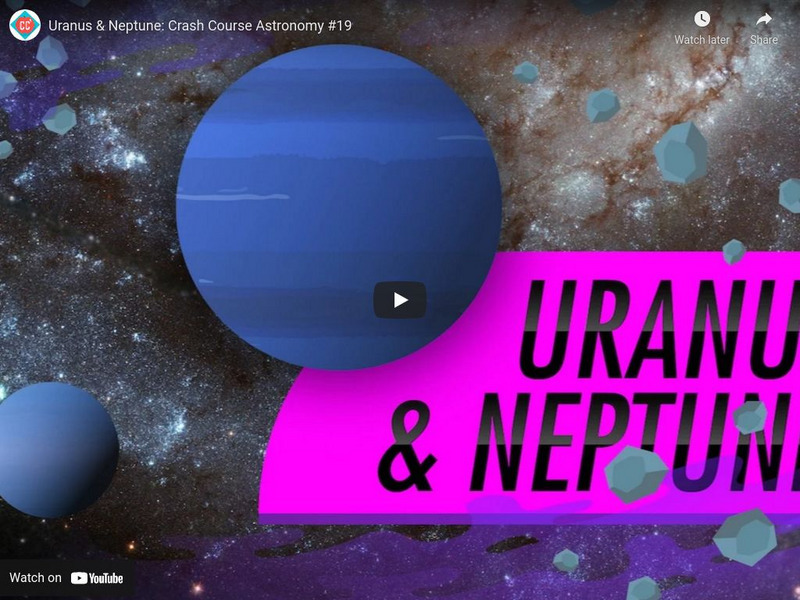
Crash Course
Crash Course Astronomy #19: Uranus and Neptune
Today we're rounding out our planetary tour with ice giants Uranus and Neptune. Both have small rocky cores, thick mantles of ammonia, water, and methane, and atmospheres that make them look greenish and blue. Uranus has a truly weird...

SciShow
Sci Show Kids: Explore the Solar System: The Gas Giants
Take a tour of the gas giants and learn important facts about these planets. Understand that Jupiter has a giant storm called Great Red Spot, Saturn has the biggest and brightest rings, how Uranus spins on its side, and Neptune's storms...

Crash Course
Crash Course Kids 43.2: Gas Giants Weather
In this episode of Crash Course Kids, Sabrina takes leads a virtual tour of the Gas Giants and shows what kind of weather happens on those planets. [4:42]