Hi, what do you want to do?






American Chemical Society
Norbert Rillieux, Thermodynamics and Chemical Engineering
The man who invented the earliest examples of chemical engineering was an American-born, French-educated, free man of color before the Civil War, and went on to translate Egyptian hieroglyphics. There is something of...

Teach Engineering
Mechanics of Elastic Solids
Make the connection between Hooke's law and elasticity with an activity that introduces the class to the behavior of elastic materials. The resource defines stress and strain to calculate the modules of elasticity of...

Illinois Valley Community College
STEM Activities for Middle School Students
Use STEM activities within the class to provide connections to concepts. The resource includes activities that range from working with buoyancy to building rockets and launching them. Other activities involve the engineering design...

Teach Engineering
Microfluidic Devices and Flow Rate
When you have to flow, you have to flow. The lesson introduces class members to microfluidic devices and their uses in medicine. They watch a short video on how the diameter affects the rate of flow. The worksheet has individuals...

Kenan Fellows
Making Connections with Water Quality
What's in your water? And, why is water quality so important? Enhance your class's level of water appreciation through a lesson that demonstrates the necessity of water quality. Environmental enthusiasts explore the EPA's Clean Water...

Teach Engineering
Connect the Dots: Isometric Drawing and Coded Plans
Individuals discover how to draw cubes on triangle-dot paper. They use cubes to build structures and draw corresponding isometric drawings on dot paper in the second lesson of the series of five. The activity also introduces the concept...

Teach Engineering
Common and Natural Logarithms and Solving Equations
Log some practice with logarithms. A PowerPoint presentation provides a tutorial on the change of base formula involving natural logarithms and solving exponential equations with logarithms in the fourth installment of a seven-part...

Teach Engineering
New Perspectives: Two-Axis Rotation
Two-axis rotations ... twice the fun as one-axis rotations! The last installment of a five-part module teaches scholars how to conduct two-axis rotations. They create isometric drawings before and after the rotations.

PBS
Pbs Learning Media: Lesson 2: Chemical Cuisine
By exploring the ingredients in various foods and phuds, middle schoolers experience first-hand how phuds are engineered to taste irresistible. Students learn and discuss a new Food Rule around eating foods with easily pronounceable...
TeachEngineering
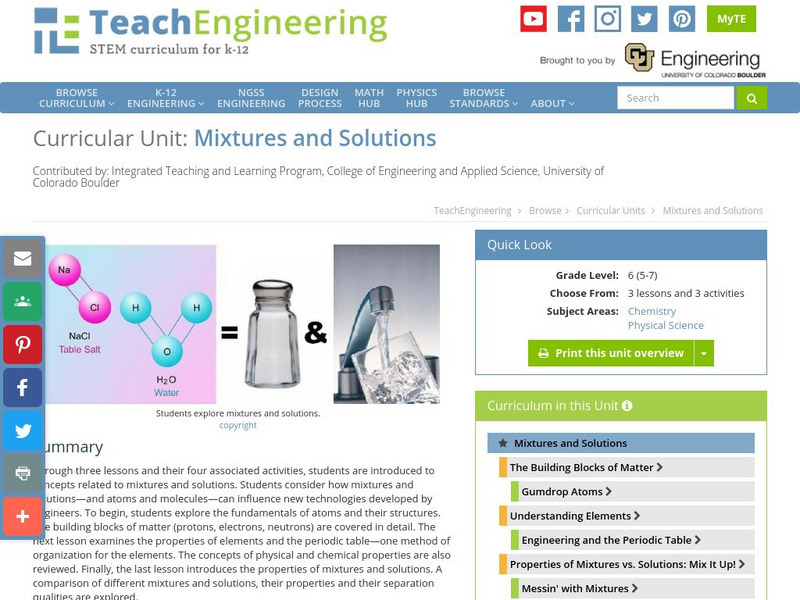
Teach Engineering: Mixtures and Solutions
This unit covers introductory concepts of mixtures and solutions. Students think about how mixtures and solutions, and atoms and molecules can influence new technologies developed by engineers. The first lesson explores the fundamentals...
TeachEngineering
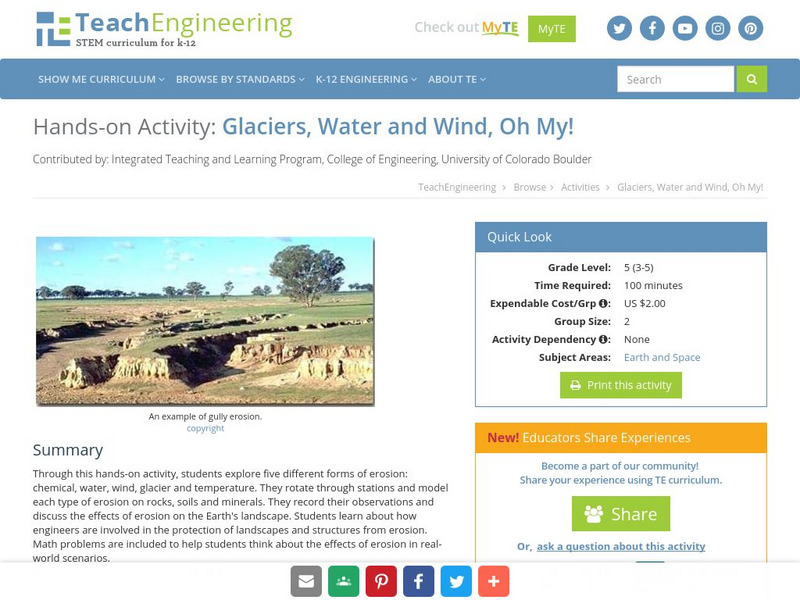
Teach Engineering: Glaciers, Water and Wind, Oh My!
This hands-on activity explores five different forms of erosion (chemical, water, wind, glacier and temperature). Students rotate through stations and model each type of erosion on rocks, soils and minerals. The students record their...
TeachEngineering
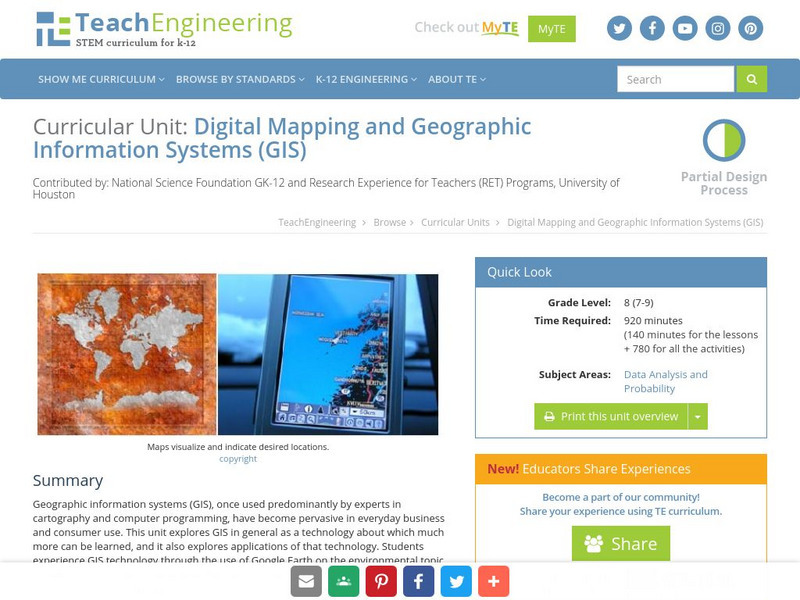
Teach Engineering: Digital Mapping and Geographic Information Systems (Gis)
Geographic information systems (GIS), once used predominantly by experts in cartography and computer programming, have become pervasive in everyday business and consumer use. This unit explores GIS in general as a technology about which...
Technovation
Curiosity Machine: Challenges: Build a Self Powered Rocket
A challenge where students will launch a small object using a chemical reaction. The site contains tips, a lesson plan, and a place for students to document their engineering design process.
E-learning for Kids
E Learning for Kids: Science: Arctic Ocean: How Can We Change Materials?
Join Jacob on the Nova Zembla Expedition, and help him use suitable materials for building his house.