Hi, what do you want to do?






Brigham Young University
It's All in the Details
Designers communicate their vision for a set through a progression from thumbnail sketches, to drawings, to renderings. After examining a series of renderings, class members begin work on their own rendering paying particular attention...

K20 LEARN
Who's Coming To Dinner? Descriptive Writing
"The Dinner Party" is the anchor text in a lesson designed to encourage writers to use sensory details in their stories. After brainstorming descriptive words and phrases for the five senses, class members read Mona Gardner's...

Brigham Young University
The Presentation
As their final act in a 10-lesson theater arts unit, set designers present their models to the class and explain how their choices of line, color, and texture support the theme they wish to convey.

Project Articulate
Textured Landscapes with Grant Wood
Explore the world of textured landscapes through the eyes of the famous artist, Grant Wood. Here is an elementary art lesson in which scholars learn about Grant Wood's life, view his work, draw their own textured landscape, and then...

Bantam Books
The Tempest: Think-Aloud Annotation
It can be difficult to refer back to a text when analyzing it, so annotation is a great tool for kids to track what they are reading. A thorough and well-organized lesson guides learners through the process of annotating William...

Museum of Tolerance
Music Evokes Memories and Emotions
Dim the lights, take a deep breath, and press play to explore the emotions and memories that music elicits. Class members begin using relaxation techniques designed to create a positive listening experience. As music plays, learners...

Montclair Art Museum
Eric Carle: Animals and Friends
Celebrate Eric Carle’s beloved children’s books, especially those about animals. Teachers and readers alike engage in Carle’s books as they explore the art and color in each of his stories, and how these elements support comprehension.

Core Knowledge Foundation
Rocks & Minerals
Take young geologists on an exploration of the rock cycle with this six-lesson earth science unit on rocks and minerals. Through a series of discussions, demonstrations, and hands-on investigations your class will learn...

Getting to Know
Shape and Form in Art
Introduce youngsters to the important role shape and form play in art with this extensive collection of activities and projects. From teaching first graders how to create mandalas to engaging third and fourth graders in the design...

American Institute of Architects
Architecture: It's Elementary!—Fifth Grade
Young citizens construct an understanding of urban planning in this cross-curricular unit. Covering every aspect of city development from the political, economic, and social influences to sustainable building practices, this...

Mathematics Vision Project
Module 6: Congruence, Construction, and Proof
Trace the links between a variety of math concepts in this far-reaching unit. Ideas that seem very different on the outset (like the distance formula and rigid transformations) come together in very natural and logical ways. This...

Scholastic
Persuasive Communication (Grades 9–12)
Before your students reached your morning class to learn about persuasive writing, they probably saw dozens of examples of persuasive communication in the form of advertisements. A short, introductory lesson inspires class members to...

Fairbanks North Star Borough School District
Eric Carle Mural
Inspire first grade artists to learn about abstract and realistic art while reading Eric Carle's Where are you Going? To See My Friend. Young artists design and make a mural collage by tearing shapes of paper while comparing English and...
Department of Defense
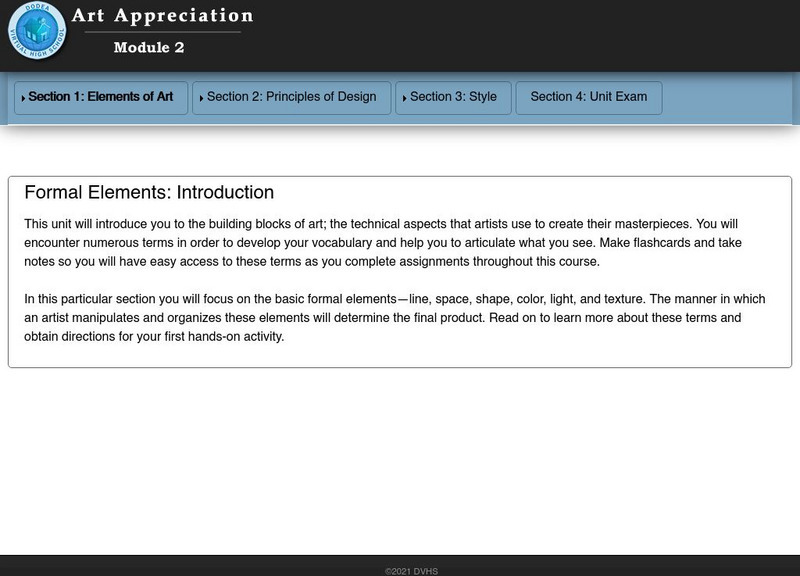
Do Dea: Art Appreciation: Unit 3: Technical Aspects of Art
In this third unit of a course on Art Appreciation, students learn how to describe the technical aspects of an artist's work by discussing elements of art and principles of design. They also look at the stylistic qualities of an artist's...

PBS
Pbs Learning Media: Math + Arts: Abstract Sculpture & Cubes
In this lesson, students will form cubes and discuss their attributes including edges, faces, vertices, and angles. Media resources and teacher materials are included.