Hi, what do you want to do?






Curated OER
Native Americans of the Chesapeake Bay: Using Primary vs. Secondary Sources
Discover the rich Native American culture that existed at the time of early European exploration into the Chesapeake region through analysis of several primary and secondary sources.

SOAR
Multicultural Youth Leadership
Teens of the world, unite! Take your class or club on a multicultural journey through the relationship between cultural values and teen leadership skills. Groups work together to learn about one another's cultures while examining the...

Scholastic
Pilgrim and Wampanoag Daily Life for Grades 3-5
Thirteen steps make up a lesson that challenges pupils to compare and contrast the daily lives of Pilgrims and the Wampanoag tribe. Learners revisit the Graffiti Wall then break into small groups for an investigative reading assignment...

College Board
2002 AP® Human Geography Free-Response Questions
Nations and states may sound like similar ideas, but these concepts have led to endless wars and conflicts. Learners explore the terms using authentic College Board materials. An additional test item delves into the influence of...

College Board
2017 AP® European History Free-Response Questions
How did the Renaissance change the politics and culture of Europe? What led to the rise of the welfare state? What did family life look like in Europe during the 1700s? Learners consider these historical questions using structured...

Santillana USA
Celebra Kwanzaa
¡Celebramos Kwanzaa! Celebrate Kwanzaa through the fictional story Celebra Kwanzaa con Botitas y sus gatitos to delightfully explain the seven principles of Kwanzaa. Dual language learners participate in reading and vocabulary...

Curated OER
The Columbian Exchange
Take a closer look at what was traded between the Europeans and the Americas during the Columbian Exchange and which led to important cultural and economic developments in both regions. Tip: Expand the assignment to include animals,...

New York State Education Department
English Language Arts Examination: August 2015
Assessing a variety of skills using numerous item types is a great way to collect data for formative and summative use. Using a challenging exam, scholars prove their comprehension and reading skills through multiple choice, task, and...

New York State Education Department
English Language Arts Examination: August 2014
Tired of searching for complex passages suitable for high school level assessments? A challenging examination includes numerous complex text excerpts as well as question items to match them. Learners analyze literary elements, author's...

EduGAINs
Ratio and Proportion
Do these items have the same ratio? Through a learning contract, pupils master proportions by practicing proportions via word problems, graphs, and with manipulatives. An exit ticket checks for understanding at the end of the...

Nemours KidsHealth
Food Labels: Grades 3-5
Bring awareness to the ingredients scholars ingest daily with two lessons that look deeply into food labels. The first lesson explores the difference between processed and fresh foods while the second lesson focuses on sugar content.

Scholastic
Pilgrim and Wampanoag Daily Life for Grades 6–8
Two slide shows, viewed side-by-side, permit middle schoolers to compare and contrast the lives of the Pilgrims of the Plimoth colony and the Wampanoags. Four videos take learners on virtual field trips to the Plymouth plantation. And an...

K12 Reader
African American Inventors: Lewis Latimer
Celebrate Black History Month getting to know more about Lewis Latimer. Here, scholars read about his life and success, then apply their new-found knowledge by responding to questions about the text with short answers.

Nourish Interactive
Learn the Food Groups Memory Game
Help youngsters sharpen their memories and learn the food groups with this classic matching activity! Learners take turns flipping over cards with fun images of different fruits, vegetables, dairy products, and proteins until...

New York State Education Department
English Language Arts Examination: June 2015
Many teachers and districts want to give their pupils test-taking practice before state standardized testing occurs. Here's a resource that features a complete exam with numerous passages, a variety of item types, a conversion chart, and...

Syracuse City School District
Literary Elements
Address the literary elements in a piece of writing using these materials. The packet includes plenty of resources, and focuses mainly on theme, character, and point of view, with some materials for setting, symbolism, and author's...

National Council of Teachers of Mathematics
Stitching Quilts into Coordinate Geometry
Who knew quilting would be so mathematical? Introduce linear equations and graphing while working with the lines of pre-designed quilts. Use the parts of the design to calculate the slope of the linear segments. The project...

Social Studies Coalition of Delaware
Urban Mouse Rural Mouse
Explore rural and urban environments over the course of four days. Each day offers a new look into how both environment compare and contrast. Activities include the observation and analyzation of images, a read aloud and grand discussion...

Scholastic
Pilgrim and Wampanoag Daily Life
A lesson looks at the Pilgrims and Wampanoag tribe during the first Thanksgiving. Scholars compare and contrast information presented by an online activity then discuss their findings. Learners examine the two group's daily routines and...

Scholastic
The First Thanksgiving Feast
Following an online activity, scholars listen to a read-aloud of If You Were at the First Thanksgiving by Anne Kamma. Pupils discuss their family traditions and complete a T-chart comparing the holiday then and now. Collages are made to...

Teach-nology
The Purpose of Summaries
How can you tell the author's purpose from just a short summary? Kids read three different summaries of books to determine whether the author meant to entertain, persuade, or inform.
Department of Defense
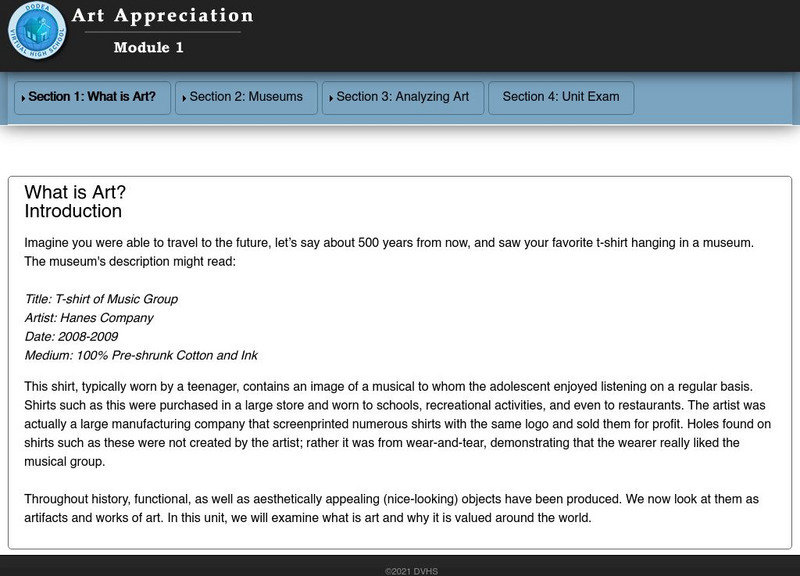
Do Dea: Art Appreciation: Unit 2: Introduction
In this second unit of a course on Art Appreciation, students are shown how to explain what the meaning of art is, they learn about the function of art in different cultures, why so much value is placed on art and cultural items, and...