Hi, what do you want to do?






National Institute of Open Schooling
Electrochemistry
In an electrolytic cell, electrical energy is converted into chemical energy, the exact opposite of a battery! Lesson 15 in a series of 36 explores electrochemistry. Participants begin by reading and discussing oxidation/reduction...

University of Notre Dame
Safe Science Lab Safety Awareness
Prepare young scientists for the ins and outs of lab safety with a thorough list of symbols, icons, and rules about staying safe during experiments. Additionally, the resource provides several assessment pages for kids to reflect on what...

Teach Engineering
Piezoelectricity
What effect makes children's shoes light up? Answer: Piezoelectric effect. Here is a PowerPoint presentation that describes piezoelectric materials as being able to convert mechanical energy to electrical energy. Individuals learn how...

Bonneville
Activities and Assessment of Vocabulary and Units
It's pass or fail, and one must pass to move on to the next lesson—no pressure. The second of seven installments in the Off the Grid unit has pupils demonstrate their knowledge of vocabulary as well as the process of using a multimeter....

Mr. E. Science
Magnetism and Electromagnetism
The biggest magnet in the world is at the Los Alamos National Laboratory in New Mexico and can reach 100 tesla. By comparison, magnets that lift cars are about two tesla. The 11th presentation in this series covers magnetism,...

K12 Reader
Charge It!
Electrify your pupils' interest in conductors and insulators with a brief reading passage! After reading the text, learners respond to five questions that relate to the content of the passage.

Disney
Renewable Energy
Bring some energy to your physical science curriculum with this engaging Bill Nye the Science Guy lesson. Based on his Renewable Energy video, students explore the concepts of potential and kinetic energy and learn how they are applied...

University of Minnesota
Virtual Neurons
It's electric! Young anatomists use Virtual Neurons software to build, control, and analyze complex nerve circuits within the body. Colorful and packed with content, class members enjoy interacting with the nervous system...

Science Matters
Post-Assessment Energy
After nine lessons and activities about energy, here is the final assessment. The 20-questions include multiple choice, multiple choice with justification, short answer, answer analysis, and labeling diagrams to challenge learners.

Rice University
College Physics for AP® Courses
Take a look at an organized physics course. The 34-section electronic textbook covers material in AP® Physics 1 and 2. Teachers use the text to supplement lectures and have the class work through the labs. Each section contains...

College Board
2017 AP® Physics 2: Algebra-Based Free-Response Questions
In 2017, more than 15,000 scholars earned college credit based on their AP Physics 2 exam covering lenses, energy, and more. The College Board released the free-response questions, sample answers, and scoring guidelines from that exact...

Teach Engineering
Microfluidic Devices and Flow Rate
When you have to flow, you have to flow. The lesson plan introduces class members to microfluidic devices and their uses in medicine. They watch a short video on how the diameter affects the rate of flow. The worksheet has individuals...
CK-12 Foundation
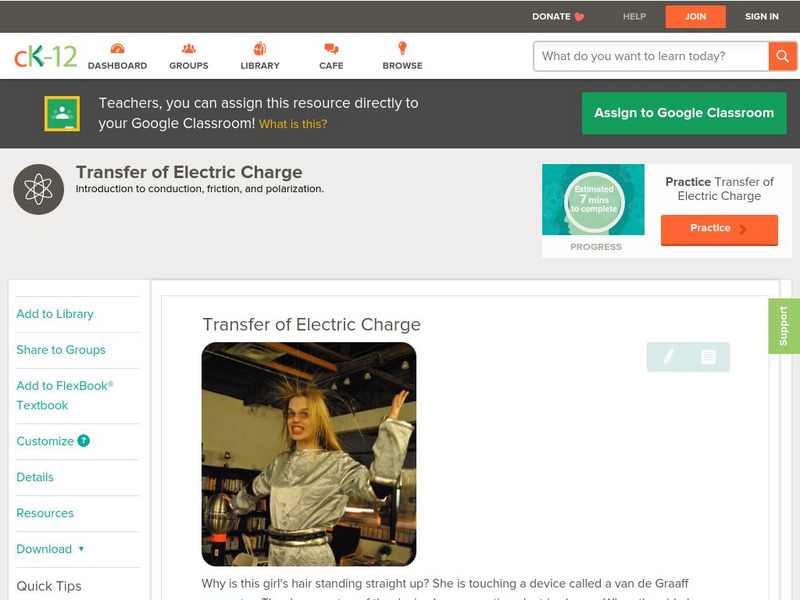
Ck 12: Physical Science: Transfer of Electric Charge
[Free Registration/Login may be required to access all resource tools.] Transfer of electric charge: transfer of electrons, conservation of charge and three ways electric charge can be transferred.
Georgia Department of Education
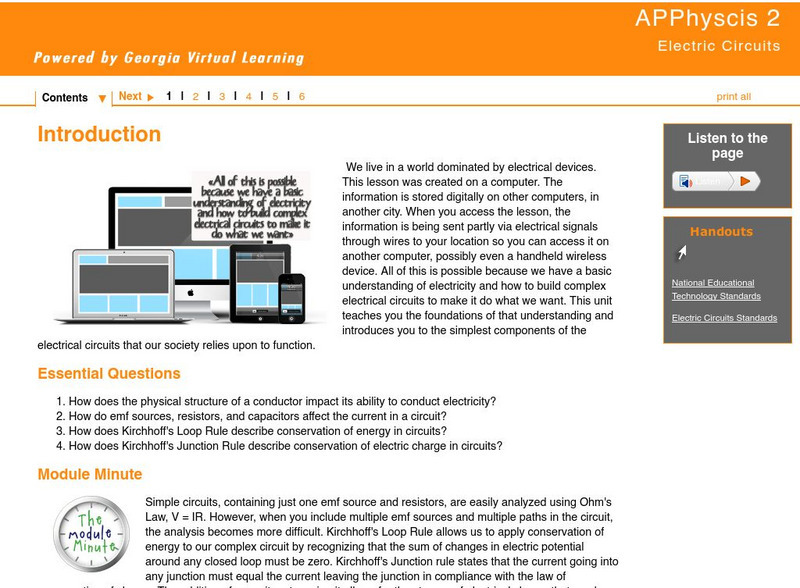
Ga Virtual Learning: Ap Physics 2: Electric Circuits
This unit teaches students the foundations of electrical circuits and introduces them to their simplest components. Covers series and parallel circuits, Kirchhoff's Rules, Ohm's Law, RC circuits, resistivity, and capacitance.
Georgia Department of Education
Ga Virtual Learning: Physical Science: Electricity and Magnetism
Students learn about static electricity using terms such as friction, induction, and conduction. They also explain and illustrate the difference between alternating and direct current, and understand the relationship among voltage,...
Texas Education Agency
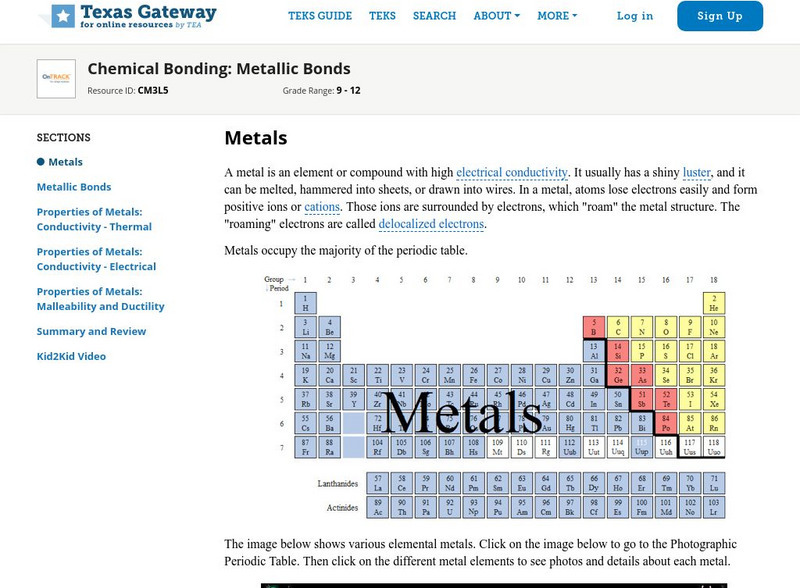
Texas Gateway: Chemical Bonding: Metallic Bonds
Given scenarios or diagrams, students will describe the nature of metallic bonding and explain properties such as thermal and electrical conductivity, malleability, and ductility of metals.

National Geographic
National Geographic: Building Circuits
In this lesson, students build series and parallel circuits and test their conductivity. Includes handouts with diagrams, and a vocabulary list with definitions.
Exploratorium
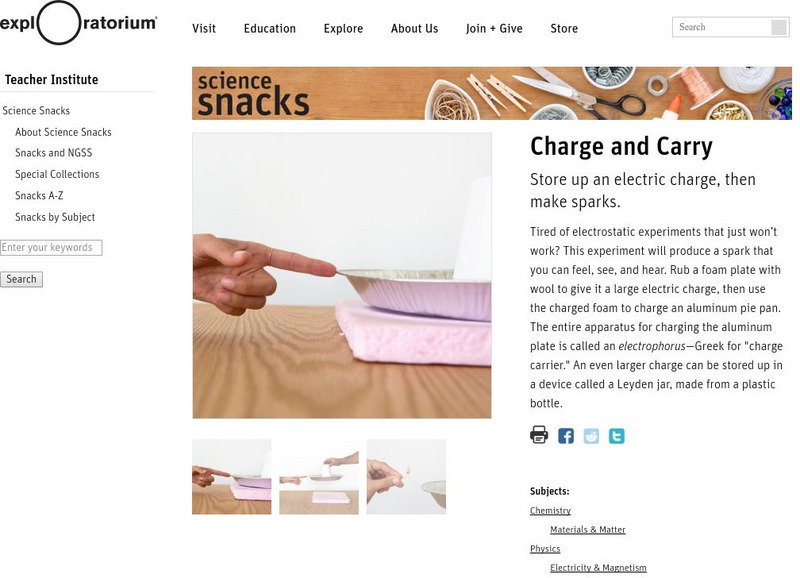
Exploratorium: Science Snacks: Charge and Carry
This site from The Exploratorium Museum is a full description of a short activity. An electrophorus plate and a Leyden jar are made. The electrophorus is charged by induction. Its charge is transferred to the Leyden jar by conduction...
SRI International
Performance Assessment Links in Science: Mystery Card 3
Straightforward introduction to electrical circuits using minimal materials and time. Students learn about the basics of electrical circuits by experimenting with "mystery cards" -- index cards with hidden aluminum foil used to conduct...
Georgia Department of Education
Ga Virtual Learning: Charge and Coulomb's Law
Learning about charge and forces of attraction will be keys to understanding electrostatics and the basis of this learning unit. Developing a greater understanding of charge and the charge model is necessary to understanding electricity.
CK-12 Foundation
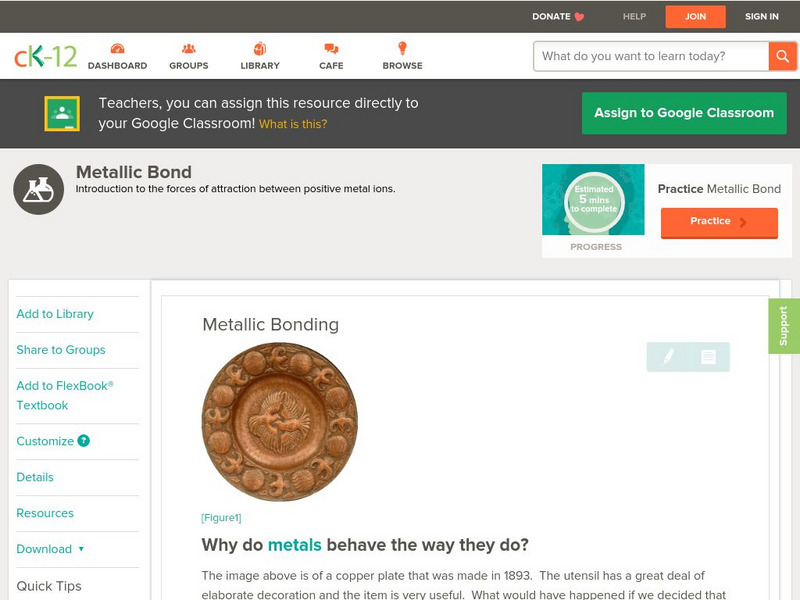
Ck 12: Chemistry: Metallic Bond
[Free Registration/Login may be required to access all resource tools.] Describes the metallic bond and properties of metals. Includes review questions.
E-learning for Kids
E Learning for Kids: Science: Arctic Ocean: What Are Conductors and Insulators?
Visit Vlad and learn about the properties of conductors and insulators, and what materials are used for them.