Hi, what do you want to do?






Core Knowledge Foundation
Astronomy—Our Solar System and Beyond Tell It Again!™ Read-Aloud Anthology
A read-aloud anthology explores our solar system and beyond. Informational texts about astronomy invite pupils to discuss readings. Extension activities examine vocabulary, sayings, and phrases. Scholars work through the writing process...

American Museum of Natural History
Planetary Mysteries
A website all about planetary mysteries—it's a one-stop-shop for all things, stars, planets, and space travel. Scholars read an astronomy overview to discover the page's big ideas, then choose from the plethora of resources, including...

K5 Learning
Space Based Astronomy
How much astronomy can you study with the naked eye? Learn more about the ways scientists explore the galaxy with a short reading passage and set of short-answer questions.

Fluence Learning
Writing About Informational Text: Beyond the Beyond—Galaxies
Everyone has a different point of view, even when it comes to the enormity of the universe. Two separate text passages explain the scope of a galaxy, prompting young readers to write an essay about each author's argument and how the...

Space Awareness
Living in the Milky Way
Get to know our galaxy with an astronomy-themed, hands-on activity. Scholars watch an informative video, answer questions, and construct a model of the Milky Way in order to examine its contents and the distance inside it.

K5 Learning
The Astronomy Project
A passage about an astronomy lesson may leave readers starstruck. Fifth graders read about a class's exploration into the makeup of the galaxy and its constellations before answering six questions about the terms and vocabulary...

International Technology Education Association
Telescope as Time Machine
This resource provides an explanation of NASA's GALEX mission and how the space-based telescope can view distant galaxies as they were billions of years ago. The resource also discusses the other aspects of galaxies that GALEX...

American Museum of Natural History
Journey to the Stars
Fifteen detailed pictures and informative captions delve deep into the exploration of stars—their life cycle and importance in the universe.

Mrs. Sol's Class
Solar System Project
Finish or launch your unit on the solar system with a jigsaw project covering major celestial concepts such as the Milky Way Galaxy, asteroids, meteors, comets, Earth's moon, and, of course, all the planets. Learners start by...

NASA
Taking a Cold, Clear Look at the Universe
Take a look with another perspective. Pupils read to find out what portion of the electromagnetic spectrum a space telescope sees and the difficulties of viewing infrared radiation from other objects in space. Individuals discover how...

Starry Night Education
The Stars
Three astronomy activities in one resource! Here you will find one hands-on activity, one demonstration, both with discussion questions, and one activity worksheet. During these lessons young scientists discuss how stars are...

American Museum of Natural History
Cosmic Connection
Do you see what I see? Individuals view eight images from the Hubble Space Telescope and then determine exactly what is being shown in the images. The pictures range from the rings of Saturn to views of billions of galaxies that take up...

American Museum of Natural History
What Do You Know About Astronomy
Develop an understanding of the universe. Learners answer 10 multiple choice questions about several topics in astronomy. Questions contain information about the age of the universe, gravitational attraction, galaxies, planets and comets...

American Museum of Natural History
Being an Astronomer: Neil deGrasse Tyson
An interview delves deep into the life of famous astronomer Neil deGrasse Tyson.

Space Telescope Science Institute
Amazing Space: Galaxies Galore: Games and More
This is a fun and useful site to learn about galaxies. Content includes a building model to create your own Milky Way, games for learning the various types of galaxies, and more fun games.
NASA
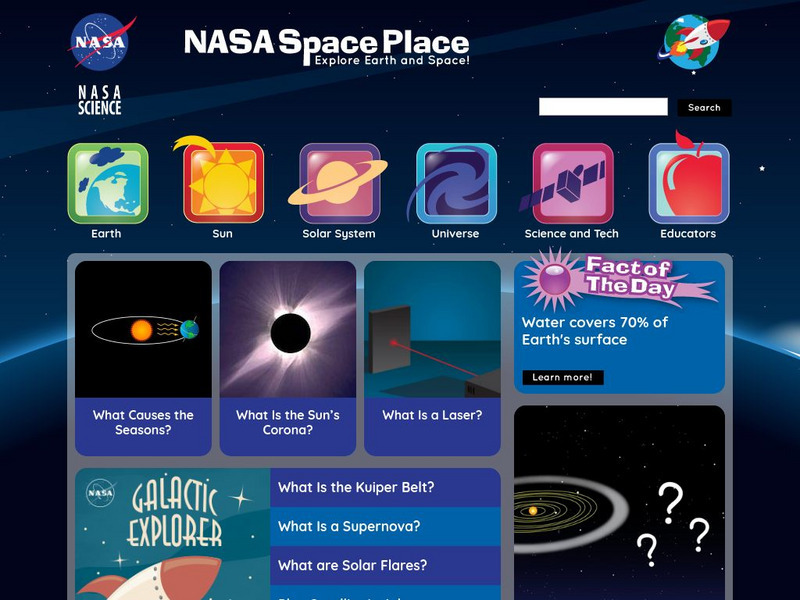
Nasa: The Space Place
This site from the National Aeronautics and Space Administration allows students to explore topics related to planet earth and outer space. A number of games and interactive features are available.

TED Talks
Ted: Ted Ed: How Small Are We in the Scale of the Universe?
In 1995, scientists pointed the Hubble Telescope at an area of the sky near the Big Dipper. The location was apparently empty, and the whole endeavor was risky- what, if anything, was going to show up? But what came back was nothing...
Space Telescope Science Institute
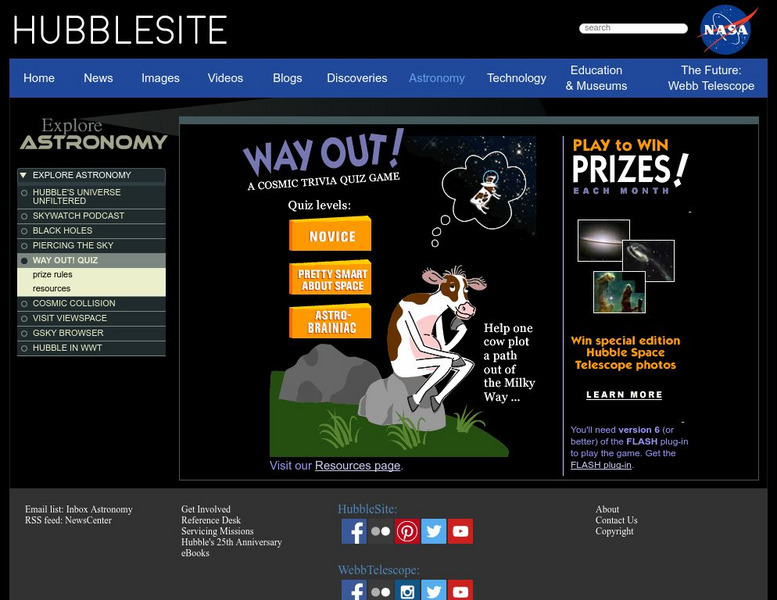
Hubble Site: Way Out!
Can you help a cow plot a path out of the Milky Way? This hilarious space game is for all ages and is offered by HubbleSite. Users may pick their level of expertise and can choose from novice, pretty smart about space, or an astrobrainiac.