Hi, what do you want to do?






National Security Agency
Classifying Triangles
Building on young mathematicians' prior knowledge of three-sided shapes, this instructional activity series explores the defining characteristics of different types of triangles. Starting with a shared reading of the children's...

Bowland
Rods and Triangles
Scholars explore triangles with rods of different lengths. Using rods of 2, 4, 6, 8, and 10 cm class members build as many different types of triangles as they can. They also describe properties of these triangles and determine...

McGraw Hill
Triangles
After reviewing characteristics of seven types of triangles, young geometers discover how to find the missing angle of a triangle. Then, they practice identifying triangles, find missing angles, and find missing side lengths of...

K-5 Math Teaching Resources
2-D Shape Cards
Add some visual support to your elementary geometry lessons with this set of printable shape cards. From triangles and squares to octagons and nanogons, this simple resource can be used in countless ways to develop children's knowledge...

Mathed Up!
Loci and Constructions
A General Certificate of Secondary Education math review has class members make basic constructions. Using a protractor and a ruler along with a compass, pupils develop drawings of triangles with given measurements. Scholars use their...

Concord Consortium
Triangles: Angle Space
Three angles in a triangle, three-dimensional space, it all seems connected somehow. Given several different triangles, pupils use the three angles of the triangle as coordinates to plot points in three-dimensional space. They explore...

EngageNY
Applying the Laws of Sines and Cosines
Breaking the law in math doesn't get you jail time, but it does get you a wrong answer! After developing the Law of Sines and Cosines in lesson 33 of 36, the resource asks learners to apply the laws to different situations. Pupils must...

Flipped Math
Unit 3 Review: Parallell and Perpendicular Lines
Learners watch a quick review on the Parallel and Perpendicular Lines unit. The pupils work through ten review problems ranging from identifying types of angles formed by parallel lines and transversals to writing equations of parallel...

Mathematics Vision Project
Geometric Figures
Logical thinking is at the forefront of this jam-packed lesson, with young mathematicians not only investigating geometric concepts but also how they "know what they know". Through each activity and worksheet, learners wrestle with...

American Farm Bureau Foundation for Agriculture
Shapes on the Farm
Whether you live in the city, the suburbs, or out on the farm, shapes are everywhere in the world around us. Presented with an illustration of a farm, youngsters are tasked with coloring in all of the triangles,...

Charleston School District
Parallel Lines Cut by a Transversal
Pupils study angle measurements between different types of angles associated with parallel lines and transversals. The independent practice asks pupils to identify the types of angles in a diagram and to determine the measure of...

Mathematics Vision Project
Module 5: Modeling with Geometry
Solids come in many shapes and sizes. Using geometry, scholars create two-dimensional cross-sections of various three-dimensional objects. They develop the lesson further by finding the volume of solids. The module then shifts...

Curated OER
Know Your Polygons!
Young scholars identify and categorize different polygons. For this polygons lesson plan, students research and identify properties of polygons, identify different polygon shapes, and categorize different triangles and quadrilaterals.

EngageNY
Similar Triangles in Circle-Secant (or Circle-Secant-Tangent) Diagrams
First angle measures, now segment lengths. High schoolers first measure segments formed by secants that intersect interior to a circle, secants that intersect exterior to a circle, and a secant and a tangent that intersect exterior to a...

Mathematics Vision Project
Module 6: Congruence, Construction, and Proof
Trace the links between a variety of math concepts in this far-reaching unit. Ideas that seem very different on the outset (like the distance formula and rigid transformations) come together in very natural and logical ways. This...

Concord Consortium
Circling Trains
And round and round the park we go! Given a description of an amusement park with the locations of three attractions connected by walkways, learners consider what happens when additional attractions join the mix by doubling the length of...

EngageNY
Mid-Module Assessment Task - Precalculus (module 1)
Individuals show what they know about the geometric representations of complex numbers and linearity. Seventeen questions challenge them to demonstrate their knowledge of moduli and operations with complex numbers. The assessment is...

Mathematics Vision Project
Module 3: Polynomial Functions
An informative module highlights eight polynomial concepts. Learners work with polynomial functions, expressions, and equations through graphing, simplifying, and solving.

Mathed Up!
Angles
What does a geometric farmer drive? A protractor, of course! A set of assessment worksheets prompts learners to use a protractor as they measure angles, name angles, and identify lines. Use the video as a way to...
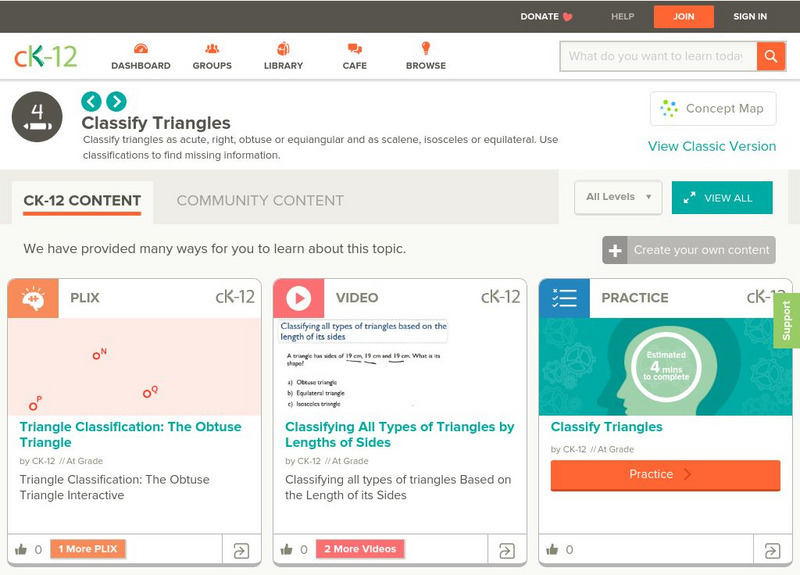
CK-12 Foundation
Ck 12: Elem Math: Classifying Triangles Within Composite Figures
[Free Registration/Login may be required to access all resource tools.] In this learning module, students are presented with a composite figure and must identify the types of triangles within it. An accompanying video demonstrates a...
Khan Academy
Khan Academy: Identify Triangles by Angles
Practice identifying triangles by their angles as acute, right, or obtuse. Students receive immediate feedback and have the opportunity to try questions repeatedly, watch a video or receive hints.
Khan Academy
Khan Academy: Identify Triangles by Side Lengths
Practice identifying triangles by their side-lengths as equilateral, isosceles, or scalene. Students receive immediate feedback and have the opportunity to try questions repeatedly, watch a video or receive hints.
Khan Academy
Khan Academy: Properties of Shapes
Identify and compare shapes based on their attributes. Shapes include triangle types, quadrilateral types, pentagons, and hexagons. Students receive immediate feedback and have the opportunity to try questions repeatedly, watch a video...

E-learning for Kids
E Learning for Kids: Math: Riksjas, Toek Toek: Polygons
Explore polygons with Wang, a ricksha puller. Answer his questions and he will give you a free ride!