Hi, what do you want to do?






EngageNY
Solving General Systems of Linear Equations
Examine the usefulness of matrices when solving linear systems of higher dimensions. The instructional activity asks learners to write and solve systems of linear equations in four and five variables. Using matrices, pupils solve the...

EngageNY
Linear Transformations as Matrices
Don't stop with two-dimensional learning, go to the next dimension! Learners verify that 3x3 matrices represent linear transformations in the third dimension. Additionally, they verify the algebraic properties that extend to vector...

EngageNY
Composition of Linear Transformations 2
Scholars take transformations from the second to the third dimension as they extend their thinking of transformations to include three-dimensional figures. They explore how to use matrices to represent compositions of...

EngageNY
Vectors and the Equation of a Line
Represent linear equations in both two and three dimensions using parametric equations. Learners write parametric equations for linear equations in both two and three variables. They graph and convert the parametric equations to...

Mathematics Common Core Toolbox
Golf Balls in Water
Here's a resource that models rising water levels with a linear function. The task contains three parts about the level of water in a cylinder in relationship to the number of golf balls placed in it. Class members analyze the data and...

EngageNY
Solution Sets to Inequalities with Two Variables
What better way to learn graphing inequalities than through discovering your own method! Class members use a discovery approach to finding solutions to inequalities by following steps that lead them through the process and...

Curated OER
Expressing Geometric Properties with Equations
Algebra and geometry are not interchangeable. Demonstrate why not with a series of problems that deal with the equations of circles and equations of lines that meet specific criteria.

EngageNY
Complex Numbers and Transformations
Your learners combine their knowledge of real and imaginary numbers and matrices in an activity containing thirty lessons, two assessments (mid-module and end module), and their corresponding rubrics. Centered on complex numbers and...

EngageNY
Why Are Vectors Useful? 2
Investigate the application of vector transformations applied to linear systems. Individuals use vectors to transform a linear system translating the solution to the origin. They apply their understanding of vectors, matrices,...

02 x 02 Worksheets
Factoring
Factor in this resource when teaching how to factor polynomials. Scholars use algebra tiles to factor linear and quadratic expressions. They practice their skill by working on example problems from a worksheet.

EngageNY
Modeling with Polynomials—An Introduction (part 2)
Linear, quadratic, and now cubic functions can model real-life patterns. High schoolers create cubic regression equations to model different scenarios. They then use the regression equations to make predictions.

Noyce Foundation
Between the Lines
Explore linear and square dimensions by comparing areas of similar figures. A creative set of five activities designed for elementary through high school classes asks young scholars to compare areas of specific polygons. The first two...

EngageNY
Matrix Addition Is Commutative
Explore properties of addition as they relate to matrices. Using graphical representations of vector matrices, scholars test the commutative and associative properties of addition. They determine if the properties are consistent for...

EngageNY
Introduction to Networks
Watch as matrices break networks down into rows and columns! Individuals learn how a network can be represented as a matrix. They also identify the notation of matrices.

Illustrative Mathematics
Floor Plan
A multi-step problem has learners finding the actual area based on a scale drawing and then converting units at the end. Two different solution choices are listed depending on the preference on which step to start first. Both methods can...
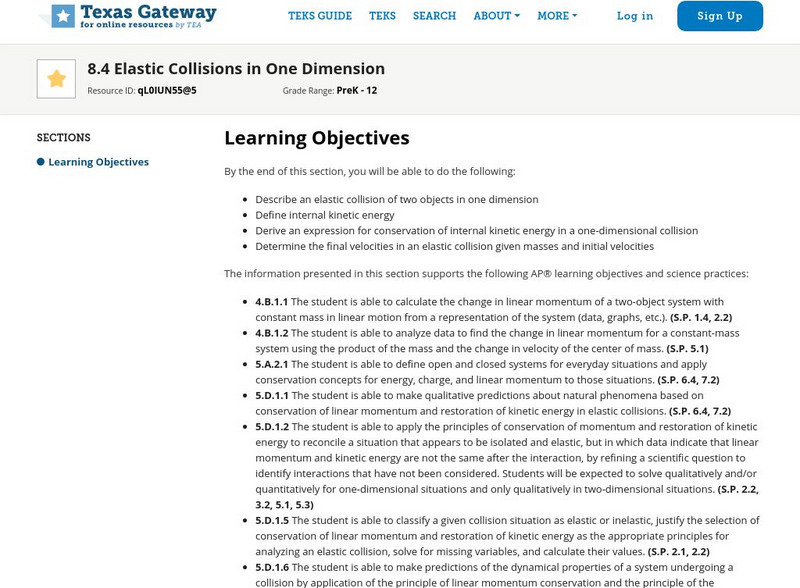
Texas Education Agency
Texas Gateway: Linear Momentum & Collisions: Elastic Collisions in One Dimension
By the end of this section, you will be able to describe an elastic collision of two objects in one dimension, define internal kinetic energy, derive an expression for conservation of internal kinetic energy in a one-dimensional...
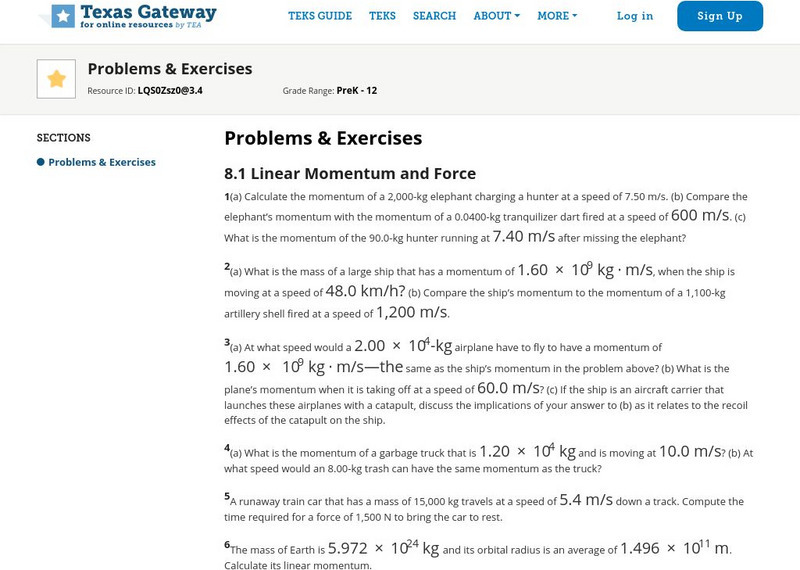
Texas Education Agency
Texas Gateway: Linear Momentum and Collisions: Problems & Exercises
This is a list of 64 problems/exercises to solve covering the content in Chapter 8: Linear Momentum and Collisions from the AP Physics online text.
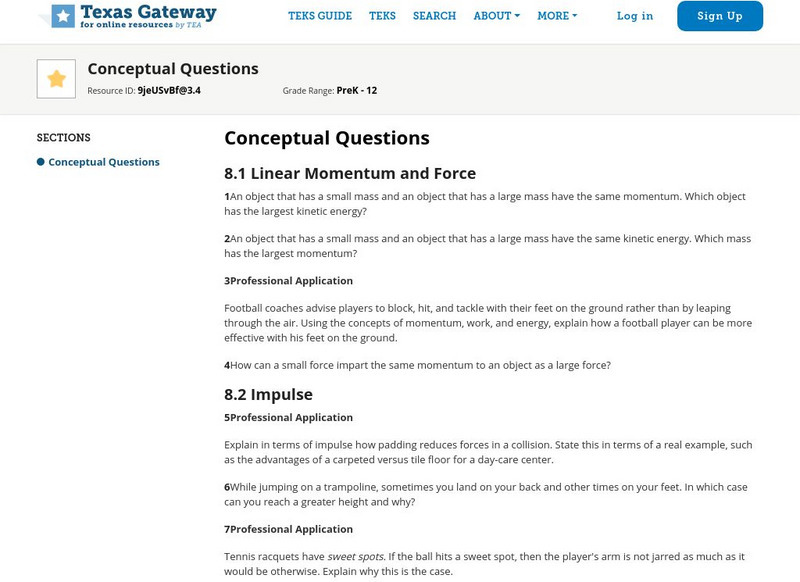
Texas Education Agency
Texas Gateway: Linear Momentum and Collisions: Conceptual Questions
This page features 22 questions covering the major concepts in Chapter 8: Linear Momentum and Collisions from the AP Physics online text.
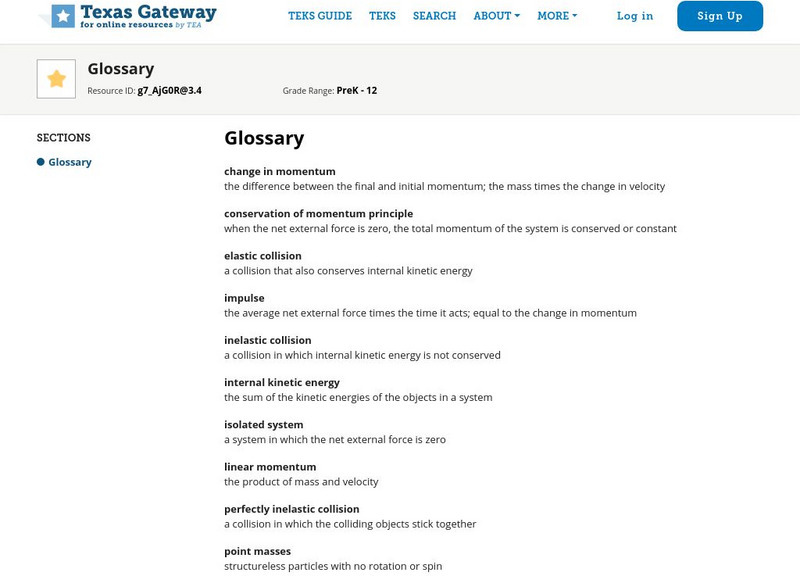
Texas Education Agency
Texas Gateway: Linear Momentum and Collisions: Glossary
This is a glossary of the terms and definitions used in Chapter 8: Linear Momentum and Collisions from the AP Physics online text.
CK-12 Foundation
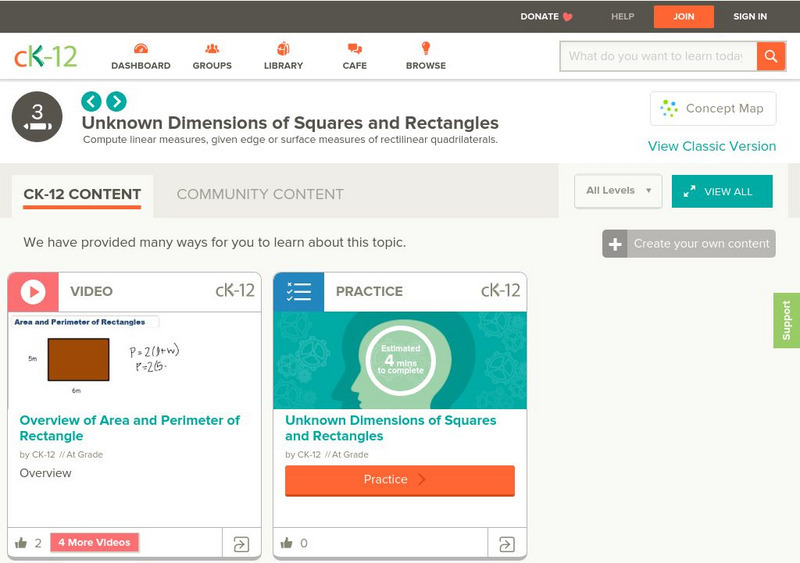
Ck 12: Elem Math: Unknown Dimensions of Squares and Rectangles (Grade 3)
[Free Registration/Login may be required to access all resource tools.] This learning module features five videos and a set of practice questions in which students learn to compute linear measures, given edge or surface measures of...
Texas Education Agency
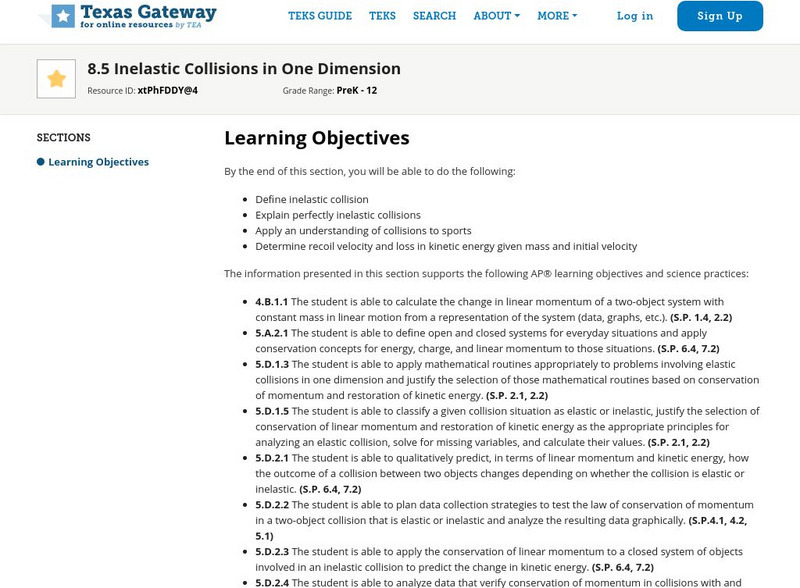
Texas Gateway:linear Momentum & Collision: Inelastic Collisions in One Dimension
By the end of this section, you will be able to define inelastic collision, explain perfectly inelastic collisions, apply an understanding of collisions to sports, and determine recoil velocity and loss in kinetic energy given mass and...