Hi, what do you want to do?






EngageNY
Mid-Module Assessment Task: Grade 6 Math Module 2
Make sure scholars know all about fractions and decimals — not just a fraction of the information. The 12th installment of a 21-part series is a mid-module assessment. Learners solve problems in the context of a birthday party and a...

Virginia Department of Education
Modeling Division of Fractions
Provide a meaningful context for learning about the division of fractions with this upper-elementary math instructional activity. Presented with a simple, real-world problem, young mathematicians work in small groups to develop...

Buffalo State
Adding and Subtracting Positive and Negative Integers
A well-rounded unit on positive and negative integers is a great addition to your middle school math class. Learners work through five activities, each focused on a different skill, before playing a Game of Life to practice the...

Virginia Department of Education
Integers: Addition and Subtraction
Young mathematicians construct their own understanding of integers with an inquiry-based math lesson. Using colored chips to represent positive and negative numbers, children model a series of addition and subtraction problems as...

EngageNY
Using the Identity and Inverse to Write Equivalent Expressions
The fifth installment in the series of 28 lessons helps math scholars explore the result of adding opposite numbers and multiplying reciprocals. Through this exploration, they develop a working definition of identity and inverse properties.

EngageNY
Games of Chance and Expected Value 1
There's a strong chance that class members enjoy learning math through engaging games. Scholars analyze games of chance to determine long-term behavior. They learn to calculate expected value to help with this assessment.

CK-12 Foundation
Trigonometric Functions and Angles of Rotation: The Triangle in the Circle
Go around the unit circle and create triangles. Pupils move a point around the unit circles to visualize the triangle associated with the angle in standard position. The three main trigonometric functions are defined in terms of the legs...

EngageNY
The Volume Formula of a Pyramid and Cone
Our teacher told us the formula had one-third, but why? Using manipulatives, classmates try to explain the volume formula for a pyramid. After constructing a cube with six congruent pyramids, pupils use scaling principles from...

EngageNY
Solving Equations
Teach solving equations through an exploration of properties. Before pupils solve equations they manipulate them to produce equivalent equations. The activity switches the focus from finding a solution to applying properties correctly.

Math Salamanders Ltd.
Multiplication as Repeated Addition to 10x10
The class works to change 15 repeated addition problems into their multiplication counterparts and then completes 15 more where they do the opposite. This is a great way to build an understanding of what multiplication is and could...

Balanced Assessment
Birthday Card
Add a twist to the practice of simplifying expressions. The task asks scholars to decode a mathematical puzzle using their knowledge of expressions. If they are able to write and simplify the expression, the mathematics behind the puzzle...

National Security Agency
Fraction Fever
This unit on fractions allows for upper-aged elementary learners to explore ways to find the greatest common factor and least common multiple of two numbers. Ultimately, young mathematicians will be able to identify equivalent fractions,...

Curated OER
Using Algebra Tiles to Explore Distributive Property
Math is fun with algebra tiles! Young mathematicians explore eight expressions involving the distributive property and use algebra tiles to expand simple expressions. The resource is perfect for both guided and independent practice.

EngageNY
Getting the Job Done—Speed, Work, and Measurement Units
How do you convert from one measurement to another? Pupils use unit rates to convert measurements from one unit to another in the 21st segment in a 29-part series. They convert within the same system to solve length, capacity,...

Noyce Foundation
Snail Pace
Slow and steady wins the race? In the assessment task, scholars calculate the rates at which different snails travel in order to find the fastest snail. Hopefully, your class will move much more quickly in finishing the task!

California Education Partners
Window Washers
Aim high with a task on window washers. An assessment task challenges learners to determine the number of windows two people wash. They do this using a given number of window rows on each side of a building. In addition, they find the...

California Education Partners
Lashelles Garden
Let knowledge grow bountifully like plants in a garden. Given a diagram of a rectangular garden split into plots, scholars determine the area of the entire garden and the areas of the individual plots. As a culminating activity, they...

EngageNY
First-Person Computer Games
How do graphic designers project three-dimensional images onto two-dimensional spaces? Scholars connect their learning of matrix transformations to graphic design. They understand how to apply matrix transformations to make...

EngageNY
Using Matrix Operations for Encryption
Data encryption is an important security measure for sensitive data stored on computers. Pupils learn how to utilize matrices for creating code. They also get a great review of matrix multiplication, inverse matrices, and the identity...

California Education Partners
Bake Sale
Work with fractional cookies. The three-part assessment task checks the pupils' ability to find the product of fractions and whole numbers, mixed numbers, or fractions. Learners determine the amount of ingredients needed and how many of...

California Education Partners
Theater Field Trip
Here's an assessment task that's better than watching a show. Young mathematicians solve word problems involving multiplication and division with equal groups. They must find the total number of attendees on a trip to a theater based on...

Alabama Learning Exchange
Exponents and Division
Create a human fraction to learn about division of exponents. Scholars develop the rule for division of exponents by being part of a human fraction to explore and justify the rule. They also consider zero exponents and negative exponents.
CK-12 Foundation
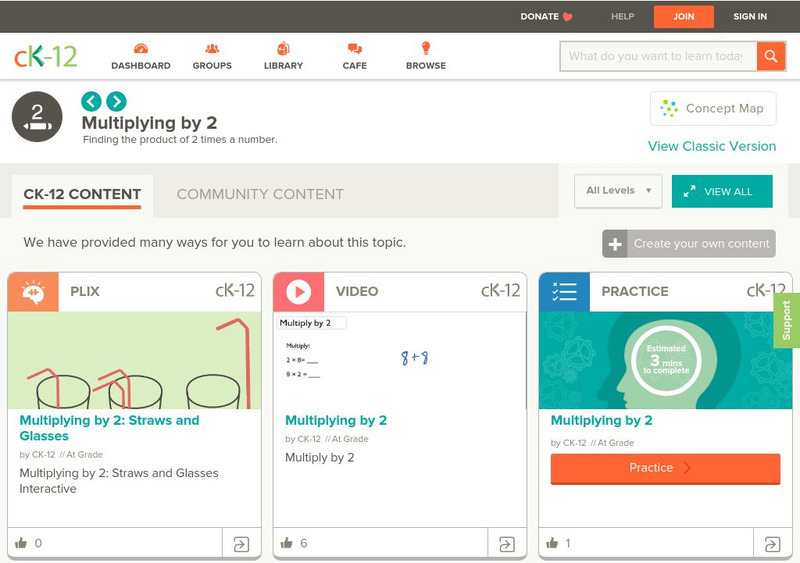
Ck 12: Elem Math: Multiplying by 2
[Free Registration/Login may be required to access all resource tools.] The PLIX interactive media allows students to manipulate straws into glasses to understand the concept of multiplying by twos, followed by a video that connects...