Hi, what do you want to do?






Judicial Learning Center
The Appeal Process
Why doesn't the Supreme Court hear testimony from witnesses? How do they complete an entire proceeding in less than two hours? A helpful lesson guides scholars of criminology through these and other questions by explaining how appeals...

Constitutional Rights Foundation
Plyler v. Doe: Can States Deny Public Benefits to Illegal Immigrants?
Illegal immigration is an ever-changing source of consistent controversy. A reading passage about the rights of undocumented workers and illegal immigrants—and the lack thereof—guides high schoolers into a mock trial activity. Three...

Judicial Learning Center
Civil Rights and Equal Protection
Almost every American is familiar with the Supreme Court case of Brown vs. Board of Education. Far fewer understand the constitutional reasoning or the wide-ranging consequences of the ruling in the field of criminology. The interesting...

Judicial Learning Center
Your 4th Amendment Rights
Americans love to learn about their rights, especially those that protect them from the government's power to invade their privacy. Young people are especially engaged by this topic. An informative lesson explores four Supreme Court...

Judicial Learning Center
The Power of Judicial Review
Marbury v. Madison is arguably the most important landmark case in the history of the Supreme Court. A fact-filled lesson provides background information about the case and two others related to the concept of judicial review. Scholars...

Ohio Center For Law-Related Education
Four Activities: Thurgood Marshall and the Nomination and Confirmation of Federal Judges
The process of nominating and confirming federal judges can sound like a lot of bureaucratic hoops, but a resource breaks down the steps of the Supreme Court nominations in a simpler manner. Learners participate in four activities that...

Judicial Learning Center
Types of Court Cases
How can one court acquit someone of a crime, while another convicts the person of the same one? It's all because of the differences between civil and criminal trials. An informative resource provides scholars in the field of criminology...

School Improvement in Maryland
Analysis of Marbury v. Madison
Should the United States Supreme Court have the power of judicial review? Instructors guide class members through a review of Marbury v. Madison and assist class members in writing a brief of the case. As independent practice,...

EngageNY
Studying Conflicting Interpretations: Perspectives on Plessy v. Ferguson: Part 3
Scholars closely read Justice John Marshall Harlan's dissenting opinion in the Plessy v. Ferguson case, seeking to understand why he disagreed with the court's decision that racial segregation laws for public spaces were constitutional....

Judicial Learning Center
Your 1st Amendment Rights
Why should classes care about the First Amendment? An engaging lesson serves as a powerful tool for answering just that. As all four cases in the lesson relate directly to freedom of expression in schools, young scholars explore the...

Law for Kids
General Election Activity Booklet
It's never too early to practice smart voting! Gain practice voting in a general election using a booklet compiled of an assortment of activities including a word search, maze, graphing, and more!

Hyperion Publishing
Words We Live By: Your Annotated Guide to the Constitution
The language of the Constitution can feel quite ominous to young learners, but there are a variety of strategies you can utilize to help your class grasp the important concepts and ideals in our nation's founding document. This lesson...

K5 Learning
Fight for Equality: Thurgood Marshall
Students read an informational text passage on Thurgood Marshall and his contribution to African Americans' rights, and then answer questions based on what they read.

Constitution Facts
U.S. Constitution Crossword Puzzles: Basic #1
Reinforce U.S. Constitution facts with a crossword puzzle. Scholars show what they know by completing the 53 prompts.

EngageNY
Understanding Box Plots
Scholars apply the concepts of box plots and dot plots to summarize and describe data distributions. They use the data displays to compare sets of data and determine numerical summaries.

ProCon
Gun Control
According to some estimates, there are more guns than people in the United States. Learners decide if America should enact more gun control laws. They analyze information about gun deaths in the United States by year, read about the...

Thinkport Education
Thinkport: Supreme Court Opinions and Student Rights
In this module students examine the differing opinions of Supreme Court justices in several court cases involving student rights.
CommonLit
Common Lit: American Justice in the Supreme Court
The Supreme Court is the highest court of the United States. It was set up by our Constitution to make important decisions about the law. This article describes how the Supreme Court works, and its impact on American justice. It also...
CommonLit
Common Lit: The Supreme Court's Ruling in Brown vs. Board of Education
A learning module that begins with "The Supreme Court's Ruling in Brown vs. Board of Education" by U. S. Supreme Court, accompanied by guided reading questions, assessment questions, and discussion questions. The text can be printed as a...
CPALMS
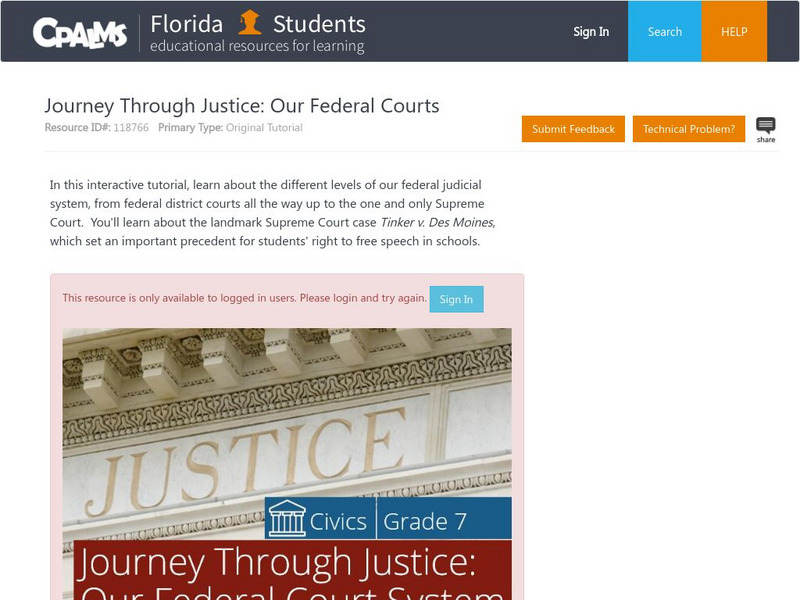
Florida State University Cpalms: Florida Students: Journey Through Justice: Our Federal Courts
In this tutorial, students learn about the various levels in the federal judicial system and look at a famous Supreme Court case, Tinker v. Des Moines.

TED Talks
Ted: Ted Ed: The Lost Art of Democratic Debate
Democracy thrives on civil debate, but we're shamefully out of practice. Watch this fun refresher, with TEDsters sparring over a recent Supreme Court case (PGA Tour, Inc. v. Martin) whose outcome reveals the critical ingredient in...
CommonLit
Common Lit: "You Have the Right to Remain Silent": History of Miranda Rights
Can your rights protect you if you don't even know what they are? Supreme Court case Miranda v. Arizona answered that question by requiring police officers to read the "Miranda Rights" when making an arrest. This text will explain the...
University of Missouri
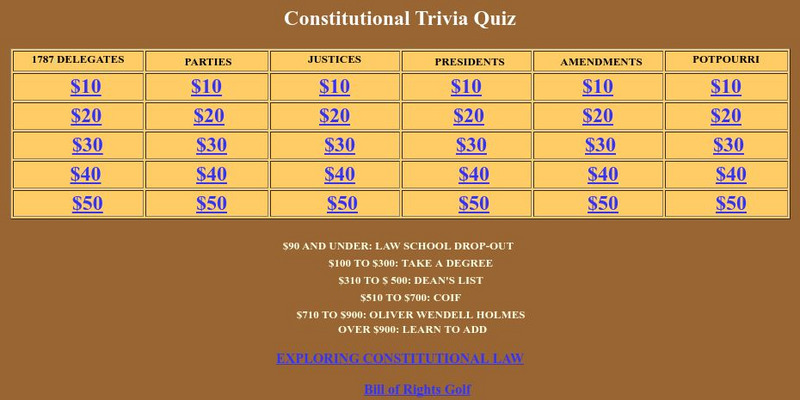
Exploring Constitutional Conflicts: Constitutional Trivia Quiz
Are you a law school drop out or a Supreme Court justice? Take this trivia quiz over the Constitution and find out! Self-correcting and answers are provided.
CommonLit
Common Lit: Book Pairings: "Things Fall Apart" by Chinua Achebe
Selected (12) reading passages (grades 6-11) to pair with "Things Fall Apart" by Chinua Achebe. In this classic novel, Okonkwo, a wealthy and respected member of the Umuofia clan, resists the forces of change brought to Africa by...