Hi, what do you want to do?






Teach Engineering
Start Networking!
Class members create their own social networks by collecting signatures before graphing the interactions with their fellow classmates. The degree distribution of the simulated social network is determined by calculating the degree of...

Teach Engineering
Curb the Epidemic!
Class members use an applet on the Internet to simulate the spread of a disease. The simulation allows individuals to determine two nodes to vaccinate to limit the number of nodes infected. By running several simulations, scholars...

Teach Engineering
Complex Networks and Graphs
Show your class how engineers use graphs to understand large and complex systems. The resource provides the beginnings of graph theory by introducing the class to set theory, graphs, and degree distributions of a graph.

Curated OER
Peer Review Meets D.I.Y.: Publishing a Student Science Journal
Peer review of science laboratory reports? You bet! First, learners work in pairs to review a scientific article. Then they trade lab reports for peer review. The end result is the publication of a classroom scientific journal!

Teach Engineering
Processes on Complex Networks
Introduces your class to random processes in networks with an activity that uses information about disease spread using the susceptible, infectious, resistant (SIR) model. Participants determine whether a susceptible person becomes...

Curated OER
Publisher Brochures
Young scholars create brochures on subjects they are studying in Publisher. In this nonfiction writing lesson, students use Publisher to create a brochure telling all the main ideas of a topic they are studying. Young scholars use text...

Curated OER
Animal Characteristics
Students create a graphic organizer to study animal characteristics. In this animal characteristics lesson plan, students use a program in Microsoft Word to create a brainstorm about different animal characteristics.
TeachEngineering
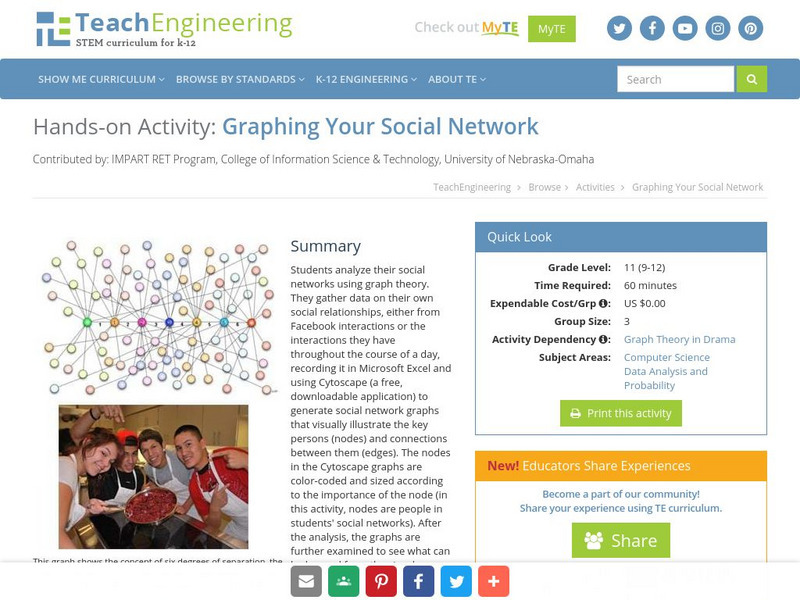
Teach Engineering: Graphing Your Social Network
Students analyze their social networks using graph theory. They gather data on their own social relationships, either from Facebook interactions or the interactions they have throughout the course of a day, recording it in Microsoft...
TeachEngineering
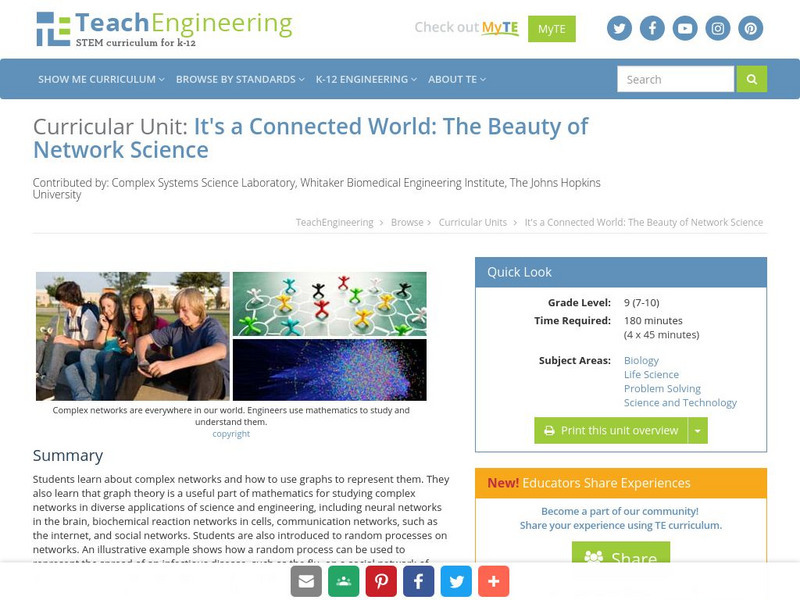
Teach Engineering: It's a Connected World: The Beauty of Network Science
Students learn about complex networks and how to use graphs to represent them. They also learn that graph theory is a useful part of mathematics for studying complex networks in diverse applications of science and engineering, including...
TeachEngineering
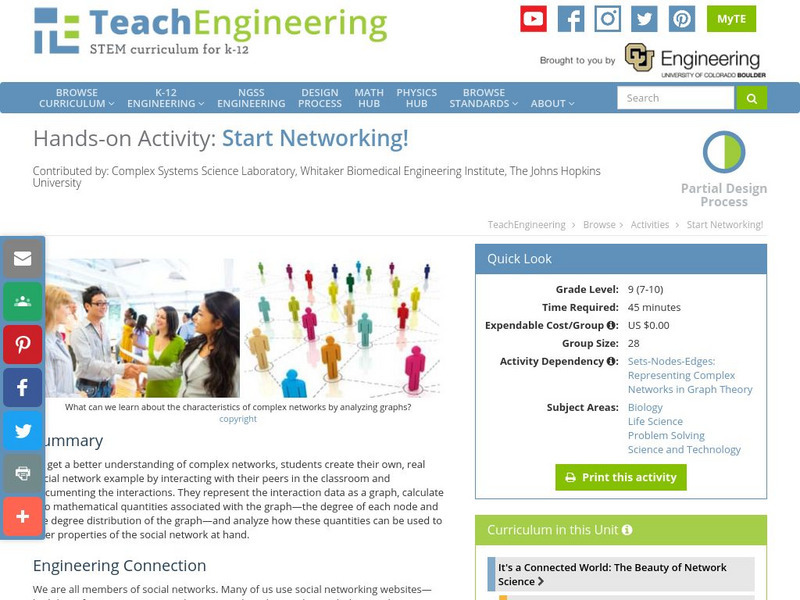
Teach Engineering: Start Networking!
To get a better understanding of complex networks, students create their own, real social network example by interacting with their peers in the classroom and documenting the interactions. They represent the interaction data as a graph,...
TeachEngineering
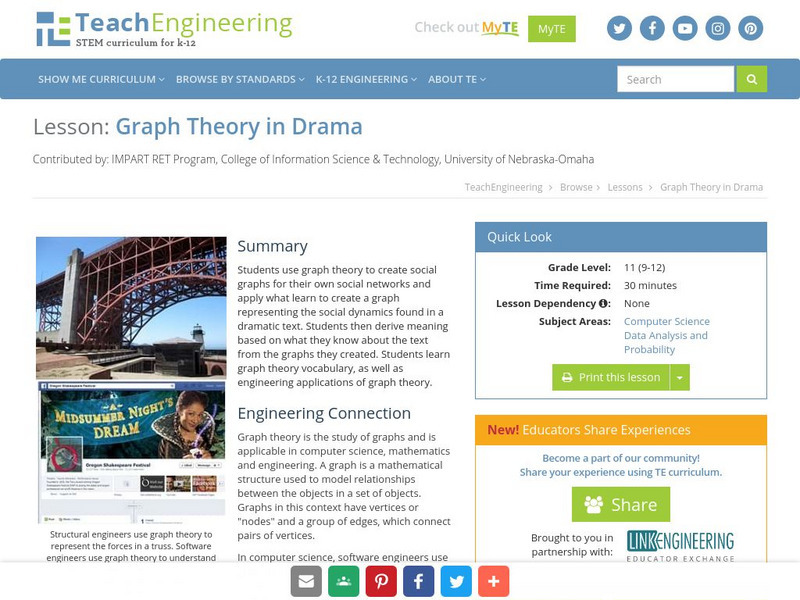
Teach Engineering: Graph Theory in Drama
Students use graph theory to create social graphs for their own social networks and apply what learn to create a graph representing the social dynamics found in a dramatic text. Students then derive meaning based on what they know about...
TeachEngineering
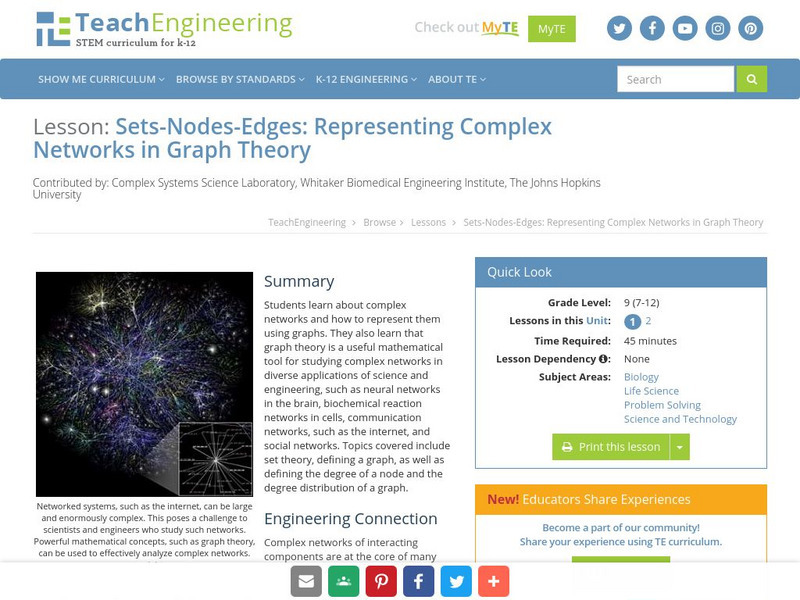
Teach Engineering: Complex Networks and Graphs
Students learn about complex networks and how to represent them using graphs. They also learn that graph theory is a useful mathematical tool for studying complex networks in diverse applications of science and engineering, such as...
TeachEngineering
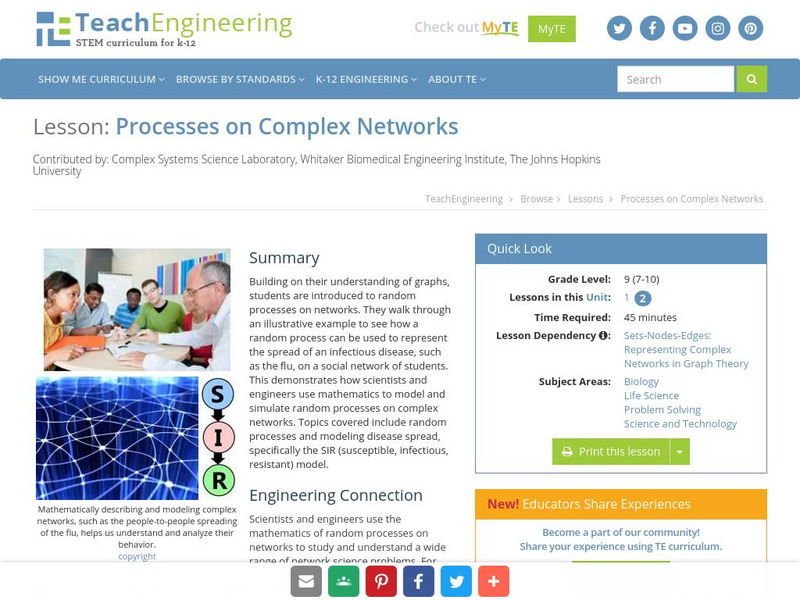
Teach Engineering: Processes on Complex Networks
Building on their understanding of graphs, students are introduced to random processes on networks. They walk through an illustrative example to see how a random process can be used to represent the spread of an infectious disease, such...
TeachEngineering
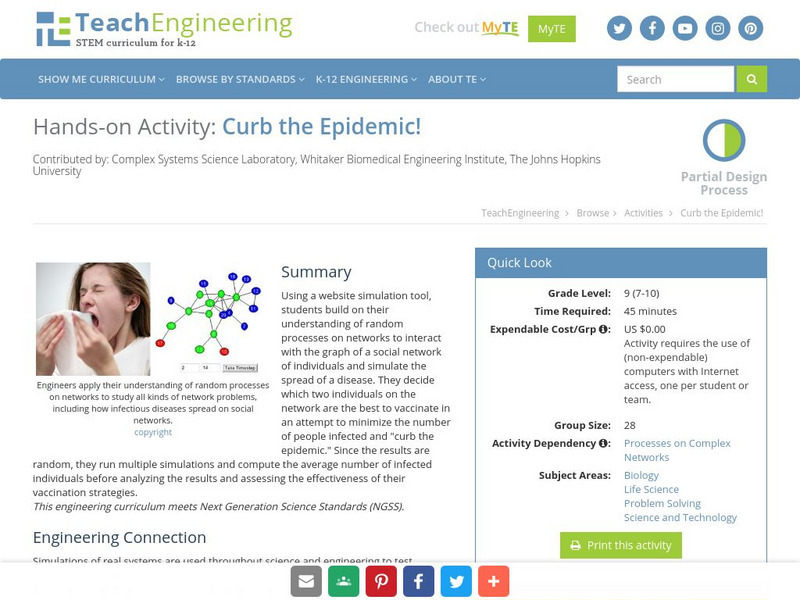
Teach Engineering: Curb the Epidemic!
Using a website simulation tool, students build on their understanding of random processes on networks to interact with the graph of a social network of individuals and simulate the spread of a disease. They decide which two individuals...
TeachEngineering
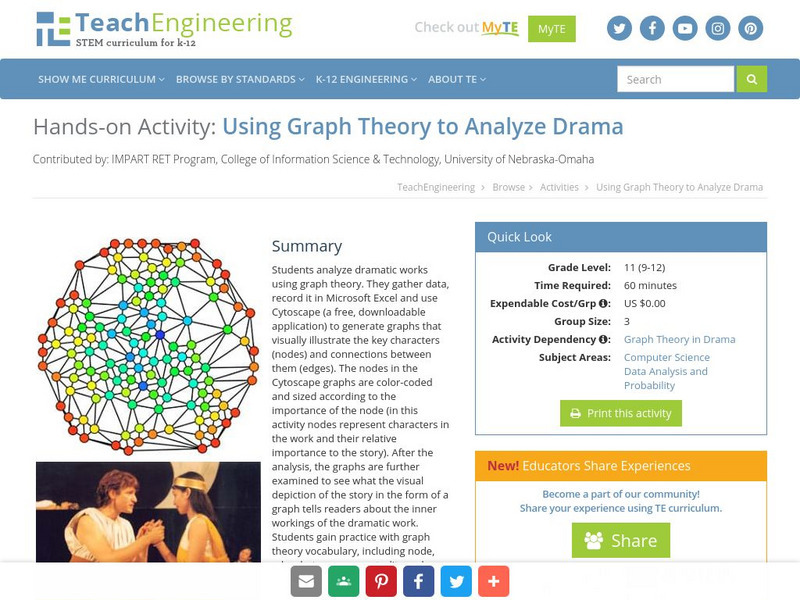
Teach Engineering: Using Graph Theory to Analyze Drama
Students analyze dramatic works using graph theory. They gather data, record it in Microsoft Excel and use Cytoscape (a free, downloadable application) to generate graphs that visually illustrate the key characters (nodes) and...

TED Talks
Ted: Ted Ed: The Networked Beauty of Forests
Deforestation causes more greenhouse gas emissions than all trains, planes and automobiles combined. Suzanne Simard examines how the complex, symbiotic networks of our forests mimic our own neural and social networks- and how those...

Louisiana Department of Education
Louisiana Doe: Curriculum Hub: Ela Guidebooks: Teenage Brain
Ninth graders read three informational texts to understand how social media affects the teen brain
Other
Brainspire: What Are the Effects of Technology on Human Interaction?
This article examines the positive and negative ways that technology impacts human interactions and relationships within families and with the wider world, as well as the implications the over-use of technology has on the growing child....
Other popular searches
- Dangers of Social Networking
- Social Networking Facebook
- Social Networking Sites
- Social Networking Activity
- Social Networking In
- Social Networking Websites
- Social Networking Online
- Social Networking Essays
- Social Networking Portfolio
- Social Networking Skills
- Social Networking on Line
- Social Networking Face Book