Hi, what do you want to do?






Curated OER
Amusement Park Physics
Learners get up close and personal with principles of motion. In this physics lesson plan, students collect and analyze acceleration data on amusement park rides. Learners use CBLs to collect data in this lesson plan.

Curated OER
Principles of Physics: A Real Scream!
Students apply their knowledge of the physics principles of force, energy and motion to researching the physics behind amusement park rides.

Curated OER
Mathematical Modeling and Physics
Twelfth graders use a web site to investigate roller coaster physics. In this mathematical modeling lesson, 12th graders are grouped according to their performance on a test. Each group is given an activity to complete on a web site...

Curated OER
Properties of the Ocean: Measurement
Learners simulate the development of an underwater amusement park after reading background on Coral Reef State Park. They decide which factors they would need to consider such as the ocean floor, currents, wave patterns and water...

Curated OER
Roller Coasters
Twisting and turning through the sky, roller coasters are popular attractions at amusement parks around the world, but how exactly do they work? Explore the physics behind these thrilling rides with an engineering design activity....

Curated OER
The Science of Swinging
Students learn how a pendulum works in the concept of an amusement park ride. In this pendulum lesson, students are introduced to Newton's first law of motion and how it works in an amusement park ride. Continuous motion and inertia are...

Alabama Learning Exchange
Energy and Work Amusement Park Style
Learners distinguish between kinetic and potential energy. They recognize that energy can change from one form to other forms. They identify and describe several forms of energy.

Kenan Fellows
Engineering Skills Through Problem Based Learning
Navigate the ups and downs of learning about energy. Future engineers consider how potential and kinetic energy apply to roller coasters. They design a roller coaster of their own and then use computer design software to showcase their...

Curated OER
Circular Motion
Twelfth graders discuss centrifugal force, frictional force, and critical speed as it relates to the popular amusement park ride, the Gravitron.

Curated OER
Phat Shredders and Phony Phorces: Snowboarding, Winter Sports, Olympics, Sport Safety, Science, Physics
Students study about the history, physical science, and safety issues involved in snowboarding.

Virginia Department of Education
Work and Power
Assist your class with correctly calculating the values for force, work, and power as they determine the amount various activities require. They gather data and participate in a group discussion to compare results upon conclusion of the...

Curated OER
Roller Coaster Mania
Fifth graders extend their knowledge of developing maps. They work in cooperative groups to develop an amusement park display and a brochure.

Curated OER
Services for the Disabled At Wild Safari
Students discover and enter the website for Six Flags Amusement park. Individually, they identify and discuss the types of services available to the handicapped. After reading the website, they answer comprehension questions and write...

Curated OER
Rockin Roller Coaster
Students discuss gravitational potential energy, kinetic energy, and the relationship between potential and kinetic energy. They create a working roller coaster from provided materials and criteria then evaluate each roller coaster. They...

Curated OER
May The Force Be With You
Eighth graders investigate Newton's Laws of Motion. They use the example of a roller coaster for illustration purposes. A force associated with a roller coaster is tested, data graphed, and a conclusion is drawn. They use excel in order...

Curated OER
Observing Motion
First graders explore movement and motion. In this motion lesson plan, 1st graders how objects can move as well as how the Earth is in constant motion and the force of gravity. Students complete a coloring sheet.

Curated OER
May the Force Be With You
Students read an article, brainstorm ideas and prepare journals investigating why people enjoy 'thrill' rides, what forces affect the body on these rides and how they can become dangerous.

Curated OER
Let's Outrage the Bull
Learners study kinetic and potential energy. In this energy lesson, students in grades K-2 understand the differences between kinetic and potential energy. Learners in grades 3-5 demonstrate that kinetic and potential energy. Students in...

Curated OER
Catapults!
Pupils work together to discover the relationship between the angle of catapults and the flight of different objects. They discover the heavier the object the more force is needed. They examine how engineers use this information to...

Curated OER
Web Design
Students are introduced to the seven web design elements. Using examples, they identify the use of good and bad elements. They work with a computer program to help them design their own website and share them with the class.
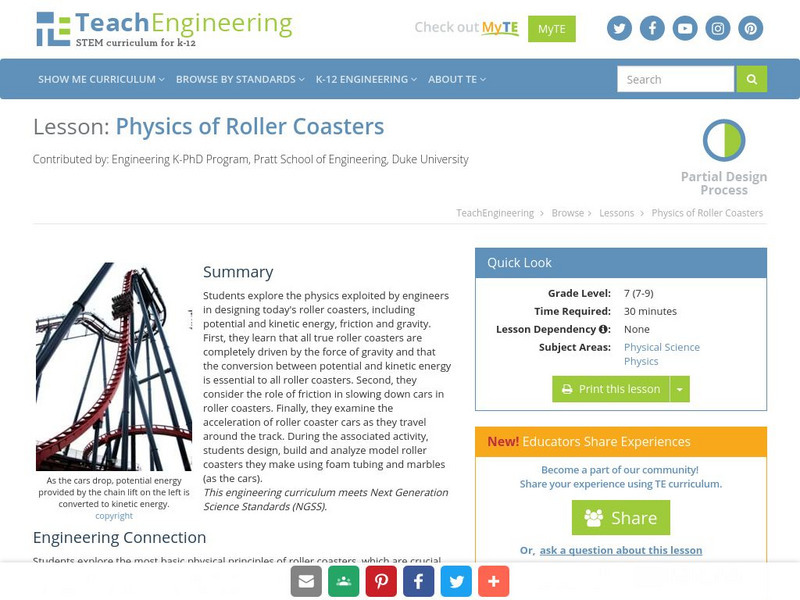
TeachEngineering
Teach Engineering: Physics of Roller Coasters
Students explore the physics utilized by engineers in designing today's roller coasters, including potential and kinetic energy, friction, and gravity. First, students learn that all true roller coasters are completely driven by the...

TeachEngineering
Teach Engineering: The Science of Swinging
Students learn what a pendulum is and how it works in the context of amusement park rides. While exploring the physics of pendulums, they are also introduced to Newton's first law of motion - about continuous motion and inertia.
![The Engineering Place: Roller Coasters [Pdf] Lesson Plan](https://statictemp.lp.lexp.cloud/images/attachment_defaults/resource/large/FPO-knovation.png "The Engineering Place: Roller Coasters [Pdf] Lesson Plan")
NC State University
The Engineering Place: Roller Coasters [Pdf]
A lesson where students construct a roller coaster and test it under different conditions to learn about force and motion.