Hi, what do you want to do?






Curated OER
Observation and Discovery
Young scholars explore the basic skills guiding sound scientific invvestigation and methodology. They are introduced to a powerful scientific tool-the microscope. Students review the parts of the microscope. They discuss the inventor...

Curated OER
Science Biographies: A Poster Approach
Second graders examine the lives and contributions of five people who have impacted science in the four lessons of this unit. Key facts in the life of the persons are placed on a timeline and a mini-biography is created.

Curated OER
Magnificent Microscopes
Students use a microscope in a series of activities that are designed to help them explore the "invisible world" and make meaningful microscopic discoveries and learn the importance of the microscope as a tool in science and research.

Curated OER
Light - Stop Faking It!
This well-designed presentation covers many important aspects of the science behind light. In it, pupils view slides that have a lot of the important vocabulary associated with science, slides of famous scientists who made important...

Curated OER
History of Biotechnology
Ancient, classical, and modern methods of biotechnological methods are introduced in this science PowerPoint. Students should be interested to see how advanced people have been through the ages in adapting their methods to procure...

K12 Reader
Microscopes Magnify Things
After examining a short article about light microscopes, readers record their responses to a series of comprehension questions based on the text.

Curated OER
17 - Cells
The first of three pages in this handout provides a brief history of our understanding of the cell. It also differentiates between prokaryotic and eukaryotic cells. The second is a collection of true and false, multiple choice, and short...

University of Connecticut
More Than Just Dust Bunnies
Teenagers will never complain about cleaning their rooms after this activity. In the first instructional activity of a four-part series, budding scientists collect samples of dust, chalk, and other particulates from various areas of...

Curated OER
Magnificent Microscopes Unit Including Mystery and Alternative Assessment Activity
After drawing and labelling a microscope, forensic science explorers use one to solve a simulated murder mystery. They examine each piece of evidence and draw what they observe at each magnification. Working in groups of four, your...

Curated OER
Biotechnology
A continuous cascade of information comes through this PowerPoint on biotechnology. The topic is defined, a history is presented, and basic genetic engineering techniques are explained. The topic is covered in an objective manner,...

Curated OER
Safe Food Supplies
High schoolers answer the question how are food supplies maintained safely for human consumption? They are able to answer the following questions: what personal and pulic decisions must be made regarding the safe handling of food?, What...

Curated OER
Micro-Organisms
In this identifying the definitions of micro-organisms worksheet, students match the correct key words with the correct definitions. Students match 8 answers.

Curated OER
Science Biographies for Research Detectives
Second graders research and explore lives of famous scientists, analyze accomplishments of scientists, and create presentations. Six lessons on one page.

Curated OER
Introduction to Biology
Students study cell theory and the link between it and technology. In this cell theory lesson students examine the importance of cell theory.
Houghton Mifflin Harcourt
Harcourt: Biographies: Anton Von Leeuwenhoek
This brief biography of Anton von Leeuwenhoek is a great resource to understand how influential he was to the discovery of cells in his time.
University of California
Ucmp: Antony Van Leeuwenhoek
This site from University of California has a biography and picture of Antony van Leeuwenhoek, a scientist in the 18th century.
Florida State University
Florida State University: The Leeuwenhoek Microscope
Microscope pioneer and amateur scientist Leeuwenhoek built a number of tiny microscopes with a variety of lenses.

Famous Scientists
Famous Scientists: Antonie Van Leeuwenhoek
Learn about the life and work of Antonie van Leeuwenhoek, best known for his work on the improvement of the microscope, and considered to be the first microbiologist.

Wikimedia
Wikipedia: Anton Van Leeuwenhoek
This site from the Wikipedia encyclopedia provides a concise explanation of van Leeuwenhoek's (1632-1723 CE) contribution to the improvement of the microscope and his contributions to cell biology.
Other
Science Superstars: Anton Van Leeuwenhoek
This site is provided for by Zephyrus. So, who was Anton van Leeuwenhoek (1632 -1723 CE)? What else did Leeuwenhoek do? Did he achieve anything else? What honors were awarded to him? These questions are answered in this informative site.
Other
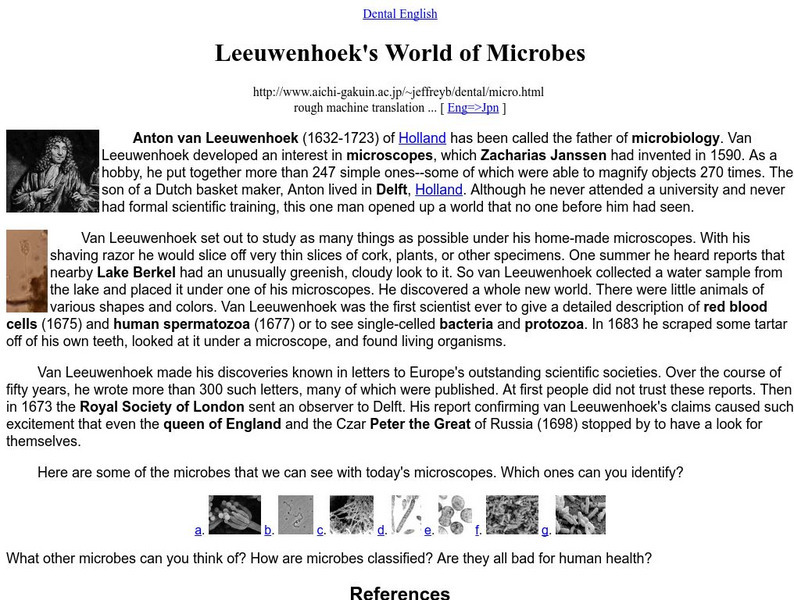
Leeuwenhoek's World of Microbes
This site has some history of van Leeuwenhoek (1632-1723 CE) with a description of his major accomplishments in the field of microbiology
CK-12 Foundation
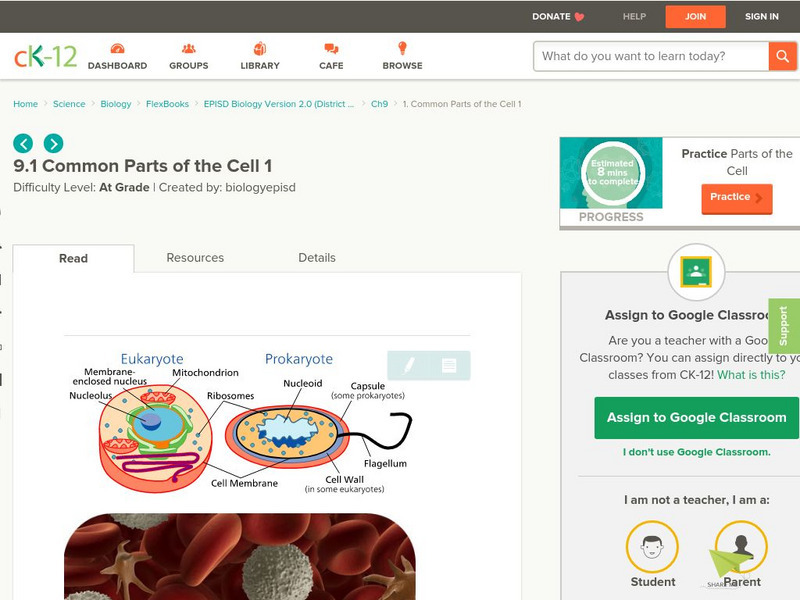
Ck 12: Common Parts of the Cell 1
[Free Registration/Login may be required to access all resource tools.] Online activity summarizes the cell theory, describes four parts all cells have in common, and the importance of the work of Robert Hooke and Anton van Leeuwenhoek.
Curated OER
Science Superstars: Anton Van Leeuwenhoek
This site is provided for by Zephyrus. So, who was Anton van Leeuwenhoek (1632 -1723 CE)? What else did Leeuwenhoek do? Did he achieve anything else? What honors were awarded to him? These questions are answered in this informative site.

TED Talks
Ted: Ted Ed: The Wacky History of Cell Theory
Video describes the development of the cell theory and some of the scientists and disagreements involved. [6:12] Includes a short quiz and a list of additional resources to explore.