Hi, what do you want to do?






Curated OER
Ocean Circulation
In this physical oceanography PowerPoint, viewers learn about ocean circulation, sea surface temperatures, and salinity. Relationships among these aspects are explained, as well as their impact on the atmosphere and climate. Each slide...

Curated OER
Earth Science
Students analyze the mechanisms for generating ocean currents, temperature, and deep ocean circulation. They are able to assess the formation and breaking of waves and their effect on shorelines, particularly the North Carolina coast. ...

Curated OER
Ocean Circulation
Students view and analyze buoy, satellite, temperature vs depth data to study about ocean circulation and how is related to atmospheric circulation. They read and interpret satellite image data related to: Surface wind speeds, Wave...

Curated OER
Ocean Streams
The instructions for demonstrating ocean turnover are provided in this resource. You could set this up for your earth science class as part of a lecture on convection currents or as an explanation of how ocean currents form. An animation...

Curated OER
Round and Round
Learners interpret data from a three-dimensional array of current monitors to determine an overall pattern of water circulation. They hypothesize what effect an observed water circulation pattern might have on seamount fauna. A very...

Curated OER
Density Dynamics
Learners set up working models demonstrating lake turnover and the formation of deep water masses in the oceans.

NOAA
Currents
Learn how ocean currents are vital to humans and marine life. The eighth installment of a 23-part NOAA Enrichment in Marine sciences and Oceanography (NEMO) program, focuses on ocean currents and how they affect global climate. The...

Curated OER
Ocean Currents Quiz
In this ocean activity, students complete a 13 question multiple choice on-line interactive quiz about ocean currents. Prior knowledge is assumed.

NOAA
To Boldly Go...
When we think of ocean exploration, many of us have visions of sunken pirate ships full of treasure or mysterious creatures of the deep. What really motivates deep-sea investigation? The first in a series of diverse six-part lessons...

Curated OER
No Escape
Via four student handouts, marine biology learners examine the topography and circulation cell of the Fieberilng guyot. Then they examine the number of individual hydroids counted at each depth. Pupils use the information to relate water...

Curated OER
The Great Ocean Conveyor
Students investigate water density. In this water density lesson, students conduct an experiment with food coloring, water and salt to see how the salt effects bodies of water.

Polar Trec
Sea Ice Impact
The arctic seas contain currents that are both warm (with high salinity) and cold (relatively fresh water) that circulate throughout the year. Through discussion, a lab, and a web quest, participants explore the impacts of melting and...

Curated OER
Learning Lesson: How it is Currently Done
Students create their own ocean currents by using everyday items. They examine the constant pushing of molecules that makes us feel wind. They discuss how the water moves in the Southern Hemisphere.

Curated OER
Tracking Narwhals in Greenland The Ocean Unicorn
Students study the ecology, habitats, geographic range and feeding habits of narwhals. They determine at least three reasons for the decline in the narwhal populations and complete the accompanying worksheets.

Curated OER
Top to Bottom
Marine science classes read about the 2005 North Atlantic Stepping Stones Expedition and review climate change. They use maps to locate the seamount chains. In collaborative groups, they research how climate change may be altering the...

Teach Engineering
The Great Pacific Garbage Patch
The Great Pacific Garbage Patch is one of several garbage patches around the world where garbage accumulates naturally. As part of a GIS unit that combines oceanography, environmental science, and life science, class members investigate...

Curated OER
Frozen Out
Students investigate how climate changes affect top predators in Arctic marine ecosystems. Students complete a worksheet and write a report based on their responses to a scientific paper.

Curated OER
The Good, The Bad, and the Arctic
Students investigate the social, economic and environmental consequences that might result from Arctic climate change. Students identify and discuss at least three consequences.

NOAA
El Niño
El Nino, La Nina ... and the Santa Maria? The 11th installment of a 23-part NOAA Enrichment in Marine sciences and Oceanography (NEMO) program explains the mechanism of El Nino/Southern Oscillation. Pupils use previous data to determine...

Curated OER
Australia, Oceania, and Antarctica Today
Students explore the importance of research in Antarctica, then explain how snow becomes part of the Antarctic ice cap. They explore Antarctica's harsh environment and discover how scientists drill ice cores and what information ice...

Curated OER
Polar Day: Arctic Clean Up
Students explore the concept of pollution. In this environmental stewardship lesson, students examine primary sources to research the complexity of pollution and its effect on the Arctic.

US Department of Energy
Make Your Own El Niño
Students observe and discuss a demonstration of the El Niño effect, trade winds, and upwelling. They view and analyze the teacher using a blow dryer to replicate the El Niño winds on colored water and oil in a large tub.
Woods Hole Oceanographic Institution
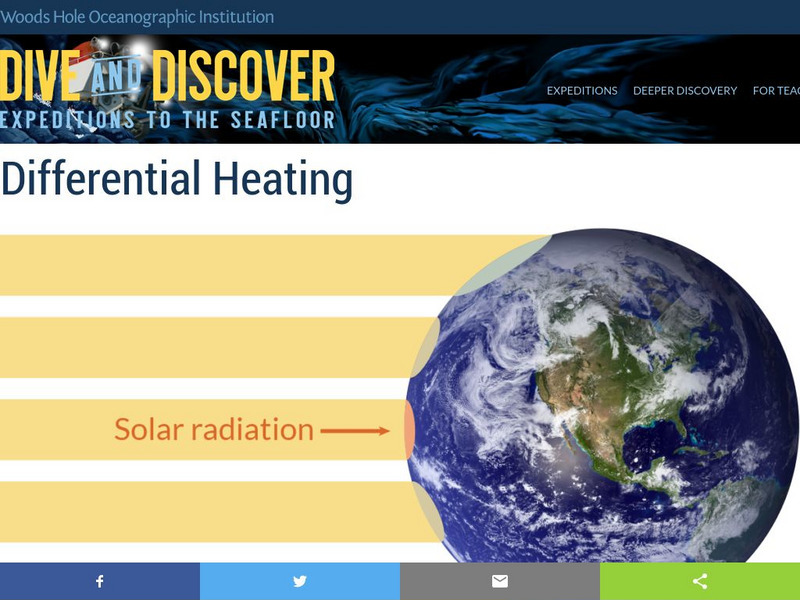
Woods Hole Oceanography Institute: Deep Ocean Circulation
What causes the circulation of ocean waters that are too deep to be affected by wind? Find out how salinity and temperature drive the deep sea currents. This resource has several videos and an online quiz.
CK-12 Foundation
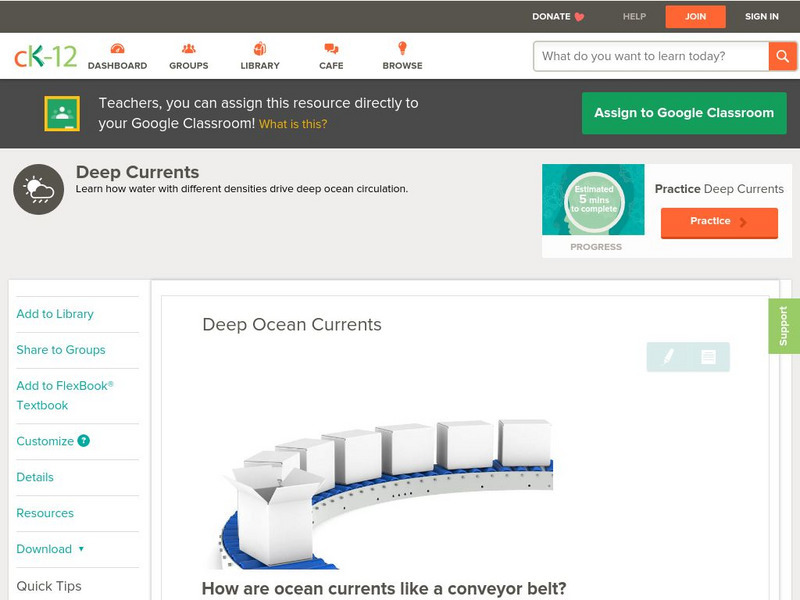
Ck 12: Earth Science: Deep Ocean Currents
[Free Registration/Login may be required to access all resource tools.] Learn how water with different densities drives deep ocean circulation.