Hi, what do you want to do?






DiscoverE
Air Train
Train your pupils to be master engineers. Young learners design a train that travels along a fishing line. The train needs to safely carry pennies as passengers without falling out.

DiscoverE
Levitating Train
Levitation isn't just for magicians. Pupils design and build a small portion of track for a maglev train using magnets and Lego bricks. The goal is to get the trains to levitate—without using magic!

Florida Center for Reading Research
Phonological Awareness: Phoneme Matching, Sound Train
Make a phonics train filled with matching initial phonemes. Early readers say the name of the objects on each of their cards, identify the initial letter sounds or phonemes, then paste them on a train. They make three trains, which means...

Curated OER
The Little Engine that Could Mini Unit Plan
The best part about teaching little ones is setting up fun, thematic learning stations. Here is a full day of activities that all relate to the story, The Little Engine that Could. Included are six different activities that cover...

Teach Engineering
A Simple Solution for the Circus
Class members are challenged to design a device that will move a circus elephant into a train car. Groups brainstorm ideas that use simple machines to load the elephant. They then choose one of their ideas, sketch a plan, and present it...

Teach Engineering
Challenges of Laparoscopic Surgery
Get some laparoscopic training without the pain with an activity that challenges class members to find out what it is like to perform laparoscopic surgery. Teams perform three different tasks and quantify their performance. The...

National Nanotechnology Infrastructure Network
Noodling Around: Powers of Ten
How many noodles long is your classroom? Find out when engineers of all ages explore measurement through the use of pool noodles. With the noodles pre-cut to certain metric lengths, the activities could be used to introduce the metric...

Florida Center for Reading Research
Phonics: Letter-Sound Correspondence,
What a fun way to practice medial sound-letter correspondence! This alphabet activity has pupils flip cards, determine the medial sound, and place it on one of the train cars if it matches.

Teach Engineering
Earthquakes Living Lab: FAQs about P Waves, S Waves and More
Let's talk about earthquakes .... Using the Internet, pupils research what causes earthquakes, how scientists measure them, their locations, and their effects. The resource is not only informative, but it also builds crucial...

Teach Engineering
Egg-cellent Landing
The classic egg-drop experiment gets a new bounce with an activity that asks pairs to design a lander similar to one used to land a rover on Mars within a fixed budget. The activity provides a great introduction to the idea of...

Teach Engineering
Ramp and Review (for High School)
Rolling for momentum. As part of a study of mechanical energy, momentum, and friction, class members experiment rolling a ball down an incline and having it collide with a cup. Groups take multiple measurements and perform...

Teach Engineering
Let's Get it There Fast
Are planes the best shipping method? Using maps, pupils determine the fastest mode of transportation between two cities. Given a list of items to ship, groups decide the best shipping method to finish the 18th segment of a 22-part unit.

The New York Times
Perspective and Leonardo’s “Perspectograph”
Filippo Brunelleschi's invention of linear perspective during the Renaissance was further developed by his apprentice, a young artist named Leonardo da Vinci. Now modern artists can give da Vinci's famous perspectograph a try...

National Nanotechnology Infrastructure Network
Lab On A Slab
Capillary action is the frugal chemist's dream ... the less liquid used, the more tests they can run! Learners experiment with the best design to maximize the benefits of capillary action. Using a liquid sample, they design a capillary...

TeachEngineering
Teach Engineering: Wide World of Gears
In an interactive and game-like manner, students learn about the mechanical advantage that is offered by gears. By virtue of the activity's mechatronics presentation, students learn to study a mechanical system as a dynamic system under...
TeachEngineering
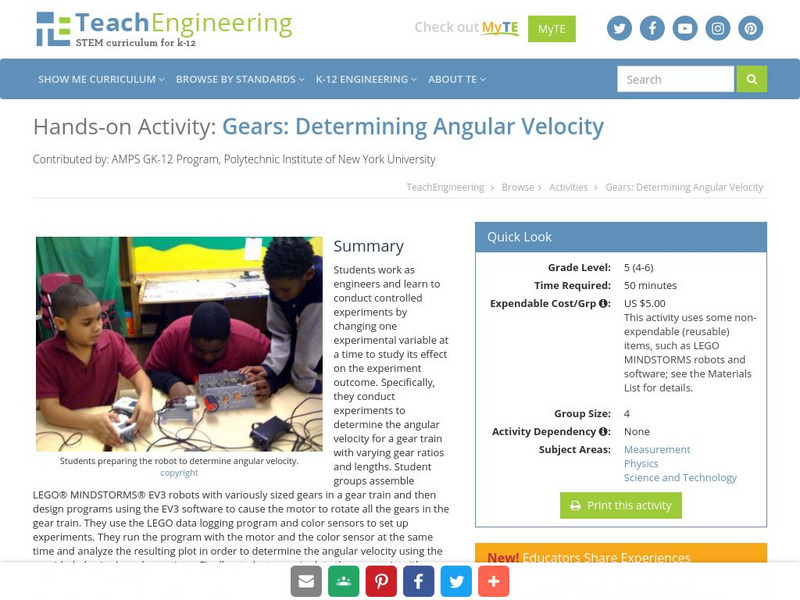
Teach Engineering: Gears: Determining Angular Velocity
Students work as engineers and learn to conduct controlled experiments by changing one experimental variable at a time to study its effect on the experiment outcome. Specifically, they conduct experiments to determine the angular...
TeachEngineering
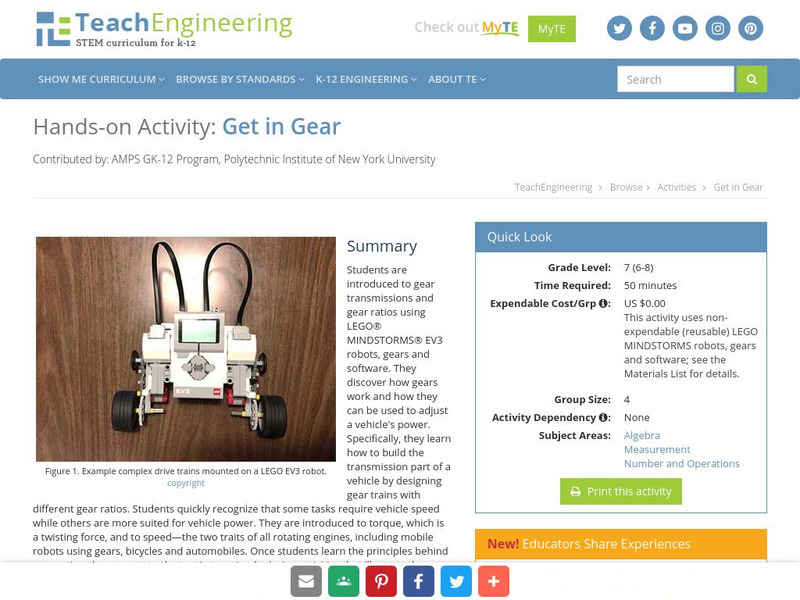
Teach Engineering: Get in Gear
Students discover how gears work and how they can be used to adjust a vehicle's power. Specifically, they learn how to build the transmission part of a vehicle by designing gear trains with different gear ratios.
TeachEngineering
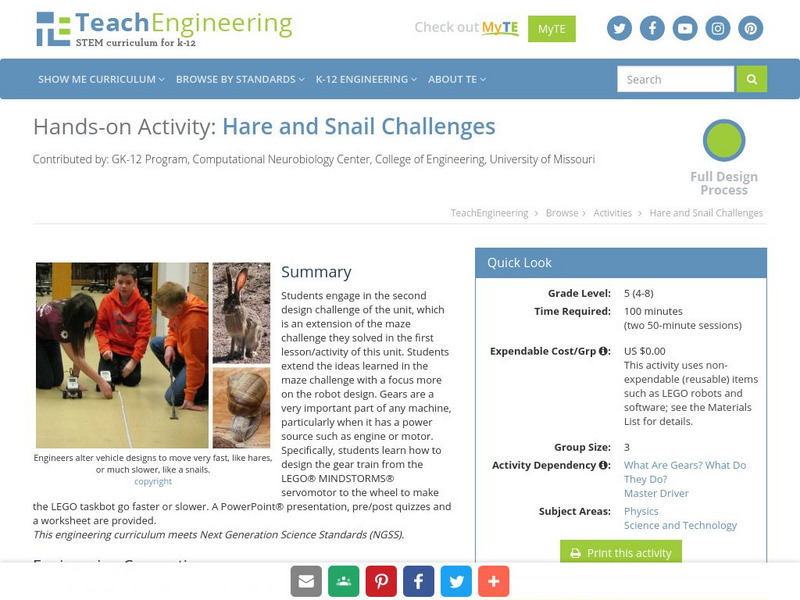
Teach Engineering: Hare and Snail Challenges
Students extend the ideas learned in the maze challenge in this unit with a focus more on the robot design. They learn how to design the gear train from the LEGO MINDSTORMS NXT servomotor to the wheel to make the LEGO taskbot go faster...
TeachEngineering
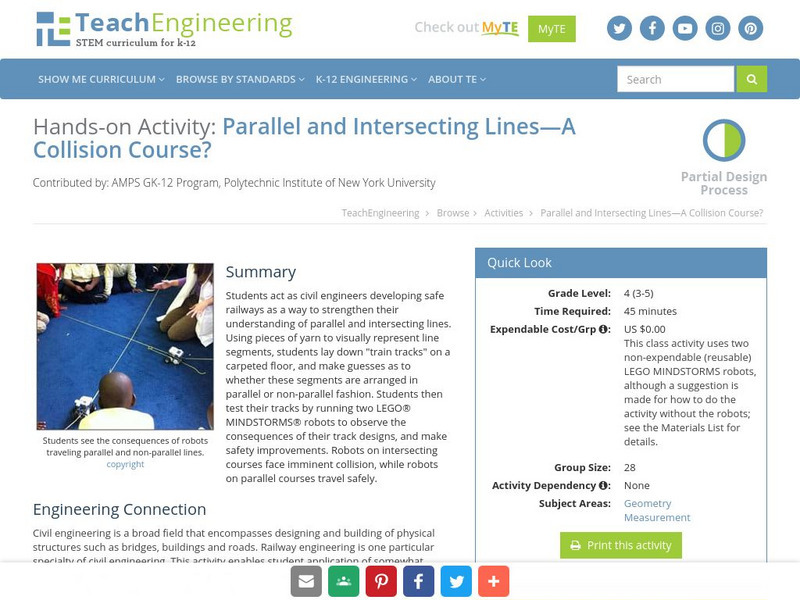
Teach Engineering: Parallel and Intersecting Lines: A Collision Course?
Students act as civil engineers developing safe railways as a way to strengthen their understanding of parallel and intersecting lines. Using pieces of yarn to visually represent line segments, students lay down "train tracks" on a...
TeachEngineering
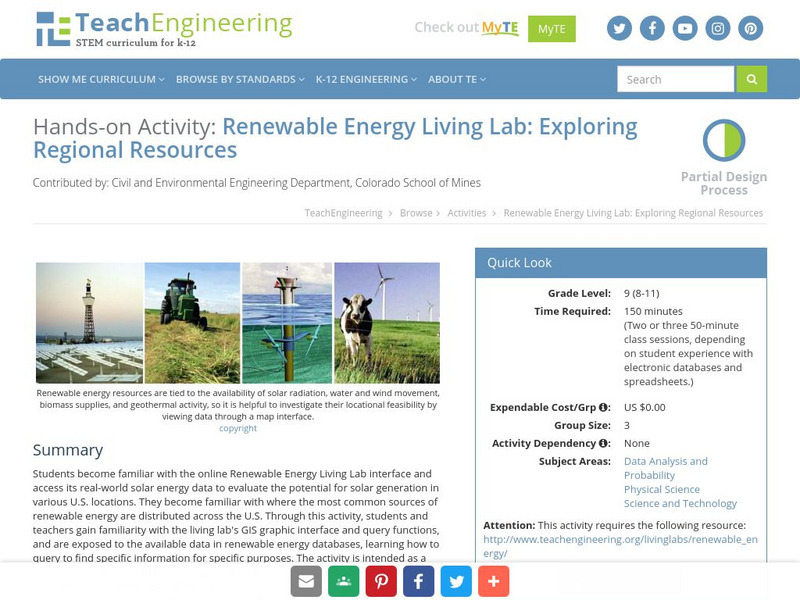
Teach Engineering: Renewable Energy Living Lab
Students become familiar with the online Renewable Energy Living Lab interface and access its real-world solar energy data to evaluate the potential for solar generation in various U.S. locations. They become familiar with where the most...
TeachEngineering
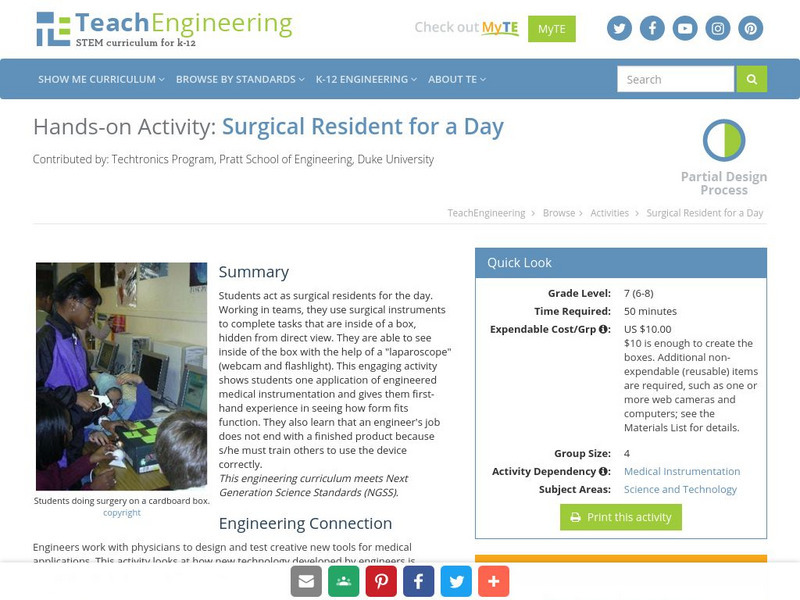
Teach Engineering: Surgical Resident for a Day
In this activity, students will become surgical residents for the day. As a team, they will be asked to use surgical instruments to complete a task inside of a black box. They will be able to see inside of the box with the help of a...
TeachEngineering
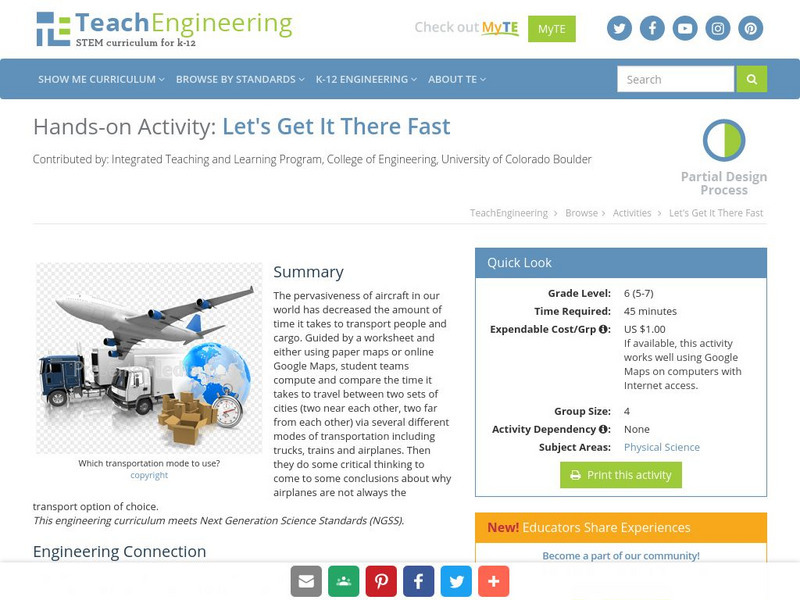
Teach Engineering: Let's Get It There Fast
The purpose of this activity is to demonstrate how aircraft have decreased the amount of time it takes to transport people and cargo. Students will compute the time it takes to travel between two cities for several modes of...
TeachEngineering
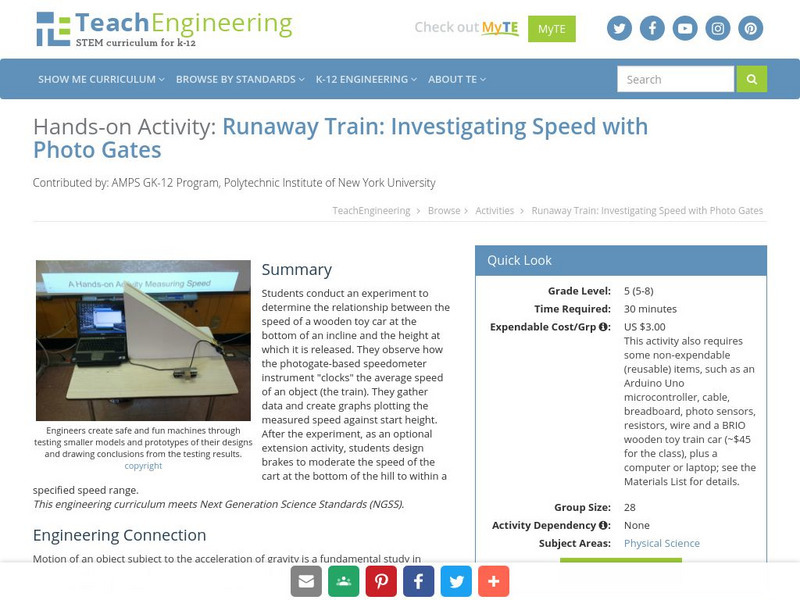
Teach Engineering: Runaway Train: Investigating Speed With Photo Gates
Students conduct an experiment to determine the relationship between the speed of a wooden toy car at the bottom of an incline and the height at which it is released. They observe how the photogate-based speedometer instrument "clocks"...

Science Buddies
Science Buddies: Career Profile: Athletic Trainer
Summarizes the important work of an athletic trainer. This Science Buddies site lays out the requirements needed to become an athletic trainer, as well as the education and job description. Included are interviews with people who have...