Hi, what do you want to do?






K12 Reader
Eratosthenes: Geographer and Mathematician
Mathematicians can be famous, too! Introduce your class to Eratosthenes with a reading passage. After they complete the passage, learners respond to five questions, some of which require opinions and others reading comprehension skills.

Illustrative Mathematics
Eratosthenes and the Circumference of the Earth
The class gets to practice being a mathematician in ancient Greece, performing geometric application problems in the way of Eratosthenes. After following the steps of the great mathematicians, they then compare the (surprisingly...

EngageNY
Families of Parallel Lines and the Circumference of the Earth
How do you fit a tape measure around the Earth? No need if you know a little geometry! Pupils begin by extending their understanding of the Side Splitter Theorem to a transversal cut by parallel lines. Once they identify the...

Curated OER
Measuring the Earth
High schoolers use principles of geometry to measure the circumference of the Earth. In this applied geometry lesson, students use mathematics to determine scientific information. They make measurements, calculate the central angle,...

Curated OER
Eratosthenes
Students examine what Eratosthenes is and the history behind him. In this earth lesson students complete a hands on activity to repeat Eratosthenes' experiment.

Curated OER
Earth
Students study the earth in relation to the solar system. In this planetary instructional activity students complete several investigations into the measurement of the earth and its magnetic field.

Curated OER
Eratosthenes And Radius of the Earth
Pupils calculate the radius of the earth. They use the method and data suggested by Eratosthenes. They investigate the interrelationships among mass, distance, force, and time through experimental processes.

Curated OER
The Round Earth And Christopher Colombus
Students engage in a historical review, starting with the existence of the horizon at sea, proceeding to various studies of the Earth's size and shape, and leading to the attempt by Columbus to reach India by sailing westward.

Curated OER
Explore the Mathematics of the Explorers
Columbus and other explorers relied upon mathematical calculations using the Earth, stars, and ships speeds.

Curated OER
Measure the Earth's Circumference
Students explore geometry by conducting a science experiment. In this circumference measurement instructional activity, students review the Greek geographer Eratosthenes who first discovered the circumference of our planet. Students...

Curated OER
Looking into Eratosthenes' Radius of the Earth
Young scholars, in small groups, research Eratosthenes and his calculations of the Earth's radius. They write a summary of the person, the experiments and his calculations to determine how accurate Eratosthenes was in his estimations of...

Curated OER
Noon Project Revisited
Students, just like Eratosthenes, try to use math to calculate immeasurable objects. Teachers need to try out the calculations before having your class do them. They should take notes to be included with their own calculations and drawings.

Curated OER
In Your Prime
Students study how to find prime numbers. They investigate the teachings of the mathematician Eratosthenes and apply his theory of prime numbers less than 100.

EngageNY
How Far Away Is the Moon?
Does the space shuttle have an odometer? Maybe, but all that is needed to determine the distance to the moon is a little geometry! The lesson asks scholars to sketch the relationship of the Earth and moon using shadows of an eclipse....

Curated OER
Newtonian Mechanics
Students familiarize themselves, through teacher demonstration, with Gavendish's apparatus first used for experimentally determining the value of the Universal Gravitational Constant G, and calculate theoretical value of Earth's...

Curated OER
Measuring The Earth
Young scholars use their geometry and trigonometry skills to determine the distance between their school and another school.

EngageNY
Unknown Angle Proofs—Proofs of Known Facts
Lead the class in a Greek history lesson plan with a geometric twist. Pupils relate a short video about geometric properties to modern-day methods of solving for unknown angles. They discuss parallel line theorems and...

Curated OER
Location
Students explore the tools used by Columbus to chart his latitude. They study the change of a location over time.

Curated OER
Direct Quotations
In this quotation activity, students use quotation marks as a form of punctuation. Students complete 22 short answer questions filling in the correct punctuation wherever necessary and completing 4 multiple choice questions choosing that...

Curated OER
Whatcha Gunna Do When the Hulkster's Measuring Too??
Students measure using tools they have made. In this algebra lesson, students measure the height and distance using non-traditional measuring methods. They apply their findings to algebra and trigonometry properties of measurements.
NASA
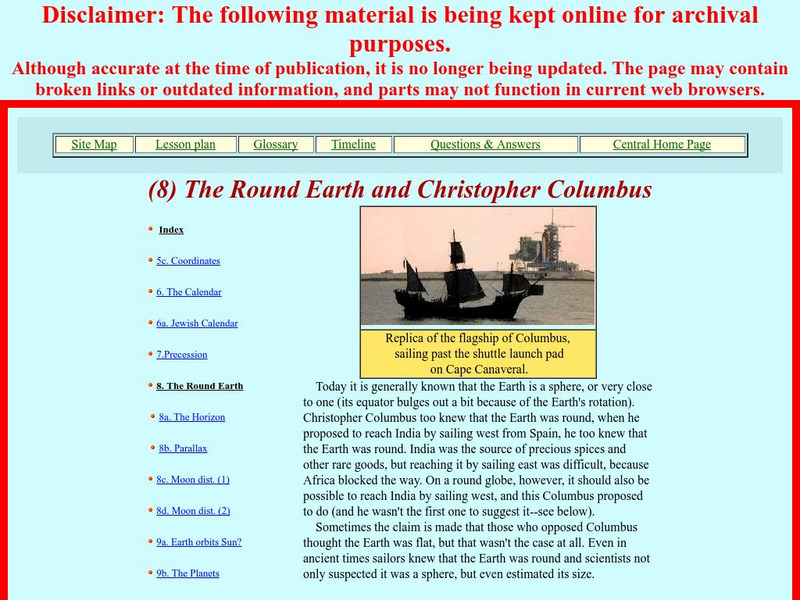
Nasa: From Stargazers to Starships: The Round Earth and Christopher Columbus
Despite popular myth, people of the 15th century actually realized that the earth was round. Some scientists had even estimated the size of the Earth. Here's an interesting explanation from a section of an online textbook on the...
Science Buddies
Science Buddies: Calculating the Circumference of the Earth
In this project, you will estimate the circumference of the earth, using a method developed about 2,200 years ago, by Eratosthenes, a Greek mathematician and the librarian of the great library at Alexandria, in Egypt.
Science Education Resource Center at Carleton College
Serc: Calculating the Radius of the Earth
Science students often have difficulty thinking about large spatial scales. The purpose of the exercise is to redo Eratosthenes' calculation of the radius of the Earth using data from to sites in ancient Egypt. The excercise teaches...