Hi, what do you want to do?






Teach Engineering
Energy Skate Park
Skate through a simulation on energy with an a activity that uses a computer simulation of a skater to reinforce the concept of conservation of energy. The resource guides pupils through scenarios using the computer simulation to...

Teach Engineering
Energy and the Pogo Stick
Let your class bounce to examine the concept elastic potential energy. Individuals bounce on a pogo stick in order to calculate its elastic potential energy. Groups then compare the elastic potential energy to the gravitational...

American Chemical Society
Exploring Energy
When asked to list everyday objects that require energy, most people list technology that use batteries or electricity. Through hands-on exploration, young scientists discover energy is much more than just circuitry. They play with...

Teach Engineering
Energy on a Roller Coaster
Roll with your class into the idea of conservation of energy. Pupils use a roller coaster track to collect data to reinforce the concept of conservation of energy and the influence of friction. Class members then create a graph from...

MENSA Education & Research Foundation
Roller Coaster Mania!
Raise the energy level of your physical science class with this exciting hands-on activity. Applying their knowledge of kinetic and potential energy and Newton's laws of motion, young engineers use foam tubing and marbles to create...

It's About Time
Defy Gravity
Test the limits of gravity while encouraging full class participation with this thrilling lesson. Pupils investigate the meaning of work and how it is equivalent to energy. They explore the joule and apply it as a unit of work. They...

Teach Engineering
Making Moon Craters
Create an egg-citing study of energy. Pupils investigate the effect of height and mass on the overall amount of energy of a falling object. The fourth segment in a six-part series on energy uses a weighted egg falling from different...

Teach Engineering
Amusement Park Ride: The Ups and Downs in Design
Groups design the ultimate roller coaster by considering potential and kinetic energy. They test their designs using marbles and then go on to rate each group's design based on aesthetics, loop diameter, and cost.

Museum of Science
Roller Coaster
Take a marble out for a roll. Using a section of flexible tubing, pupils build a roller coaster that will allow for a marble to act as the car. Learners create a loop, hill, and jump in their coasters by taping the tubing to different...

Museum of Science
Egg Bungee
Think bungee jumping looks scary? Knowing the science behind bungee jumping might make it less so. Using an egg and rubber bands, young engineers model bungee jumping. They test the distances that the egg falls for different numbers of...

PBS
Zip Line
Slide all the way to the bottom. Using the design process, pupils create a carrier for a ping pong ball that will travel down a zip line. Learners test their carriers and determine solutions to issues they encounter to complete the third...

DiscoverE
An Egg-Citing Ride
Wheeeee! Young thrill seekers build a bungee jump—not for themselves, though, but for an egg. The egg must fall from a height of five feet and rebound within two inches of the ground or floor.
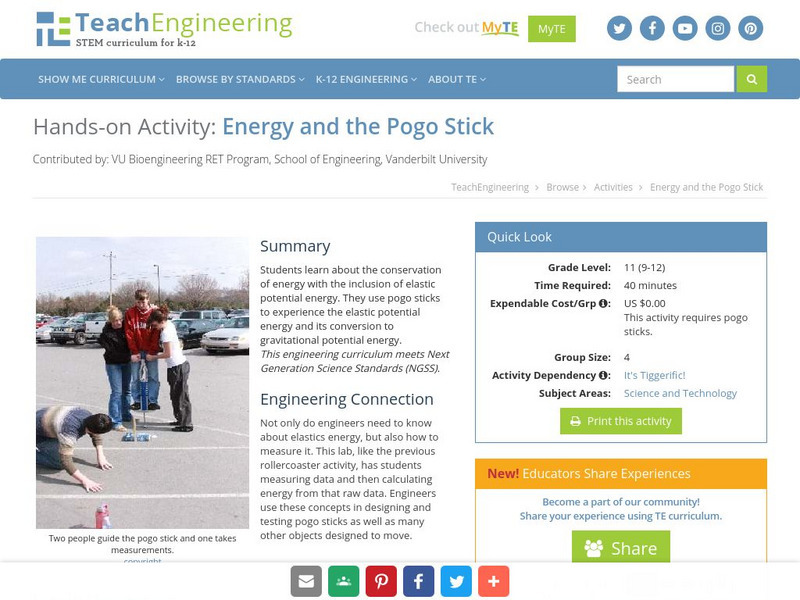
TeachEngineering
Teach Engineering: Energy and the Pogo Stick
This activity utilizes hands on learning with the conservation of energy with the inclusion of elastic potential energy. Students use pogo sticks to experience the elastic potential energy and its conversion to gravitational potential...
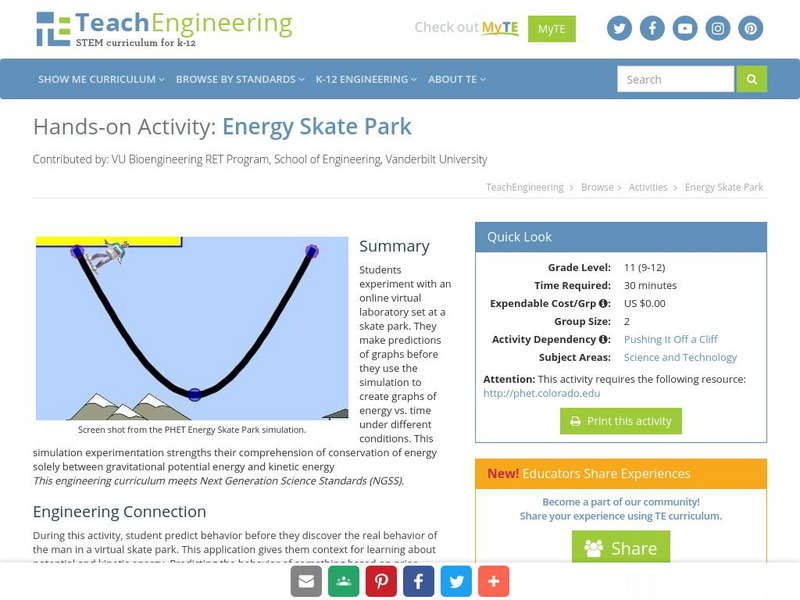
TeachEngineering
Teach Engineering: Energy Skate Park
This activity focuses on the conservation of energy solely between gravitational potential energy and kinetic energy. Students work with a virtual laboratory set at a skate park. They make predictions of graphs before they use the...
Science Education Resource Center at Carleton College
Serc: Launching a Ping Pong Ball With a Dropper Popper
An activity where students demonstrate elastic potential energy and gravitational potential energy by looking at the travel height of a ping pong when dropped vs a ping pong dropped with a "dropper popper".
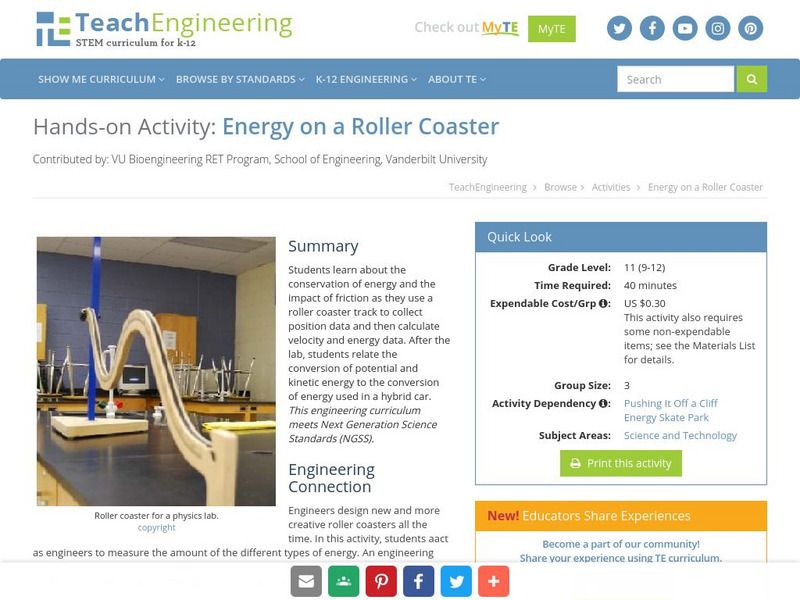
TeachEngineering
Teach Engineering: Energy on a Roller Coaster
This activity utilizes hands-on learning with the conservation of energy and the interaction of friction. Students use a roller coaster track and collect position data. The students then calculate velocity, and energy data. After the...

Museum of Science
Museum of Science and Industry: Online Science: Activities: Make an Egg Bungee
Step-by-step instructions, with photos, of how to prepare an egg for a 'bungee jump' using a plastic bag and elastics, and a yard stick to measure the distance it falls each time it is dropped. The activity investigates the Law of...
Quizlet
Quizlet: 6th Grade Science: Energy Vocabulary: Flashcards
This set of interactive flashcards focuses on 17 terms related to energy and their definitions. These include the following types of energy: Kinetic, Sound, Potential, Elastic potential, Chemical, Gravitational Potential, Electrical,...

Quizlet
Quizlet: 6th Grade Science: Energy Vocabulary: Match
In this interactive game, students match 17 terms related to energy with their definitions. These include the following: Kinetic, Sound, Potential, Elastic potential, Chemical, Gravitational Potential, Electrical, Light, Energy, Energy...
TeachEngineering
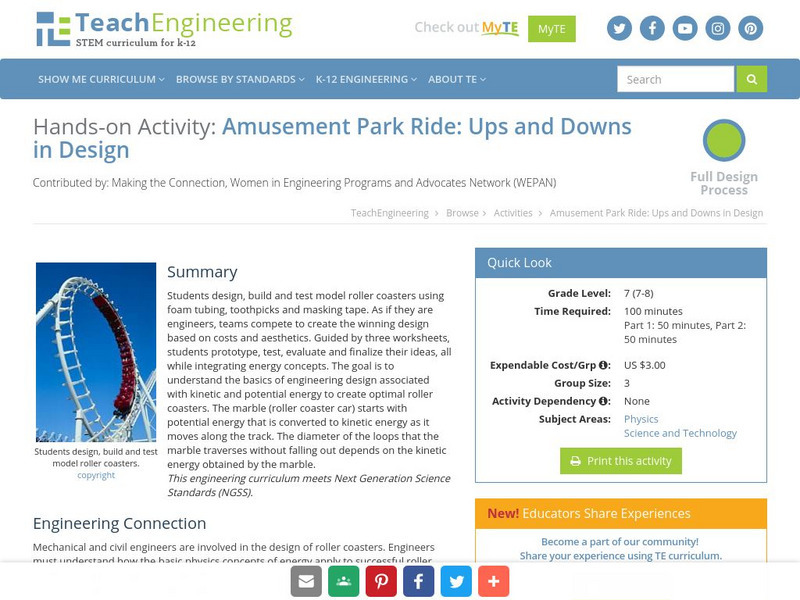
Teach Engineering: Amusement Park Ride: Ups and Downs in Design
This unit has students design and build foam tubing roller coasters. The design process integrates energy concepts as they test and evaluate their designs that address the task as an engineer would. The goal is for students to understand...

University of Colorado
University of Colorado: Ph Et Interactive Simulations: Gravity Force Lab
An interactive simulation that teaches about gravitational force, Newton's Third Law, and force pairs by varying properties affect the gravitational force exerted between two objects. This simulation can either be downloaded or played...

University of Colorado
University of Colorado: Ph Et Interactive Simulations: Gravity and Orbits
An interactive simulation that teaches about gravitational force, circular motion, and astronomy by manipulating the sun, earth, moon, and a space station to observe the effects of gravity and orbital paths. This simulation can either be...
University of Oregon
Uo: Cannon Simulator: Experimental Instructions
This virtual experiment is designed to let the student measure the relation between muzzle velocity (which determines projectile energy), gravitational potential and the effects of frictional drag caused by wind speed blowing opposite to...