Hi, what do you want to do?






Curated OER
Optical Illusion Machine
Students explore optical illusions. Using Legos, they construct and motorize a machine that has an axle that's geared up and geared down, complete a worksheet, and answer discussion questions.

Code.org
The Need for Programming Languages
LEGO see if you can recreate my design. Individuals build an arrangement from LEGO blocks and write directions for someone else to follow in order to recreate the arrangement. Pairs then swap directions and try to...

Curated OER
Simple Machines
Learners discover what simple machines are and identify a gear, a pulley, and a lever. In teams, they build at least two models each of simple machines and challenge them with specific instruction cards. Finally, students present and...

Curated OER
Levers: Catapults
Young scholars construct a catapult that shoots a cotton ball at least two meters using Legos, rubber bands, and plastic spoons. They discuss how the catapult works, and identify any problems they had with their experiment.

Curated OER
Wheel and Axle
Fifth graders construct a wheel and axle model using a Lego Dacta set. They read and discuss informational text from the book "It's Science! Machines We Use," and in small groups create a simple machine using Legos.

Curated OER
Pulleys and Levers
Fifth graders explore the concept of pulleys and levers. They read and discuss text from the book "It's Science! Machines We Use," and in small groups construct a simple lever and pulley using a Lego Dacta set.

Curated OER
Roll with the Punches: Depression Era Machinery
Students construct models of simple and complicated machines with Legos. Then they design an experiment using the scientific method. ESE modifications included.

Curated OER
Cross Country Adventure
Pupils practice measurement and geography in this instructional activity. They build a Lego vehicle using an RCX. They predict how many seconds it will take their vehicle to reach a specific state on the United States of America map that...

Teach Engineering
About Accuracy and Approximation
How accurate are robots? Groups draw lines by moving robots backwards and forwards by one rotation of the wheels. Using the appropriate formula, they determine the percent error in the length of the lines in relation to the calculated...

Curated OER
A Tour of the Solar System
Young scholars construct a spacecraft out of Lego blocks and other materials. They work on their models in small groups while building. They become familar with the planets while working cooperatively.

Curated OER
Levers
Pupils brainstorm if they think that any lever would use the same amount of paperclips. They break into small groups and use a data sheet as well as a lever, Lego person, fulcrum, and some paperclips and prove what they think by taking...

Curated OER
Build a Snowplow
Students design and build a snowplow using LEGO materials. They compete in an Engineer's Challenge to clear a path through Styrofoam peanuts.

Curated OER
Egyptians as Engineers
Student design and build Lego vehicles that drag given amount of weight up an incline. They show how this demonstrates Egyptian methods of pyramid construction.

Curated OER
Wheel & Axle Tractor
Young scholars design and build a tractor using LEGO materials. They write and draw their designs.

DiscoverE
My Friend Robot
Can you do better than a robot? Teams write instructions for a hypothetical robot to build a structure. They test their instructions by acting them out to see if they produce the desired structure.

Curated OER
Choose Your Toy
In this decision-making worksheet, learners choose 1 out of 6 toys for a young boy. Students match 7 vocabulary terms to their proper definitions. Learners fill in 3 blanks in 2 sentences. Students complete a variety of assignments about...

Curated OER
Electrical motors
Learners investigate and experiement with a 9-volt motor. They will use the connecting wire and battery pack to discover fans.
TeachEngineering
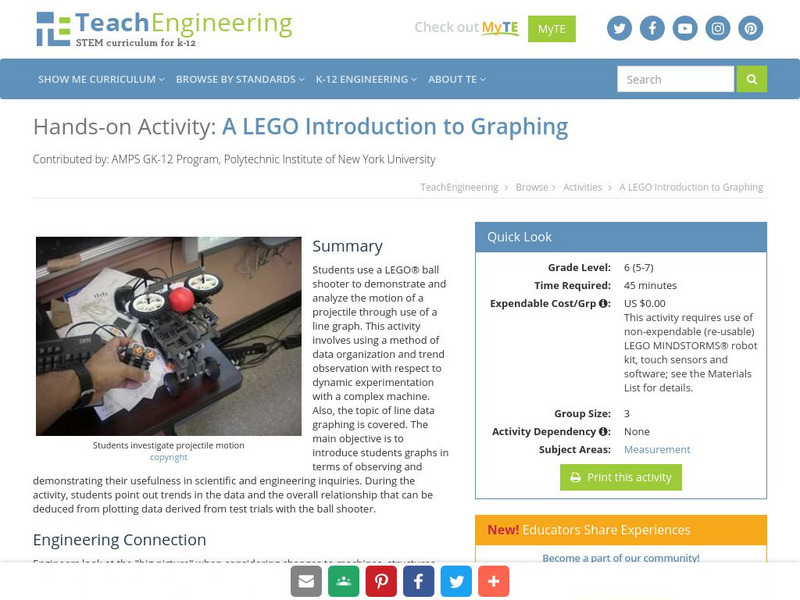
Teach Engineering: A Lego Introduction to Graphing
Students use a LEGO ball shooter to demonstrate and analyze the motion of a projectile through use of a line graph. This activity involves using a method of data organization and trend observation with respect to dynamic experimentation...
TeachEngineering
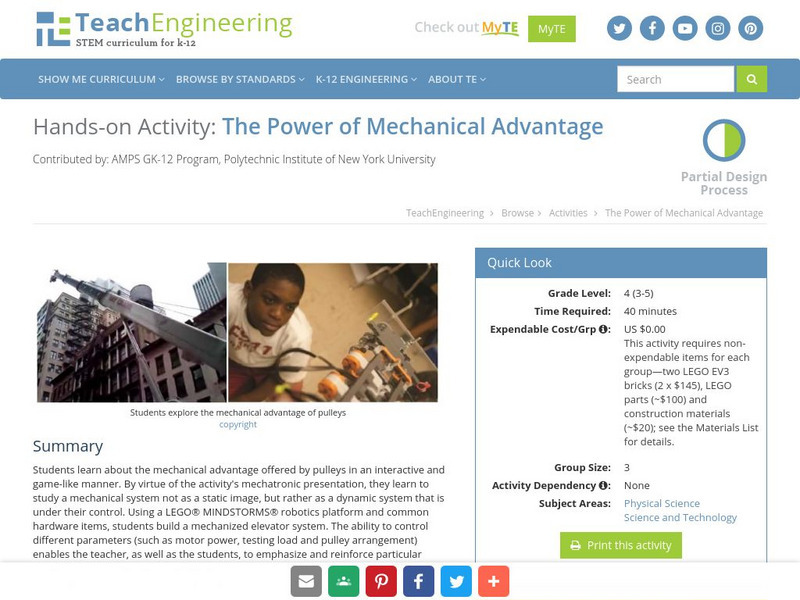
Teach Engineering: The Power of Mechanical Advantage
Students learn about the mechanical advantage offered by pulleys in an interactive and game-like manner. By virtue of the activity's mechatronic presentation, they learn to study a mechanical system not as a static image, but rather as a...

TeachEngineering
Teach Engineering: Wide World of Gears
In an interactive and game-like manner, students learn about the mechanical advantage that is offered by gears. By virtue of the activity's mechatronics presentation, students learn to study a mechanical system as a dynamic system under...
TeachEngineering
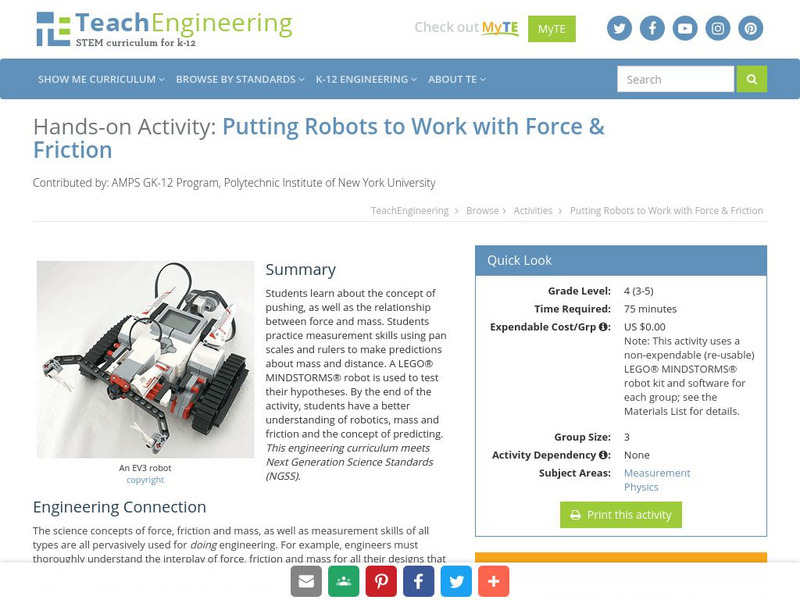
Teach Engineering: Putting Robots to Work With Force & Friction
Students learn about the concept of pushing, as well as the relationship between force and mass. Students practice measurement skills using pan scales and rulers to make predictions about mass and distance. A LEGO MINDSTORMS NXT robot is...
![Robotc: Thinking About Programming: Programmer & Machine [Pdf] Article](https://statictemp.lp.lexp.cloud/images/attachment_defaults/resource/large/FPO-knovation.png "Robotc: Thinking About Programming: Programmer & Machine [Pdf] Article")
Other
Robotc: Thinking About Programming: Programmer & Machine [Pdf]
In this lesson, students learn about the roles of the programmer and the robot, and how the two need to work together in order to accomplish their goal. Students also understand logic behind the robot's actions, and break a big plan down...
Museum of Science
The Museum of Science: Sketch Gadget Anatomy
The Museum of Science provides this site that shows the activity in which young scholars sketch all the elements of a compound machine describing each component's function. Also includes an extension activity for homework.
TeachEngineering
Teach Engineering: What Is a Motor? How Does a Rotation Sensor Work?
Students learn about electric motors and rotational sensors. They create a basic program using the LEGO MINDSTORMS NXT interface to control a motor to move a small robot.