Hi, what do you want to do?






Curated OER
Create a Classroom Exhibit: Rocks and Minerals
Young scholars bring in rocks and minerals from home. They observe them and describe them carefully, completing a worksheet. Finally, a classroom exhibit is created.

Curated OER
Prairie Food Chains & Webs
Learners complete a food chain. In this ecosystem lesson, students learn about producers, consumers and decomposers. Learners identify herbivores, carnivores and omnivores and complete two worksheets.

Curated OER
Water Quality Testing
Student explore factors affecting ecosystems. They test local water samples for pH level. After creating a methodology for data collection, they collect data, compare results, and draw conclusions based upon results.

Curated OER
The Biological Carbon Cycle
Students learn about the biological carbon cycle. In this carbon cycle lesson, students access the web site and mouse over the diagrams to follow the carbon cycle. They read about what happens to humans and plants during this cycle.

Curated OER
Breaking News English: Laboratory-Created Eggs and Sperm
In this English worksheet, learners read "Laboratory-Created Eggs and Sperm," and then respond to 47 fill in the blank, 7 short answer, 20 matching, and 8 true or false questions about the selection.

Curated OER
All Caught Up!
Students discover the difficulty involved in trying to isolate a target species by fisherman. They discuss this issue and its problems as a class. They examine how bycatching affects their lives.

Curated OER
Dino Fossils
Primary paleontologists discover the information they can gather from examining fossils. They place pictures in the correct sequence showing how an animal becomes a fossil. They discuss which sediments would preserve fossils better as well.

Curated OER
Food Chains and Webs--- "What's for dinner?"
Students study food chains and how the organisms are linked. For this investigative worksheet students answer food chain questions, and fill out several worksheets.

Curated OER
Create a Non-native/Invasion Species
Learners view a video about non-native/invasion species. They create a non-native/invasion species that they think would have an impact on farming, industry, recreation, or water in the local environment.

Curated OER
Magnificent Metamorphosis
Students discover stages in metamorphosis through up close and real encounters with video, hands-on investigative and interactive activities using mealworms.

Curated OER
The Nitrogen Cycle
Young scholars design and create a compost pile in order to study the Nitrogen Cycle. They then use the scientific method to determine if plants grow better when they add organic matter from their compost pile to the plant's soil.

Curated OER
Food Web Relationships
In this food web instructional activity, students create a food web matrix and answer short answer questions about the food chain according to the matrix. Students complete 7 short answer questions.

Curated OER
Is It Getting Hot In Here?
High schoolers describe several factors and ways climate change could effect communities. In this climate change lesson students research climate change and complete a worksheet.

Curated OER
Printable Blank Handwriting Paper
In this handwriting skills worksheet, students practice writing on a free writing topic on the lined paper provided for them to write on.

Curated OER
Endangered Species Research
Seventh graders research animal species using the library. In this research lesson students are given an animal species to research in the library.

Curated OER
Investigate Non-native Neighborhood Invasion Species
Students investigate non-native species that are invading local or state environments. They choose one species to research and report on.

Curated OER
Breaking News English: The Chicken Came Before the Egg
For this English worksheet, students read "The Chicken Came Before the Egg," and then respond to 1 essay, 47 fill in the blank, 7 short answer, 20 matching, and 10 true or false questions about the selection.

Curated OER
Home on the Biome
Fifth graders study six major biomes, graph temperature and rainfall, and present their findings to the class.

Curated OER
I Depend on You, You Depend on Me!
Students explore the interdependency between humans and the ecosystems. They examine how uncontrolled development threatens the rain forests. They discuss how human actions affect the rain forest.

Curated OER
Yard Sale
Pupils complete activities to discover spending, goods, services, price, advertising, choice, alternatives, criteria and opportunity cost.
E-learning for Kids
E Learning for Kids: Science: Hawaii: What Are the Life Processes in Animals?
Kamoku is a boy from Hawaii who is interested in the seven life processes. Do you know what these are? Join Kamoku and discover them with him.
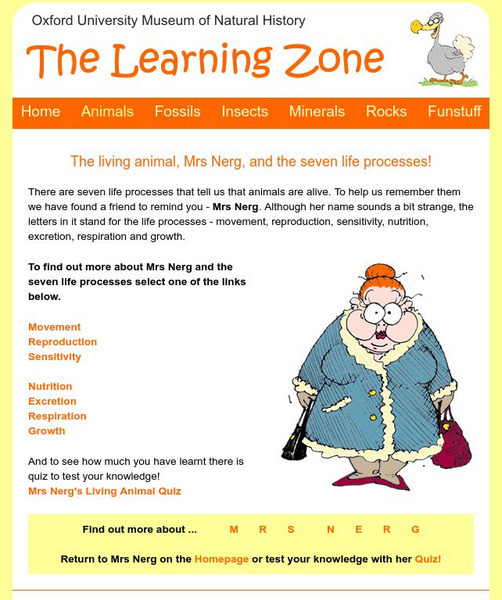
University of Oxford (UK)
Oxford University Museum of Natural History: Seven Life Processes
Explore the seven life processes that describe whether an animal is alive or not. Each characteristic is defined with examples and pictures. Also included is a living animal quiz to test how much you have learned.
University of Oxford (UK)
The Learning Zone: Animals
Learn all about the study of animals--zoology through this interactive website. You will learn about the processes that make animals alive, what makes them endangered or extinct, and the tree of life.
Wisc-Online
Wisc Online: Lifecycles of Animals and Plants
This segment covers the lifecycles of various plants and animals. Illustrations begin with the production of a gamete and describe the processes that occur throughout the lifespan of living creatures.