Hi, what do you want to do?






It's About Time
The Electricity and Magnetism Connection
Magnets don't grow in fields, but magnetic fields are important to understand. The lesson covers the effect electricity has on magnetic fields. Scholars use a compass, magnets, and electrical wire to test magnetic fields and energy...

Ascanius: The Youth Classics Institute
Anatomy and Simple Commands
Poor Joe is all in pieces, and he needs young scholars to learn the Latin words for his body parts so that they can put him back together! Learners work as a class first to perform whole-body reconstruction, and then individually. In...

National Institute of Open Schooling
Occurrence and Extraction of Metals
Steel is a man-made alloy or a mixture of metals. Lesson 18 in this series of 36 focuses on metals and their extraction from Earth. Individuals read about, discuss, and answer questions after learning how people find most metals, the...

National Institute of Open Schooling
d-Block and f-Block Elements
Potassium permanganate, containing manganese one of the transition elements, has many uses such as mouthwash and propelling rockets, making it is a very diverse compound. The lesson delves into such transition elements and...

International Technology Education Association
Tidy Up Those Sloppy Force Fields!
It is just magnetic. This resource presents the concept of Earth's and another planet's magnetic field and how spacecrafts detect them. Learners study a problem using magnetometers and participate in three experiments to come up with a...

Curated OER
Rocks and Minerals
Take young geologists on an exploration of the collection of rocks and minerals that we call Earth with an upper-elementary science lesson. Through a series of class discussion and hands-on investigations, students learn about the...

It's About Time
AC and DC Currents
An informative physics lesson includes two teacher demonstrations, one on AC currents and the other on DC currents, allowing pupils to take notes while watching. The resource includes questions to assign as homework or...

University of Notre Dame
Safe Science Lab Safety Awareness
Prepare young scientists for the ins and outs of lab safety with a thorough list of symbols, icons, and rules about staying safe during experiments. Additionally, the resource provides several assessment pages for kids to reflect on what...

It's About Time
Electromagnets
Young scientists build their own electromagnet and test it by picking up paperclips. Analysis questions evaluate knowledge at the end of the activity.

Chapman University
The Standard Model Poster
Chemistry classes will appreciate this color-coded, single-page reference sheet for The Standard Model of particle physics. It is divided into two main sections: elementary particles and compound particles, both with their antiparticles....

National Institute of Open Schooling
Coordination Compounds
Cyanide, a coordination compound, is used in the extraction of gold and silver. Part 24 in the series of 36 delves into the world of coordination compounds. Classes learn, through readings, discussions, and answering questions, how to...

American Association of Physics Teachers
Com Padre Digital Library: Open Source Physics: Magnetic Bar Field Model
A bar magnet model built by placing a group of magnetic dipoles along the magnet. This simulation shows the magnetic field of a bar magnet, and has a movable compass which shows the magnetic field values.
Physics4kids
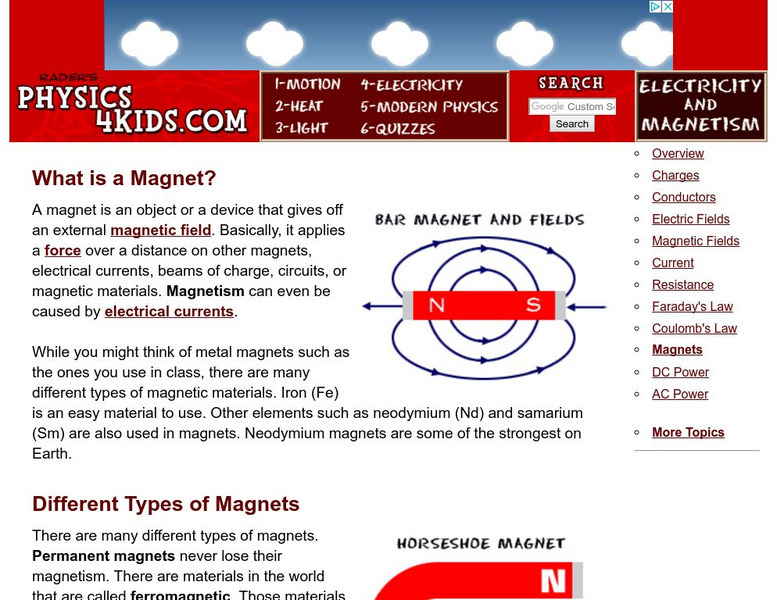
Physics4kids: Electricity and Magnetism: Magnets
Here is the site to help you learn all about magnetism and magnets! Find out what a magnet is and how it works. Click for additional details on charges, conductors, magnetic fields, currents, resistance as well as the Laws of Faraday and...
Georgia State University
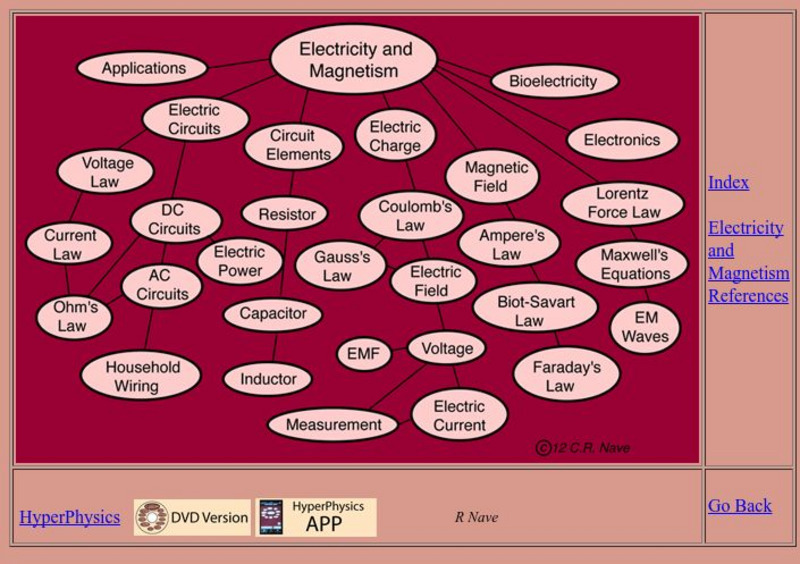
Georgia State University: Hyper Physics: Electricity and Magnetism
HyperPhysics is an exploration environment for concepts in physics by Georgia State University which employs concept maps and other linking strategies to facilitate smooth navigation. This section focuses on electricity and magnetism.
National High Magnetic Field Laboratory
Magnet Academy: Roland Eotvos
Vasarosnamenyi Baro Eotvos Lorand, better known as Roland Eotvos or Lorand Eotvos throughout much of the world, was a Hungarian physicist who is most recognized for his extensive experimental work involving gravity, but who also made...
National High Magnetic Field Laboratory
Magnet Academy: Svante Arrhenius
Svante Arrhenius was born in Vik, Sweden, and became the first native of that country to win the Nobel Prize. The award for chemistry was bestowed to him in honor of his theory of electrolytic dissociation. Arrhenius also developed the...
National High Magnetic Field Laboratory
Magnet Academy: Robert Millikan
Robert Andrews Millikan was a prominent American physicist who made lasting contributions to both pure science and science education. He is particularly well known for his highly accurate determination of the charge of an electron via...
National High Magnetic Field Laboratory
Magnet Academy: Richard Feynman
Theoretical physicist Richard Phillips Feynman greatly simplified the way in which the interactions of particles could be described through his introduction of the diagrams that now bear his name (Feynman diagrams) and was a co-recipient...
National High Magnetic Field Laboratory
Magnet Academy: Superconductivity 101
An overview of the history, applications and science of superconductivity, including the Meissner effect, BCS theory, Type 1 and Type 2 superconductors and high-temperature superconductivity.

Florida State University
Florida State University: Vision and Color Perception
A high-level scientific explanation of the way the eye senses light and sees images and color. Excellent graphics help you visualize complex workings of the human eye.
National High Magnetic Field Laboratory
Magnet Academy: Felix Bloch (1905 1983)
Physicist Felix Bloch developed a non-destructive technique for precisely observing and measuring the magnetic properties of nuclear particles. He called his technique "nuclear induction," but nuclear magnetic resonance (NMR) soon became...
National High Magnetic Field Laboratory
Magnet Academy: Paul Lauterbur
Chemist Paul Lauterbur pioneered the use of nuclear magnetic resonance (NMR) for medical imaging. He developed a technique, now known as magnetic resonance imaging (MRI), in the early 1970s that involves the introduction of gradients in...
National High Magnetic Field Laboratory
Magnet Academy: William Gilbert
William Gilbert was an English physician and natural philosopher who wrote a six-volume treatise that compiled all of the information regarding magnetism and electricity known at the time. The work included descriptions of many of...

Khan Academy
Khan Academy: What Are Magnetic Fields?
Learn what magnetic fields are and how to calculate them with this reference page.