Hi, what do you want to do?






Newseum
Editorials and Opinion Articles
Reading the news is fun, and that's a fact! With the lesson plan, scholars differentiate between fact and opinion as they read editorial articles. They complete a worksheet to analyze the information before writing their own editorials...

Media Smarts
Fact versus Opinion
Part of a series aimed at breaking down cultural bias from the Canadian Media Awareness Network, this activity identifies where opinions do and don't belong in a newspaper. Pupils review handouts about the purpose of editorial comments...

Media Smarts
Media Awareness Network: Hate or Debate?
Discuss the difference between legitimate debate on a political issue and arguments that are based on hate through a science-fiction scenario that shows how a controversial issue can be discussed in both ways. Then learn how purveyors of...

Media Smarts
You Be the Editor
Look at different case studies to discuss the ethics of journalism. Twelve real-life events are written up and your learners get to be the editors. Encourage your class to think about the implications of publishing decisions. After each...

Newseum
Believe It or Not? Time to Talk Back
Young journalists select a news story, editorial, or opinion piece that they disagree with or one that leaves them with questions. They then create their report in response and share it with the class.

American Press Institute
Newspapers in Your Life: What’s News Where?
Big news isn't necessarily newsworthy everywhere! How do journalists decide what to cover with so much happening around them? A instructional activity on media literacy examines the factors that affect the media's choice of stories to...

Curated OER
"No News Like Ancient News"
Want to know more about Ancient history? Young historians will read a minimum of two web sites to complete the chart "Residents of Olympus". They choose one Greek god or goddess to research. This could be a small group activity or...

Brown University
Following the U.S. Presidential Election
Election years provide the opportunity to evaluate news media as well as the next prospective president. High schoolers read about the same event in several different news sources, varying in type, origin, and political leaning,...

American Press Institute
In the Newsroom: The Fairness Formula
Reporting the news is easy, right? Think again! Show young scholars the difficult choices journalists make every day through a lesson that includes reading, writing, and discussion elements. Individuals compare the language and sources...

Curated OER
Macbeth News Broadcast
Here is an authentic assessment task for Shakespeare's Macbeth. Young literature scholars prepare, perform, and record a news broadcast about the major events in the play. For example, groups may choose to report on the death of Lady...

Social Media Toolbox
Social Media Roles
Social media has changed the news publishing process, so how does it affect school news publications? Lesson nine in a 16-part series titled The Social Media Toolbox explores the traditional publishing roles through the lens of social...

Online Publications
Become a Journalist
Explore the newspaper as a unique entity with a detailed and extended unit. The unit requires learners to consider the newspaper's role in democracy, think about ethics, practice writing and interviewing, and examine advertising and news...

PBS
Facts vs. Opinions vs. Informed Opinions and their Role in Journalism
Do reporters write about what they see, or what they think? Examine the differences between investigative writing and opinion writing with a lesson from PBS. Learners look over different examples of each kind of reporting, and convince...

PBS
Interviewing: The Art of Asking Questions
Interviewing skills are important, even outside of a news reporter's desk or employer's office. Take your class through the process of interviewing people they don't know with a set of case studies featuring journalists and various...

Social Media Toolbox
Social Media Messages
What are the elements of a good social media post? The 13th activity in the 16-part Social Media Toolbox incorporates all of the typical components found in a Facebook or Twitter post. Scholars work together to create great posts based...

Curated OER
Peer Pressure
Students talk about how their peers can influence their behavior. In this peer pressure lesson, students complete a KWL chart on peer pressure, read a handout on peer pressure and break into groups to discuss the information. Students...

Curated OER
Returning to the South
Learners write feelings about the concept of Home. They discuss reasons for leaving home. They read "Return South Migration" and in groups interview each other about the narrative. They complete a worksheet and write an editorial for the...

Newspaper Association of America
Press Ahead!
Give class members some great news! A media unit teaches individuals about ethics, parts of a newspaper, business writing, photojournalism, and more topics that have to do with the press. Full of material for a variety of learners,...

Curated OER
Global Environmental Issues: Air and Water Pollution
Thinking about designing a project for your social studies or environmental science classes? Use an overview of a project that prompts class groups to research an environmental issue.

Curated OER
Polished Poetry: Strange Zoo
Fourth graders use an online word list editor and software to create opening lines for a poem. They select and edit these into a complete, polished poem about an animal. They investigate parts of speech and alliteration.

Curated OER
Computers: Copyright Law
Students visit various Websites to find information about copyright laws. Their research includes information about legal and ethical behaviors regarding Internet use. In addition, students complete online student activity sheets.

Curated OER
News to the Core Reported by Very Special Students
Students create news articles that help them build their knowledge, skills, and academic confidence. In this special education lesson, students use previous knowledge to write a newsletter and demonstrate their understanding of various...
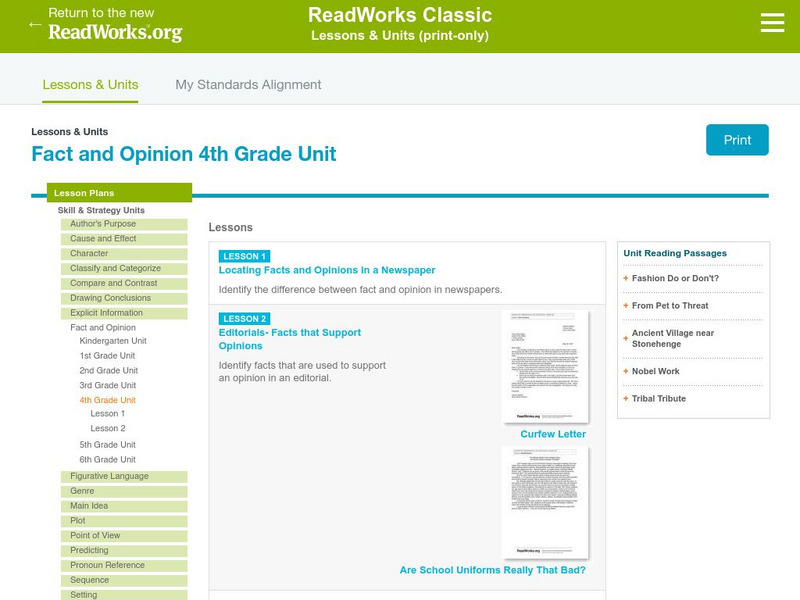
Read Works
Read Works: Fourth Grade: Two Lesson Unit: Fact and Opinion
[Free Registration/Login Required] A two-lesson plan unit on fact and opinion through which students identify facts and opinions in a newspaper article and understand how facts support opinions in an editorial. With free login, users...

Alabama Learning Exchange
Alex: Newspapers: Facts and Opinions
In order to sharpen a student's understanding of the differences between facts and opinions, this lesson incorporates both the close reading of a newspaper and the writing of a factual article and a letter to the editor.