Hi, what do you want to do?






Facing History and Ourselves
The Legacies of Reconstruction
The final lesson in the seven-resource Reconstruction Era collection examines the legacies of Reconstruction. Class members investigate why the period has been called an "unfinished revolution," "a splendid failure," and "the second...

Alabama Department of Archives and History
Alabama Tenant Farmers and Sharecroppers, 1865 to Present
The tenant farming and sharecropping systems that developed in the South after the Civil War, the reasons for their development, and the eventual decline of these systems are the focus of this two-day plan.

Curated OER
Reconstruction
Students describe the period of Reconstruction. Then students describe the concept of sharecropping. They complete a vocabulary prediction confirmation activity for the vocabulary words from the passage.

Curated OER
Reconstruction (1865–1877)
In this online interactive history learning exercise, students respond to 7 short answer and essay questions about the causes and effects of Reconstruction following the American Civil War.

Core Knowledge Foundation
The Civil War
A unit covers many aspects of the Civil War. Over six weeks, fifth graders delve deep into the history of slavery, the Civil War—before, during, and after—Abraham Lincoln, women's contributions, the Emancipation Proclamation, and...

Curated OER
Where Do We Go From Here?
Eighth graders examine the impact of Reconstruction on South Carolina. In this Reconstruction lesson plan, 8th graders use primary documents to research sharecropping and freedman's contracts in the agricultural South following the end...

Core Knowledge Foundation
The Civil War
A student reader shares information about the history of slavery, the Civil War, President Abraham Lincoln, women's contributions to the war, the Emancipation Proclamation, and reconstruction.

Center for History and New Media
Growing Up in a Segregated Society, 1880s–1930s
What did segregation look like in the beginning of the 20th century? Middle and high schoolers view images of segregated areas, read passages by Booker T. Washington and W.E.B. DuBois, and come to conclusions about how the influence of...

Curated OER
Civil Rights through Photographs
Students examine why racial tensions continued after laws were put into place to try and create equal treatment. In this two part Civil Rights lesson, students explored the causes of the movement through photography and a...

Curated OER
Kensington Mansion: Plantation, Sharecroppers, Tenants
Eleventh graders investigate the significance of the Kensington Mansion. In this South Carolina history lesson, 11th graders take field trips to the mansion and research primary and secondary sources about plantations, sharecropping, and...

Curated OER
Freedmen's Bureau: Labor Contract or Re-enslavement?
Students examine the topics of the Freedman's Bureau and labor contracting. They analyze the economic conditions in Alabama after the Civil War. They draw conclusions about the problems with sharecropping.

Curated OER
Images from South Carolina Cotton Mills
Fifth graders write a paragraph comparing their lives to the lives of a child working in South Carolina during the early 1900's. In this Industrial Revolution lesson plan, 5th graders explore primary and secondary sources to teach them...

Curated OER
Living on a Cotton Farm: Mexican Americans Life In Texas
Seventh graders are introduced to the processes of cotton farming in the early 20th century. In groups, they examine the role of Mexican Americans on the farms and the impact of a boom and bust economy on cotton. They identify the...

Curated OER
Life on Two Colonial Plantations in South Carolina
Fourth graders compare two colonial plantations. For this South Carolina history lesson, 4th graders compare the Drayton Hill plantation of Charleston Co. to the Walnut Grove Plantation of Spartanburg Co. This lesson plan uses primary...

Curated OER
From Slavery to Segregation
Students study the causes and effects of slavery and segregation. They write an essay (including either pictures, charts, graphs or copies of documents to support their essay) which addresses the African American's journey from slavery...
Stanford University
Sheg: Document Based History: Reading Like a Historian: Sharecropping
[Free Registration/Login Required] Students solve a problem surrounding a historical question by reading primary source documents. This historical inquiry lesson allows students to critically evaluate their classroom textbook's account...
Other
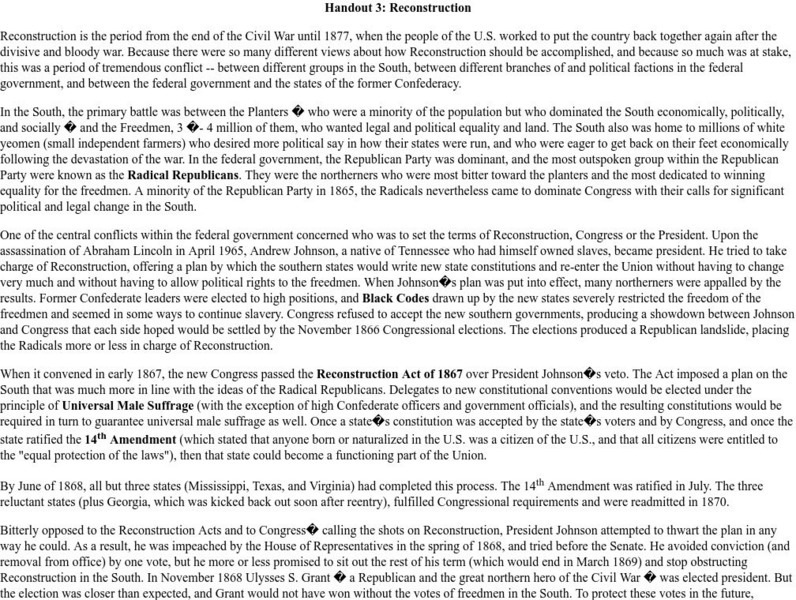
University of Western Georgia: Reconstruction in the South
An excellent distillation of the many issues addressed in the Reconstruction period in the South in the twelve years after the end of the Civil War.
OpenStax
Open Stax: The Collapse of Reconstruction
This section from a chapter on "The Era of Reconstruction" explains the reasons for the collapse of Reconstruction and describes the efforts of white southern "redeemers" to roll back the gains of Reconstruction.
Stanford University
Sheg: Document Based History: Read Like a Historian: Civil War Reconstruction
[Free Registration/Login Required] In the Civil War and Reconstruction unit, students engage in contentious historiographic debates about the period: Was Lincoln a racist? Was Reconstruction a success or failure? Was John Brown a...

Georgia Humanities Council and the University of Georgia Press.
New Georgia Encyclopedia: Sharecropping
Features a detailed discussion of sharecropping, a labor system that developed in Georgia after the Civil War in which workers raised crops for someone else in exchange for a share of the crop.

CommonLit
Common Lit: Text Sets: Reconstruction to Jim Crow
After the Civil War and end of slavery, Americans had to decide how to integrate freed African Americans. Learn about the lives of African Americans from Reconstruction to the end of the prejudiced Jim Crow era. This collection includes...
Georgia Humanities Council and the University of Georgia Press.
New Georgia Encyclopedia: Reconstruction in Georgia
After the Civil War ended, Georgia was in a state of chaos. Learn all about the Reconstruction in Georgia from 1865-1871 and how it changed the state politically, socially, and economically.
National Humanities Center
National Humanities Center: Toolbox Library: Reconstruction: African American Identity: 1865 1917
An interview, government reports, two paintings, and a work song that explore the constraints placed upon African American freedom in the late-nineteenth century as a result of reconstruction.

PBS
Pbs: Slave to Sharecropper
This collection of resources examines the life and work of freed slaves after the Civil War. Includes questions and answers on sharecropping in the American South, as well as a personal account from a former slave who became a sharecropper.