Hi, what do you want to do?






Nature
Non-Structural Hazards
Buildings often have decorative components and furnishings that can pose a hazard during an earthquake. Learners examine the classroom for such non-structural features. They consider fictional scenarios and discuss what actions...

Curated OER
Landslides, Liquefaction, and Structural Failure
Students use both online and hands-on activities to become familiar with landslides, liquefaction, and structural failure caused by earthquakes. They identify that shaking can result in damage in the form of structural failure. In...

Teach Engineering
Fairly Fundamental Facts About Forces and Structures
Don't twist and turn looking for a resource. The first installment of a six-part series teaches young engineers about the five fundamental forces of compression, tension, shear, bending, and torsion. These forces help explain different...

Teach Engineering
Stop the Stretching
Stretch your teaching repertoire with an experiment on the elongation (stretching) and failure (break) of several materials. The point of the experiment is to design a composite material for chair webbing.

Teach Engineering
Skeletal System Overview
It is best to know all about the skeletons in the closet. The third segment in a five-part series focuses on bone structure, development and growth, and functions. Class members connect what they learn to their study of...

Teach Engineering
Fun Look at Material Science
Introduce materials science with a class demonstration. After showing a PowerPoint presentation on materials and their properties, instructors provide a ceramic tile, a Popsicle stick, a paper clip, and a plastic bag as examples of...

Institute of Electrical and Electronics Engineers
Sticky Engineering Challenge
Young scholars explore the properties of different adhesives. In this physics lesson plan, students construct a building structure and determine what glue to use in the process. They present their design in class.

Curated OER
Testing the Caverns
Middle schoolers build model caverns using paper mache or clay and bury them in a tray of sand. They test the models by dropping balls onto them to simulate an asteroid hitting the earth. They evaluate the effectiveness of a structure...

Curated OER
Seismic Waves
Learners identify the four types of seismic waves, their characteristics and effects. Then they predict the level of damage each wave might cause in a residential area and test their predictions against several computer animations. ...

Teach Engineering
Mechanics of Elastic Solids
Make the connection between Hooke's law and elasticity with an activity that introduces the class to the behavior of elastic materials. The resource defines stress and strain to calculate the modules of elasticity of...

Teach Engineering
What Makes Our Bones Strong?
So is that what you meant by rubber legs? The activity has pairs subject a chicken bone to vinegar and observe what happens over a period of days. Individuals then write up a lab report and document their observations and findings.

Teach Engineering
Exploring the Forces of Tension
Let the resource stretch the minds of your young scientists with a lesson about tensile strength and stiffness of materials. Groups consider how easily materials stretch and relate this property to engineering design.

Curated OER
TE Activity: Built to Last?
Fifth graders test the shelters that were built in a prior activity. They determine the level of durability and water resistance of these shelters through a scientific investigation.
![Tech Museum: Building for the Big One [Pdf] Lesson Plan](http://lessonplanet.com/content/resources/thumbnails/411264/large/bwluav9tywdpy2symdiwmduymc0xmdm2my0xd3vtenpxlmpwzw.jpg?1589993199 "Tech Museum: Building for the Big One [Pdf] Lesson Plan")
Other
Tech Museum: Building for the Big One [Pdf]
This resource presents a project where learners design and build structures that can withstand an earthquake. The project can include an extension where students look at the factors of soil type and proximity to fault in their design....

TeachEngineering
Teach Engineering: Truss Destruction
Students work within constraints to construct model trusses and then test them to failure as a way to evaluate the relative strength of different truss configurations and construction styles. Each student group uses Popsicle sticks and...
TeachEngineering
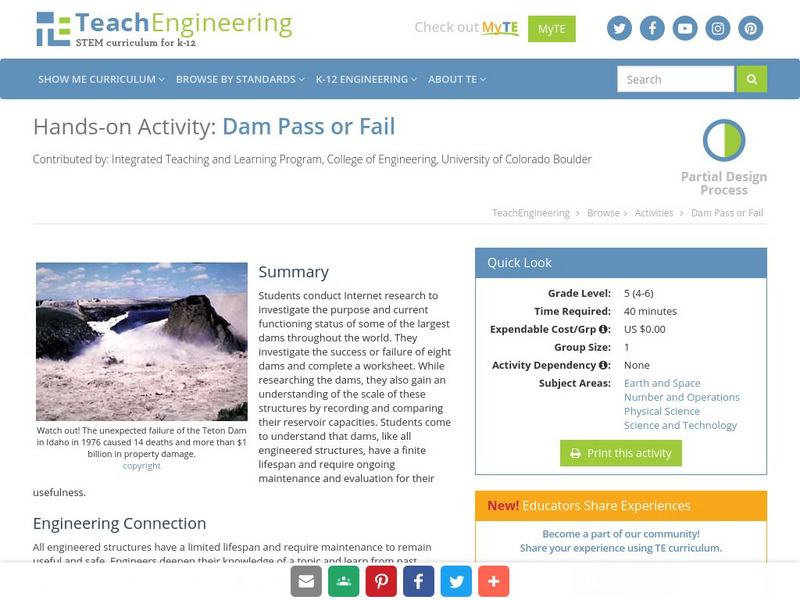
Teach Engineering: Dam Pass or Fail
Students conduct Internet research to investigate the purpose and current functioning status of some of the largest dams throughout the world. They investigate the success or failure of eight dams and complete a worksheet. While...
TeachEngineering
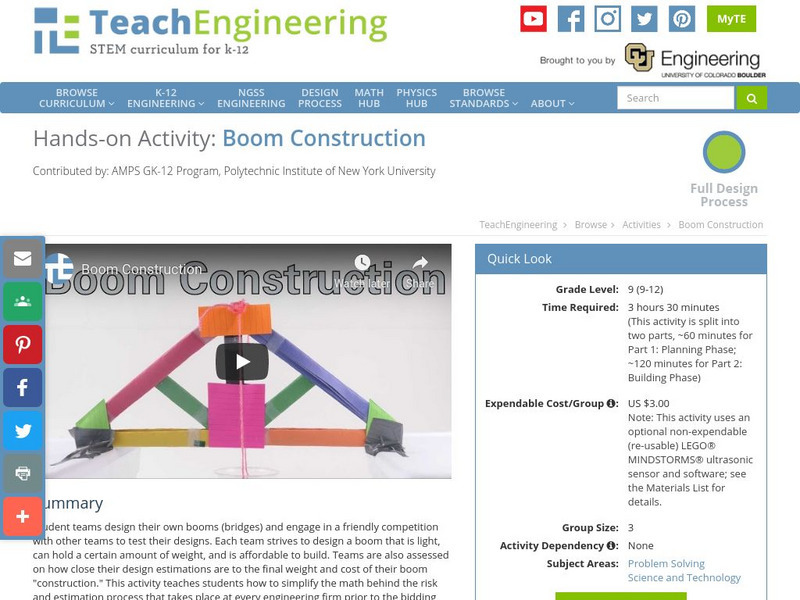
Teach Engineering: Boom Construction
Student teams design their own booms (bridges) and engage in a friendly competition with other teams to test their designs. Each team strives to design a boom that is light, can hold a certain amount of weight, and is affordable to...
TeachEngineering
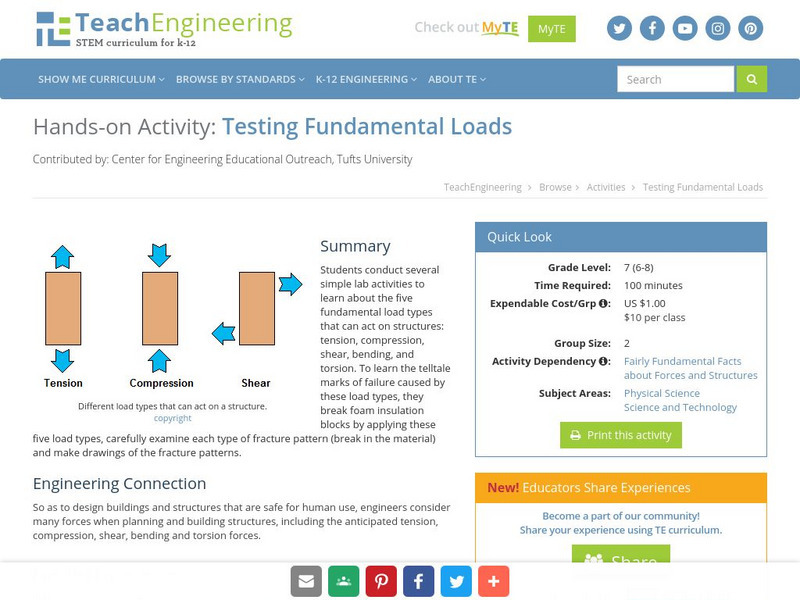
Teach Engineering: Testing Fundamental Loads
Students will conduct several simple lab activities to learn about the five fundamental load types that can act on structures: tension, compression, shear, bending, and torsion. In this activity, students break foam insulation blocks by...