Hi, what do you want to do?






Columbus City Schools
Changes All Around Us
Whoa! What just happened? That's right, change is everywhere. But what exactly is changing? Middle school science sleuths get to the bottom of the changes matter can experience. Through simple demonstrations, engaging videos, and an...

American Chemical Society
Energy Foundations
Only 10 percent of an incandescent bulb's energy is used to create light; the remaining 90 percent is heat. In the unit of activities, young chemists examine energy through hands-on activities, videos, discussions, and...

National Library of Medicine
Your Environment, Your Health: Air Quality
Some scientists argue that air pollution now causes more deaths than smoking. The second unit in a six-part series focuses on air quality. Scholars learn what's in the air, how clean the air around their school is, and what they can do...

Royal Society of Chemistry
Energy—Gifted and Talented Chemistry
What has more energy than a room full of pupils after a fire drill? This lesson plan! Explore the changes in energy during different chemical reactions, discover why some reactions feel cold and others feel hot, and tackle the concept of...

Government of South Australia
Don't Waste Your Energy
Don't lift another finger, this physical and environmental science unit has everything you need to begin teaching your class about energy. Starting with a look at the greenhouse effect, these lessons and activities take young scientists...

CCEA
Home Economics: Teen Building
Learners explore the emotional and nutritional needs of teenagers in a six-lesson unit, which covers such topics as food sources, cooking skills, emotional well-being, and the positive effect of food and family occasions.

Royal Society of Chemistry
Colour—Gifted and Talented Chemistry
Add a splash of color to your chemistry class! Science scholars discover the principles behind color through a wide variety of hands-on activities. Lessons include dyes, chromatography, and flame tests.

Next Generation Science Storylines
Why Do Some Things Get Colder (or Hotter) When They React?
Some reactions absorb heat while others release it. Young scholars investigate both types of reactions in a 12-lesson unit. Each lesson presents a lab investigation that monitors temperature and considers the types of reactions taking...

Curated OER
The Brain’s Inner Workings
Do you want to learn about how you learn? Help pupils become the best learners they can be by teaching them how their brain works. The resources available include videos about brain structure and a study guide full of activities that...
E-learning for Kids
E Learning for Kids: Science: Mediterranean Sea: What Are Reversible and Irreversible Changes?
Students will learn about reversible and irreversible changes in materials in this lesson.

E-learning for Kids
E Learning for Kids: Science: Greek Theater: What Are Reversible and Irreversible Changes?
Join Leander in his chemistry lesson, and learn about the change of different types of substances.
E-learning for Kids
E Learning for Kids: Science: Netherlands: What Are Permanent and Temporary Changes?
In this lesson, students match a substance with its state of matter, identify what state something is, and learn about temporary and permanent changes in matter.
CK-12 Foundation
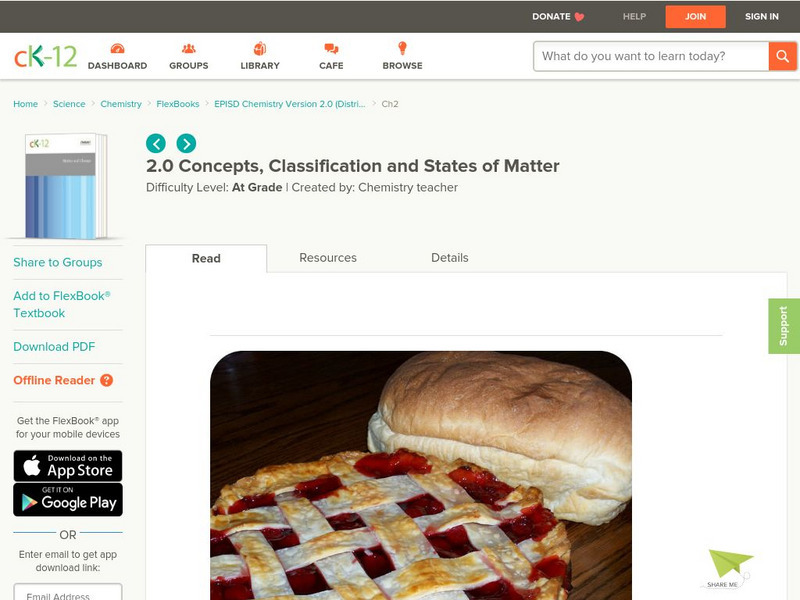
Ck 12: Concepts, Classification and States of Matter
[Free Registration/Login may be required to access all resource tools.] Freshly baked bread and cherry pie are two delicious parts of any meal. What happens to the ingredients that go into the bread and the pie as they are heated in the...
CK-12 Foundation
Ck 12: Limiting Reactant and Percent Yield
[Free Registration/Login may be required to access all resource tools.] Students will compare theoretical yield to actual yield, and then investigate what happens when one reactant runs out before the other reactants are fully consumed....