Hi, what do you want to do?






EngageNY
TASC Transition Curriculum: Workshop 15
What do a cheetah, Audi commercial, and air have in common? They're all topics of an engaging inquiry-based, hands-on workshop for educators about background knowledge, reading strategies, the CER model, and argumentative writing. The...

National Humanities Center
Teaching The Great Gatsby: A Common Core Close Reading Seminar
The 41 slides in a professional development seminar model how to use close reading techniques to examine the many layers of F. Scott Fitzgerald's The Great Gatsby. In addition to passages from the novel, slides provide biographical...

EngageNY
TASC Transition Curriculum: Workshop 8
Lights, camera, action! Math educators consider how to improve their instruction by examining a model of the five-practice problem-solving model involving a movie theater. Participants examine cognitive demand in relation to problem...

New York State Education Department
TASC Transition Curriculum: Workshop 10
How have educational standards evolved? Educators of adults examine expectations in the 10th workshop out of 15 to better determine how standards have grown. Participants respond to a variety of sample questions to determine how they...

New York State Education Department
TASC Transition Curriculum: Workshop 3
Teachers turning into high schoolers? It's not Freaky Friday! It's a thoughtful workshop that teaches participants how to plan professional development for staff. Third in a 15-part series, the workshop provides a platform for the other...

New York State Education Department
TASC Transition Curriculum: Workshop 11
You'll C-E-R a difference in classroom achievement after using a helpful instructional activity. Designed for economics, civics, government, and US history classes, participants practice using the CER model to craft arguments about...

Indiana Department of Education
Social Emotional Toolkit
Looking for some tools to help you incorporate social and emotional learning into your curriculum? Then check out this 79-page kit packed with ideas for developing social-emotional learning competencies. The first section provides...

EngageNY
TASC Transition Curriculum: Workshop 12
How can opinions slant facts? Workshop participants learn how to examine primary and secondary sources and identify the author's point of view. They also examine how visual art impacts the meaning and rhetoric of sources. Full of...

New York State Education Department
TASC Transition Curriculum: Workshop 5
Are video games sports? Pupils investigate this question as well as various nonfiction selections to learn more about claims and the support that defines them. All of the selections mimic the rigor on state tests and encourage close...

New York State Education Department
TASC Transition Curriculum: Workshop 2
Flipped classrooms and online tools killed the chalkboard! An awesome, hands-on technology workshop asks teachers across all content areas. to examine model lessons, become familiar with research, and explore tech tools they can...

New York State Education Department
TASC Transition Curriculum: Workshop 7
Designed specifically for math instructors, the seventh workshop of a 15-part series allows time to explore Webb's DOK, ponder open-ended questions, and create lessons to apply what is learned. Teachers craft high-quality math problems...
American Geosciences Institute
American Geosciences Institute: Earth Science Week: A Model of Three Faults
In this lesson, young scholars learn about the different kinds of faults and plate boundaries and where they can be found. They research and report on the faults that are present in their state. They are also asked to develop models of...

Other
Manitoba Education and Training: Physics: Particle and Wave Models of Light
A collection of ideas for teaching students about the nature of light. They learn about the history behind theories of light and the contributions of different scientists. Includes lots of experiments to build their understanding of the...
Other
Cronodon: Atoms Models of the Atom
Presents models of the atom developed by Thomson, Rutherford, Bohr, and Schrodinger. Includes successes and failures of each, illustrations, and detailed descriptions. Also discusses Dirac's model of the atom and introduces quantum...
Other
Siyavula Education: Everything Maths & Science: Models of the Atom
Discusses models of the atom developed by John Dalton, J.J. Thomson, Ernest Rutherford, Niels Bohr, and James Chadwick. Includes clear illustrations and a short comprehension exercise at the end.
CK-12 Foundation
Ck 12: The Bohr Model of the Atom
[Free Registration/Login may be required to access all resource tools.] Students will learn about the history of atomic theory, and the development of the Bohr model of the atom. Includes a simulation for exploring the Bohr Model.
University of Washington
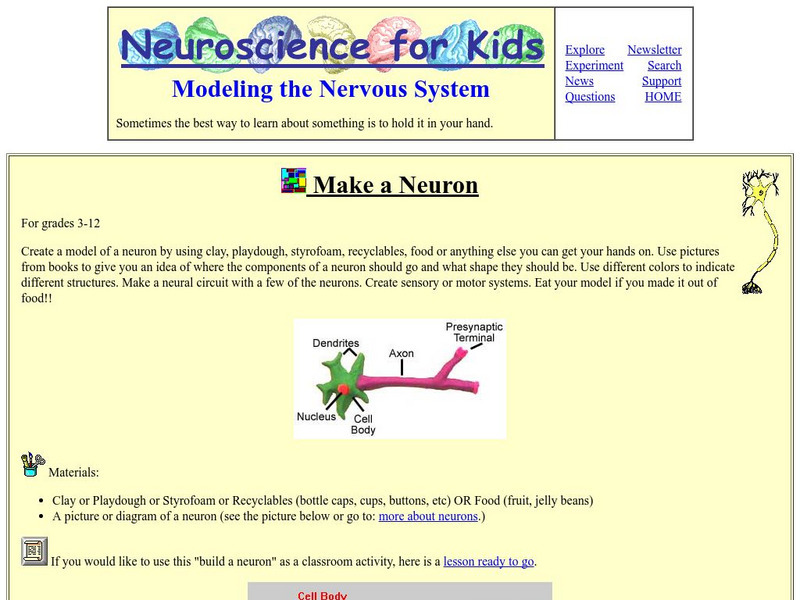
University of Washington: Modeling the Nervous System: Making a Neuron
Use this site for lots of different ideas on how to make a model of a neuron.
Stanford University
Stanford University: Path of Development (Animal Developmental Pathways)
An exciting explanation of animal development using sea urchins as a model. Animations, still images and supporting explanations make for a great learning experience.

The Wonder of Science
The Wonder of Science: 5 Ps1 1: Particle Model of Matter
A collection of work samples, phenomena, assessment templates and videos that help teachers create lessons to show that matter is made up of small particles. Through these materials students will see that matter is too small to be seen.

Texas Education Agency
Texas Gateway: Using Models to Connect to and Understand Volume Formulas
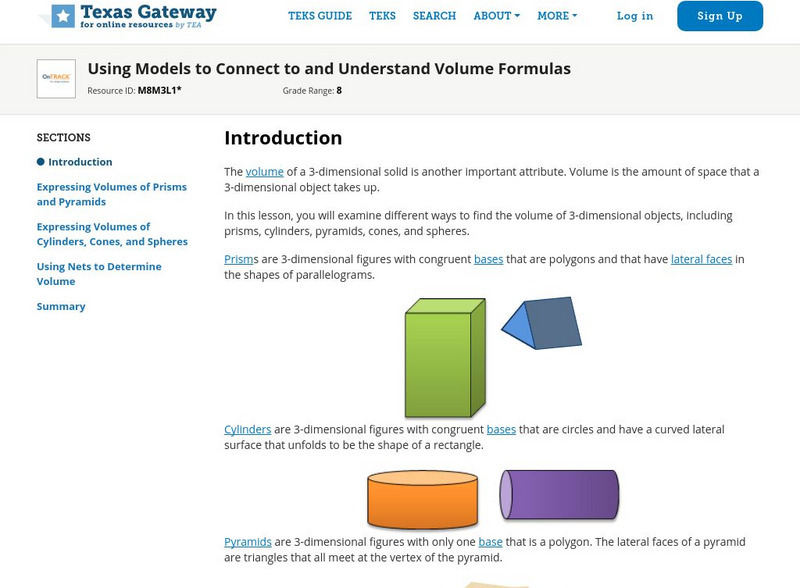
[Accessible by TX Educators. Free Registration/Login Required] The student will use models to develop formulas and connect them to the volume of prisms, spheres, cylinders, pyramids, and cones.
Texas Education Agency
Texas Gateway: Using Models to Connect to and Understand Volume Formulas
[Accessible by TX Educators. Free Registration/Login Required] The student will use models to develop formulas and connect them to the volume of prisms, spheres, cylinders, pyramids, and cones.
Better Lesson
Better Lesson: Making a Landform Model
In the NGSS, one of the performance expectations is for the children to develop a model to represent the shapes and kinds of land and bodies of water in an area. In the science practices, the children also must develop and use models....
CK-12 Foundation
Ck 12: Weak Nuclear Force and the Standard Model
[Free Registration/Login may be required to access all resource tools.] Describes the development of the model of particle physics called the Standard Model.
Texas Education Agency
Texas Gateway: Atoms, Elements and the Periodic Table: The Atomic Model [Pdf]
A slideshow looking at the contributions of scientists over time to our understanding of atomic theory. Looks at models of the atom developed by Democritus, John Dalton, J.J. Thomson, Ernest Rutherford, Niels Bohr, and James Chadwick, as...