Hi, what do you want to do?






Howard Hughes Medical Institute
The Fate of Fat
Humans need fat for energy and nutrition, but how much is too much? A short animation shows the pathway of fat as it enters the body, breaks down through digestion, and travels for use or storage. Teaching tips offer multiple ways to...

Socratica
What Is Biochemistry?
Watch as chemistry comes alive! Socratica's biology playlist kicks off with a simple video detailing the principle components of biochemistry. Content includes carbohydrates, proteins, and nucleic acids. The narrator describes each class...

American Chemical Society
What is a Complete Breakfast?
Start your day—and your class—off right with an interesting video about breakfast! The resource, part of the American Chemical Society's Reactions series, tackles the most important meal of the day. The narrator explains what makes for a...

American Chemical Society
The Cold Truth About Fat
Our bodies store two types of fat: brown fat and white fat—and brown fats are actually efficient at burning calories! An episode of the ACS Reaction series compares exercise generating brown fat to shivering cold. It turns out 15 minutes...

MinuteEarth
Why Don't Sled Dogs Ever Get Tired?
What is the sled dog's secret to running for days on end without tiring? Turns out the answer is in their metabolism. Explore the metabolic processes of these amazing sled dogs. The science shows they are able to burn their proteins and...

Fuse School
How to Harden Vegetable Oils (Margarine) through Hydrogenation
Some margarine is soft while other margarine is hard; what causes the difference? The video explains the molecular structure of margarine and the process of hardening vegetable oils with hydrogen. It focuses on the various properties and...

Fuse School
Making Soaps - Hydrolysis
Don't let teaching about hydrolysis burst your bubble! Introduce your class to soap-making with an animated video. The narrator describes the raw materials used for making both hard and soft soaps. The video includes a look at early soap...

Fuse School
Fats and Oils (Plant Oils)
Sow the seeds of knowledge with a short video about plant oils! Science scholars discover the methods people use to extract oils from olives, coconuts, and flowers. The narrator also explains the chemical structures of these oils and why...

National Science Foundation
Science of NFL Football: Nutrition, Hydration and Health
How does what you eat compare to an NFL football player? The final video in a 10-part series explains the nutrition requirements at the extreme level of an NFL player. The instructor explains the key nutrients and their nutritional...

SciShow
The Chemistry of Fried Food
Foods are fried in oils, which are basically a fat that is a liquid at room temperature. Another great video about the chemical reactions in cooking, this one explores frying food. The narrator explains that from the appearance of...

SciShow
Weight Loss Pills: Fact Or Fiction?
Most over-the-counter weight loss pills have not been tested or even approved by the FDA. Learners see the truth behind weight loss pills and why many claims are false. The narrator begins by exploring prescription diet pills—fat...

SciShow
The Deal with Fat
Fats are essential to a balanced diet and help bodies use certain vitamins as well as maintain healthy skin and hair. While watching the video, learners explore fat, which is certainly talked about a lot in terms of health. The narrator...

Crash Course
Metabolism and Nutrition (Part 1)
Use the 36th video of 47 to explore metabolism. Individuals begin to understand what metabolism is, physiologically what it does, and how anabolic and catabolic reactions assist in digestion.

Bozeman Science
Lipids
An informative video goes in depth about lipids, or fats. It describes the importance of cell membranes and hydrocarbon tails that contain the energy available for life. It also explains the construction of phospholipids and...

TED-Ed
What Does the Liver Do?
It's the heaviest organ in the human body, but exactly what role does the liver play in sustaining life? Follow along with this short video as it explores the various ways the liver filters, stores, and manufactures materials...

Steve Spangler Science
Color Changing Milk - Sick Science! #018
This visually vibrant activity demonstrates what happens when dish soap weakens the bonds that hold fats and proteins suspended in milk. Perhaps you can have chemistry lab groups perform this activity when they are learning about...

Curated OER
Health: Digestive System 101
Colorful pictures and animation accompany a thorough explanation of the digestive process. Each anatomical part of the digestive system is explained as well as the chemical signals that are affiliated with digestion and absorption....

Curated OER
How to Read a Nutrition Label
Take a look down a grocery aisle and you will see nutrition labels on every can and box of food. Do you know how to read the labels? This video shows you briefly what a nutrition label looks like and a few of the elements listed on each...
Khan Academy
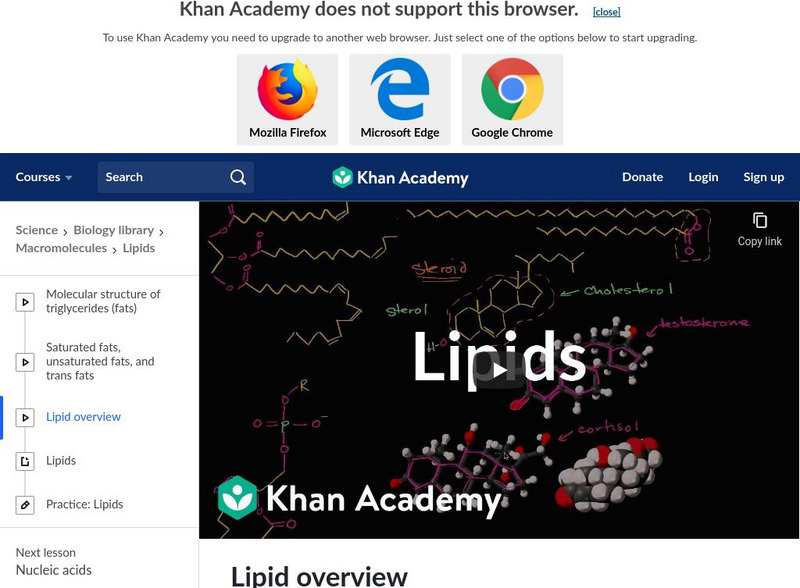
Khan Academy: Biology: Macromolecules: Lipid Overview
Learn the basics of lipids in this video. [11:30]
Khan Academy
Khan Academy: Growth and Metabolism: Digesting Food
Get an overview of three of the key macromolecules of life (proteins, fats, and carbohydrates), and how they get digested and absorbed.

PBS
Pbs Learning Media: Don't Forget the Nuts
In this Fizzy's Lunch Lab video, the food group sings about why nuts are important to eat, and students learn that they contain protein and good fats to give them lots of energy for the day. [1:31]
PBS
Pbs Learning Media: Mixed Nuts
In this Fizzy's Lunch Lab video, Fizzy introduces the Nuts! -- Almond, Pistachio, and Hazelnut -- to talk to students about why nuts are a healthy food choice that should be included in their diets, and to explain that each specific nut...
PBS
Pbs Learning Media: Fats Good and Bad
These Fizzy's Lunch Lab videos and related lesson plan provide practical and positive examples of healthy eating with an emphasis on fats. The materials will help students understand that fat is a nutrient, food sources of fat and...
Science Friday Initiative
Science Friday: Good Calories, Bad Calories?
Gary Taubes, author of the book Good Calories, Bad Calories, is interviewed about his position that carbohydrates rather than fats and cholesterol are responsible for weight gain and health issues related to diet. Joining him in this...