Hi, what do you want to do?






EngageNY
Properties of Parallelograms
Everyone knows that opposite sides of a parallelogram are congruent, but can you prove it? Challenge pupils to use triangle congruence to prove properties of quadrilaterals. Learners complete formal two-column proofs before moving on to...

CK-12 Foundation
Parallelogram Proofs: Quadrilaterals that are Parallelograms
What conditions must be met for a quadrilateral to be a parallelogram? A slider interactive allows individuals to move the vertices of a quadrilateral. They answer questions that prove whether a given quadrilateral is a parallelogram.

Radford University
Triangles in Parallelograms
What's the point of looking at triangles when trying to draw parallelograms? Given three non-collinear points, pupils determine and justify all possible points that would create a parallelogram. They then analyze the four triangles that...

EngageNY
Analytic Proofs of Theorems Previously Proved by Synthetic Means
Prove theorems through an analysis. Learners find the midpoint of each side of a triangle, draw the medians, and find the centroid. They then examine the location of the centroid on each median discovering there is a 1:2 relationship....

Inside Mathematics
Quadrilaterals
What figure is formed by connecting the midpoints of the sides of a quadrilateral? The geometry assessment task has class members work through the process of determining the figure inscribed in a quadrilateral. Pupils use geometric...

Illustrative Mathematics
A Midpoint Miracle
Young geometers develop one of the fundamental properties of quadrilaterals (connecting side midpoints gives a parallelogram) in this short but thought-provoking exercise. Using a combination of hands-on techniques and abstract algebraic...

Mathematics Assessment Project
Floor Pattern
You'll never look at floor tiles the same again. An assessment task prompts learners to investigate relationships between patterns involving squares and kites to determine angle measurements. They then prove...

EngageNY
How Do Dilations Map Segments?
Do you view proofs as an essential geometric skill? The resource builds on an understanding of dilations by proving the Dilation Theorem of Segments. Pupils learn to question and verify rather than make assumptions.

Jesuit High School
Geometry Sample Problems
I'd like to prove that this learning exercise has a lot to offer. Seven problems using triangles and parallelograms practice the traditional method of a two-column proof. After the learning exercise is some practice problems that...

Illustrative Mathematics
Right Triangles Inscribed in Circles II
So many times the characteristics of triangles are presented as a vocabulary-type of lesson, but in this activity they are key to unraveling a proof. A unique attack on proving that an inscribed angle that subtends a diameter must be a...

Curated OER
Transformations in the Coordinate Plane
Your learners connect the new concepts of transformations in the coordinate plane to their previous knowledge using the solid vocabulary development in this unit. Like a foreign language, mathematics has its own set of vocabulary terms...

Mathematics Vision Project
Congruence, Construction and Proof
Learn about constructing figures, proofs, and transformations. The seventh unit in a course of nine makes the connections between geometric constructions, congruence, and proofs. Scholars learn to construct special quadrilaterals,...

Mathematics Vision Project
Module 3: Geometric Figures
It's just not enough to know that something is true. Part of a MVP Geometry unit teaches young mathematicians how to write flow proofs and two-column proofs for conjectures involving lines, angles, and triangles.

Illustrative Mathematics
What is a Trapezoid? (Part 1)
Challenge your class to construct a definition for trapezoids. Looking at four examples and four non-examples, students individually create definitions and use them to classify an unknown shape. Allow for small group and whole-class...

Mathematics Vision Project
Geometric Figures
Logical thinking is at the forefront of this jam-packed lesson, with young mathematicians not only investigating geometric concepts but also how they "know what they know". Through each activity and worksheet, learners wrestle with...

EngageNY
Special Lines in Triangles (part 2)
Medians, midsegments, altitudes, oh my! Pupils study the properties of the median of a triangle, initially examining a proof utilizing midsegments to determine the length ratio of a median. They then use the information to find missing...

Mathematics Vision Project
Module 6: Congruence, Construction, and Proof
Trace the links between a variety of math concepts in this far-reaching unit. Ideas that seem very different on the outset (like the distance formula and rigid transformations) come together in very natural and logical ways. This...

Illustrative Mathematics
Illustrative Mathematics: G Co, G Srt Congruence of Parallelograms
In this task, a student has learned the SSS and SAS congruence tests for triangles and wonders if these tests might work for parallelograms. Aligns with G-CO.C.11 and G-SRT.B.5

Illustrative Mathematics
Illustrative Mathematics: G Co Is This a Parallelogram?
In the pictured quadrilateral, opposite sides are congruent and learners must explain whether this makes it a parallelogram. Aligns with G-CO.C.11.
Texas Education Agency
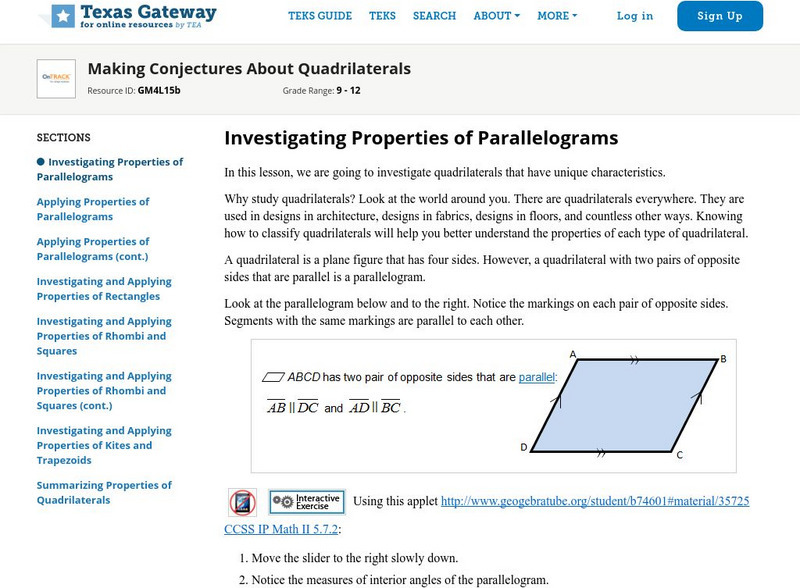
Texas Gateway: Making Conjectures About Quadrilaterals
Given examples of quadrilaterals and their component parts, the student will use explorations and concrete models to prove a quadrilateral is a parallelogram, rectangle, square, or rhombus using opposite sides, opposite angles, or...
Illustrative Mathematics
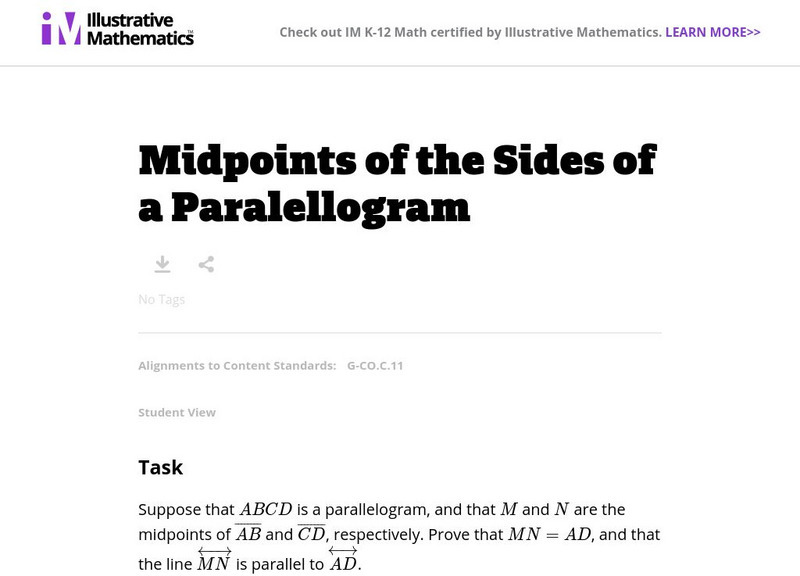
Illustrative Mathematics: G Co Midpoints of the Sides of a Paralellogram
Suppose that ABCD is a parallelogram and that M and N are the midpoints of lines AB and CD respectively. Young scholars are asked to prove that MN=AD, and that the line MN is parallel to line AD. Aligns with G-CO.C.11.

CK-12 Foundation
Ck 12: Interactive Geometry: 4.7 Theorems About Quadrilaterals
Use quadrilateral properties that are unique to parallelograms to prove that the given shape is a parallelogram.
Illustrative Mathematics
Illustrative Mathematics: G Gpe a Midpoint Miracle
In this task, students are asked to draw a quadrilateral so that no two sides are congruent, no two angles are congruent, and no two sides are parallel. The task gives students the opportunity to prove that if we join the midpoints of a...