Hi, what do you want to do?






Teacher Web
Archaebacteria and Eubacteria
Take young biologists back to the beginning of life on Earth with this presentation on bacteria. Examining the different classifications of bacteria, this presentation introduces young scientists to the concepts of autotrophs and...

Curated OER
Bacteria's Role in Food
Students grow bacteria cultures on agar in petri dishes and do a plate count. They participate in a yogurt making lab to see how bacteria produce lactic acid. They prepare a recipe and identify fungi, fermentation and the role of...

Curated OER
Yo! Gert-making yogurt
Young scientists or chefs culture yeast to produce yogurt. The materials and a general description of how make yogurt are provided, but there is very little detail otherwise. You could use this as an activity when your biology class is...

Learning Games Lab
Gram Staining
Scholars use a lab simulation to test contaminated yogurt for bacteria by gram staining. They learn proper lab procedures for handling bacteria and for sterilizing equipment, and then walk through the process on their own to try gram...

Curated OER
Fool-proof Yogurt
Students make yogurt from powdered milk. In this yogurt experiment lesson plan, students combine powdered milk, warm water and plain yogurt. They mix up the ingredients and put it in an insulated cooler for 6-8 hours.

Curated OER
There are Microbes in my Food!
Sixth graders produce yogurt in the classroom as an example of the use of microbes in food production, and record observations in science journals.

Curated OER
Microorganisms: Good Guys or Bad Guys?
Students discover the role microorganisms play in our lives. In this decomposition lesson, students examine decaying foods and plants in order to analyze the different bacteria that grows. Students discuss the good and bad of...

Curated OER
Naked to the Eye
Sixth graders conduct a variety of experiments that enable them to investigate bacteria. They use microscopes, prepared slides, video, moldy bread and pond water to observe types of bacteria and how bacteria interacts with the...

Curated OER
The Good Microbes
Some microbes are beneficial for humans. This resource asks learners to identify beverages that contain healthy microbes. There are six beverages shown, and pupils must place a check mark next to the ones they think contain healthy...

Curated OER
Microbe Experimentation
Seventh graders study microorganisms in their environments by experimenting with milk products. In this microbes lesson, 7th graders read background information about microorganisms in yogurt and soured milk. Students then follow a...

Curated OER
Prokaryote Coloring
In this prokaryote worksheet, learners answer ten questions about prokaryote cells and they color a diagram of a simple bacteria cell and its structures.

Curated OER
Investigating the Uses of Backyard Bacteria
Students discover that the answers to some of society's waste and clean-up problems may be no further than the soil beneath their feet. They perform a Gram stain on the colonies to determine some of their characteristics.

Curated OER
Discovery Science Center Activities
Fourth graders complete a variety of experiments to meet science goals. In this life sciences instructional activity, 4th graders make yogurt, discover the attraction of opposite charges in electricity, learn the effects of...

Curated OER
Rennet Cultured Cheese
Fifth graders make cheese using two different methods. In this cheese making instructional activity, 5th graders make rennet cultured cheese following the step by step directions. They also make cheese using a genetically engineered...

True Blue Schools
Now, We’re Cooking!
Practice nutritional cooking with a collection of fun meal preparation lessons. Each lesson includes a focus, objective, collaborative activity, and recipe to culminate what young cooks have learned about healthy eating.

Curated OER
The good microbes
The question posed for the class to consider; What would decay and what would not? They read the short passage on decomposition and microbes, then mark the items that would decay after a two-week period. A scientific investigation idea...

Curated OER
Better Butter
Students explore the process of making butter. In this agriculture instructional activity, students discuss how butter is made today and how it was made in the past. Students make their own butter using baby food jars and some "elbow...

Curated OER
Prokaryote Coloring
In this prokaryote coloring activity worksheet, 7th graders read an informative passage about prokaryotes. Students answer questions about the passage and color the picture.

Curated OER
TIN CAN TREAT
Young scholars conduct an experiment where they will change a liquid dairy product into a solid. They review the definitions of liquids and solids. Students are given an example of each. They are divided into groups of four, each group...

Curated OER
Picnic Safety
Students plan a picnic menu using the food safety rules. They pack a cooler with different types of cold packs and also pack a basket with food that does not have to be kept cold.

Curated OER
Microorganism Multiplication
Sixth graders explore biology by viewing video clips in class. In this microorganism identification instructional activity, 6th graders identify the types of organisms that can feed small animals such as algae and protozoans. Students...

Curated OER
Yeast Power!
Learners examine how not all microorganisms are bad and that some can actually be beneficial. In this yeast lesson students complete an experiment with yeast and answer questions.

Science Buddies
Science Buddies: Yogurt Cultures
Find out in this experiment how good bacteria can turn milk into a treat by investigating the optimal starter cultures for making yogurt from whole milk.
CK-12 Foundation
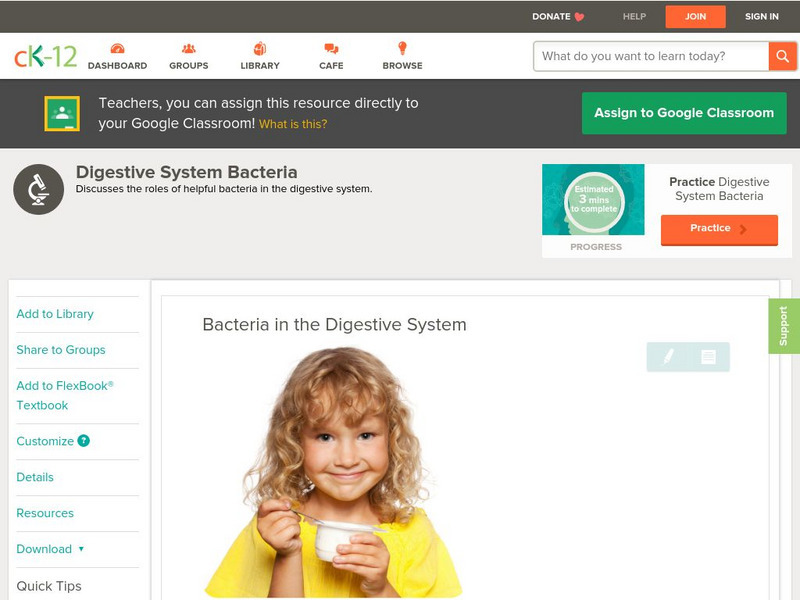
Ck 12: Life Science: Bacteria in the Digestive System
[Free Registration/Login may be required to access all resource tools.] Yogurt is a good source of calcium. Yogurt also contains active cultures of "good" bacteria. Foods that contain these beneficial bacteria are sometimes called...