Hi, what do you want to do?






Columbus City Schools
Changes All Around Us
Whoa! What just happened? That's right, change is everywhere. But what exactly is changing? Middle school science sleuths get to the bottom of the changes matter can experience. Through simple demonstrations, engaging videos, and an...

Anglophone School District
Fluids: Force in Fluids
Discuss Archimedes' Principle and fluid forces with your young scientists as they describe the relationship between mass, volume, and density during a series of engaging activities. They use the Participle Theory of Matter to explore the...

Columbus City Schools
What’s Up with Matter?
Take a "conservative" approach to planning your next unit on mass and matter! What better way to answer "But where did the gas go?" than with a lab designed to promote good report writing, research skills, and detailed observation....

Department for Children, Schools and Families
Explaining Change Processes Using a Simple Particle Model of Matter
The more things change, the more they stay the same. This unit includes seven lessons starting with physical change and moving through to chemical change. Conservation of matter is explained clearly with multiple hands-on activities and...

National Library of Medicine
Your Environment, Your Health: Air Quality
Some scientists argue that air pollution now causes more deaths than smoking. The second unit in a six-part series focuses on air quality. Scholars learn what's in the air, how clean the air around their school is, and what they can do...

Royal Society of Chemistry
Equilibria—Gifted and Talented Chemistry
Teaching is a balancing act! Keep things on an even keel with a comprehensive equilibrium lesson plan. The resource covers reversible and irreversible reactions, Le Chatelier's Principle, and the industrial applications of equilibrium...

Annenberg Foundation
By the People, For the People
A picture speaks a thousand words—no matter how old. The 18th installment of a 22-part series on the making of American history has scholars research the causes of the Great Depression and the factors of the New Deal. Using photographic...

NASA
Astronomy Mission Module
Yes, scientists say, there is other life in our solar system! And the best place to look is on Europa, a moon of Jupiter. Here, learners mimic the techniques scientists use to gather information about objects in our solar system, write...

NASA
NASA Engineering Design Challenges - Spacecraft Structures
What kind of design challenges are there in building structures to support rocket engines? The unit takes design teams through the process of building the lightest possible thrust support structure that can withstand the necessary forces...

Core Knowledge Foundation
Rocks & Minerals
Take young geologists on an exploration of the rock cycle with this six-lesson earth science unit on rocks and minerals. Through a series of discussions, demonstrations, and hands-on investigations your class will learn...

Curated OER
The Human Body
Students explore human growth and development as they participate in class activities, reading and discussion. Worksheet and handouts are included in the lesson.

Curated OER
Meteorology Madness
Students probe the dynamic weather changes through several hands-0n activities in this seven lessons unit. The hydrologic cycle, clouds, atmosphere, air movement, fronts, and forecasting form the components presented in this unit.

Curated OER
Earth: The Water Planet
Students elicit data on the water cycle, ocean topography, and island formation in this six lesson unit. The ocean floor and the properties of water are examined through a variety of discussions and hands-on experiments.

Curated OER
Introduction to Electricity
Students experiment with static electricity and make their own electrical circuits. Students experiment with their circuits to explore conductors and insulators. Students identify Thomas Edison as the person who invented the electric bulb.

Curated OER
May the Force Be With You: A Unit on Magnets
Students uncover data about magnets and practice classifying them by amounts of attraction and magnetism as an invisible force is introduced. The unit presents the topic within eight lessons.

Other
Science4 Us: Changes in Matter
Through an instructional video, games, and activities, students explore three types of change matter makes: physical change, in which only the shape of the matter changes; physical phase change in which matter changes to a different form...
Concord Consortium
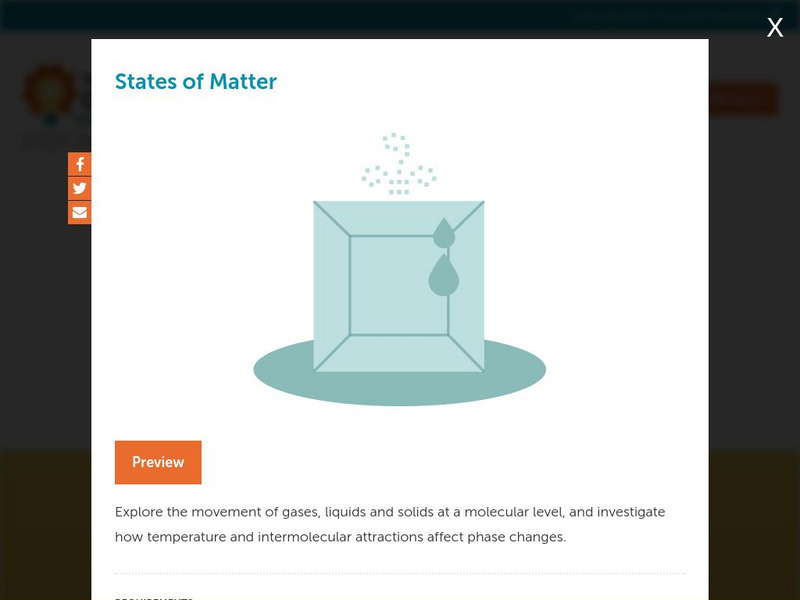
Concord Consortium: Stem Resources: States of Matter
Using simulations observe what solids, liquids, and gases look like at the atomic scale. After observing the different states of matter at their atomic level, students will be able to conclude about the forces and attractions that exist...
Concord Consortium
Concord Consortium: How Can a Small Spark Start a Huge Explosion?
In this Activity 1 investigates What makes materials different from each other? Students will continue to learn about energy and to investigate how energy changes relate to changes in matter. Students will also explore what makes...
Other
Wisconsin K 12 Energy Education Program (Keep)
The mission of KEEP is to improve energy education in Wisconsin's schools. It provides teachers access to resources, activities and web support for many hands-on lessons for all grade levels.