Hi, what do you want to do?






Illustrative Mathematics
Ordering Numbers
Deepen the number sense of young mathematicians with this unique ordering exercise. Given a list of the numbers 1, 5, 10, 50, and 100, young learners must determine where the numbers from a second list fit in the sequence. To increase...

Oregon Department of Education
Building Number Sense
It's never too early to begin a child's math education. This collection of fun hands-on activities engage youngsters in building their number sense as they learn how to count objects, identify numerals, compare amounts, and much more.

Curated OER
Mathematical Treasure Hunt
The hunt is on! Young mathematicians follow clues and complete a series of ten math puzzles as they try to crack Dr. Integer's code and find the location of his hidden treasure.

Illustrative Mathematics
Where Do I Go?
Practice sequencing numbers 1–100 in a card sequencing activity. The hands-on learning makes a short activity flexible and fun. The opportunities are endless and easy to implement.

Noyce Foundation
Tri-Triangles
Develop an understanding of algebraic sequences through an exploration of patterns. Five leveled problems target grade levels from elementary through high school. Each problem asks young mathematicians to recognize a geometric pattern....

5280 Math
Polygon Polynomials
Patterns in polygons lead to patterns in polynomials. Presented with a series of polygons, individuals create polynomial expressions to represent their patterns. The algebra project consists of nine problems that incorporate polynomial...

Historical Thinking Matters
Rosa Parks: 3 Day Lesson
How can evidence and perspective challenge even the most well-known of stories? Through primary and secondary source analysis, think-alouds, and discussion, young historians evaluate the historical narrative of Rosa Parks across multiple...

Noyce Foundation
Measuring Mammals
Explore the meaning of scale and proportion with a set of five activities that examines the topic from elementary through high school. The first lessons explore ratio by examining pictures of different sizes. The next three activities...

Council for Economic Education
Wages and the Black Death
While the Black Death wiped out a third of Europe's population during the Middle Ages, its destruction paved the way for better wages for workers and even an early form of modern capitalism. The relationship between the cataclysmic...

101 Questions
Tether Ball
All work and no play makes for a boring classroom! Bring back memories by analyzing the patterns of a tether ball. Given the dimensions of the ball, pole, and rope, young scholars must determine how many times the ball will wrap around...

Smithsonian Institution
Stamp Stories of Westward Expansion
What a fantastic project idea for discussing not only the history of America's expansion into the West, but for reviewing any major unit of history in your class. Pupils build stamp collections to visually represent themes of the...

Illustrative Mathematics
Congruent Triangles
Geometers prove that triangle PQR is congruent to triangle ABC by describing any combination of rotations, reflections, and translations that would prove it so. There is only this single task on the handout, but a detailed explanation of...

Dr. Seuss Enterprises
Read Across America
Celebrate the whimsical world of Dr. Seuss on Read Across America Day with a collection of science, technology, engineering, the arts, and mathematics activities, each linked to a popular Dr. Seuss story.

NASA
Speaking in Phases
Hear from deep space. Pupils learn how satellites transfer information back to Earth. They learn about three different ways to modulate radio waves and how a satellite sends information with only 0s and 1s. Using sound, class members...

Beauty and Joy of Computing
Sprite Drawing and Interaction
Discover how to program objects to move on a screen. In the second lab of a five-part unit, each learner uses block instructions to program a sprite to follow their mouse (cursor). They investigate how to use these same block...

American Museum of Natural History
Horse Gaits Flipbooks Walk, Trot, and Gallop!
Scholars follow seven steps to create horse-themed flipbooks. Three printable options allow them to choose from walking, trotting, or galloping scene.

Computer Science Unplugged
Treasure Hunt—Finite-State Automata
Introduce your class to the concept of finite-state automata with an activity that asks individuals to try to map their way to Treasure Island by taking different routes though an island chain. Each island has two ship sailing...

PBS
The Little Red Hen: A Tale of Cooperation
Ensure that your kids don't even consider saying "Not me!" when it comes time to read by engaging them in this set of lesson plans based around "The Little Red Hen." The class reads the story together before starting in on additional...

Illustrative Mathematics
Zeroes and factorization of a quadratic polynomial I
This activity uses the division algorithm and the definition of a zero/root of a function to guide your class to see the relationship between zeros and factors of a general quadratic, which can later be generalized to the Remainder...

Illustrative Mathematics
Writing Expressions
Practice writing algebraic expressions from written phrases. The objective is to consider two seemingly similar phrases, write them as algebraic expressions, and then simplify using the order of operations. Learners are challenged to...

Autism Speaks
Improving Sleep for Children with Autism
Sometimes learners with autism have trouble getting into routines and schedules, especially when it comes to sleep. Quickly refer to a guide that provides tips, checklists, sample schedules, and visuals to help your child become a better...

Curated OER
Dino Fossils
Primary paleontologists discover the information they can gather from examining fossils. They place pictures in the correct sequence showing how an animal becomes a fossil. They discuss which sediments would preserve fossils better as well.

Curated OER
Spring Bulletin Board
Students create a Spring bulletin board. Students color and cut out frogs and attach them to pipe cleaners. The frogs then bounce and move. Students discuss frogs and how tadpoles become frogs.
Rice University
Rice University: Let's Count!
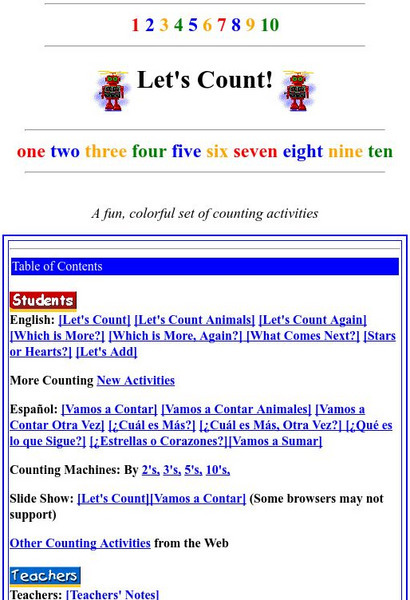
Let's Count is a website that offers opportunities to count lots of different sets of things. You can also view the same website in Spanish.