Hi, what do you want to do?






Curated OER
Trading Rendezvous
Students explore the fur trade between the settlers and Native Americans. Through class discussion, students explain and give examples of how the fur trade worked. In groups, they simulate the fur trade using materials provided by the...

Curated OER
La Salle and the Fur Trade
Fourth graders examine the fur trade of the 1700's. In this explorers lesson, 4th graders discuss how the French explorers traded items with the Native Americans for fur. They look at the explorer La Salle and how he influenced the fur...

Curated OER
Lives of Native Americans and Settlers
Students assess the effect of contact between the Native Americans and Europeans after 1492. They explore the lives of the early European colonists and the Native Americans living along the East Coast of North America. Lesson contains...

Curated OER
Fur Trading
Students take on a role such as a farming community, hunting community or a trading post. They decide which products they focus on and then trade with the other groups.

Curated OER
Westward Expansion - Fur Trade
Students complete a unit of lessons to learn how products reach the market and study the history of the fur trade. In this history and trade lesson, students first learn about the technology that allowed products to reach market faster....

Curated OER
Fur Trade Economics
Students demonstrate understanding of what the fur trade was and how it was operated, including the bartering process, by participating in a mock trade activity and assessing the value of items based on their needs and wants.

Curated OER
Pocumtucks in Deerfield
As part of a study of colonial and Native American history, class members focus on the beliefs and land use of the Pocumtucks, who settled near Deerfield, Massachusetts. Students examine their beliefs about land use and ownership, the...

Curated OER
Ft. Vancouver the Fur Trade: A Skin for a Skin
Learners study Fort Vancouver. They discuss trading and what is meant by "a skin for a skin." They complete math story problems that represent possible trading scenarios. They explore the Chinook Jargon trade language.

Curated OER
Barter Day
Fourth graders understand the process of bartering. For this barter day lesson, each student barters an item in their desk with another student. All items are returned at the end of the activity and it is important to tell the students...

Curated OER
Who are the Women of the Pacific North West: 1830-1870?
Learners view a picture from the Vancouver National Historic Reserve and discuss the people in the picture. They locate Cromwell's Map and discuss the villages located close to Fort Vancouver. Students read information regarding the role...

Curated OER
Hivernants: The Wintering Voyageurs
Learners research the history of fur posts in North America. In this North American history lesson, students apply skills of historical interpretation by collecting and analyzing data from historic sources on the fur trade expansion.

Curated OER
A Critical Challenge Approach to Woman in New France and Huronia
Students works in groups to study the lives of women in New France and Huron communities. In this French and Indian history lesson, student groups research cultural attributes that existed for women in New France and Huron communities....

Curated OER
Comparison of American Colonies
Students explore the lifestyles of the American colonies. They conduct various activities according to their grade level including jigsaw research and creating a poster. Lesson includes primary source readings related to the topic.

Curated OER
English Perspectives
To further their understanding of the basis of the conflicts between the Pocumtucks and the English settlers, class members research the religious beliefs and attitudes of the Puritan farmers that settled in Deerfield, Ma.

Curated OER
Pocumtucks In Deerfield
Students read a story about the Pocumtucks' religious beliefs. Using the text, they discover their concept of land ownership and how they migrated within their territory in different seasons. They use primary and secondary sources to...

Curated OER
Colonial Currency
Fifth graders develop a common currency. In this colonial currency lesson, 5th graders exchange beads, rice, coins, and paper bills for goods and services. Students explore web tools to research ways colonists used money, even if it was...

Curated OER
Happy Endings: The Final Battle
Fifth graders explore all the myths of the battle of Yorktown. A variety of primary documents are viewed and analyzed for discussion. They become aware that what one sees and hears is not always as it seems in reality. Each group...

Curated OER
Changing Landscape at the Fort Vancouver Reserve
Students investigate the international background and consequences of The Louisiana Purchase, The War of 1812, and The Monroe Doctrine. The lesson helps to improve critical thinking skills about American History.

Curated OER
Jamestown Celebrates 400th Anniversary
Students view a world map and identify the locations of England and Virginia and discuss what kinds of things they would take with them on this kind of trip. They read the words in the news box on the student page and fill in the blanks...

Curated OER
Black Hawk Island Hike
Students explore Wisconsin's natural and cultural history through hands-on exploration of Upham Woods. They are shown the basic paddling skills and they work in teams to paddle across the river on barge. Students describe cultural...

Curated OER
English Perspectives
Pupils perform research in order to answer an essential question: How did the cultural characteristics, beliefs, attitudes, behaviors, and economic conditions of the French, English, and Indians contribute to the growth of inter-group...
![American Journeys: French and English Approaches to Exploration [Pdf] Lesson Plan](https://static.lp.lexp.cloud/images/attachment_defaults/resource/large/FPO-knovation.png "American Journeys: French and English Approaches to Exploration [Pdf] Lesson Plan")
Other
American Journeys: French and English Approaches to Exploration [Pdf]
A lengthy lesson plan that examines French and English approaches to exploration and colonization in reference to religious factors. Using primary sources from French missionary Gabriel Sagard and Wiliam Bradford, first governor of...
National Endowment for the Humanities
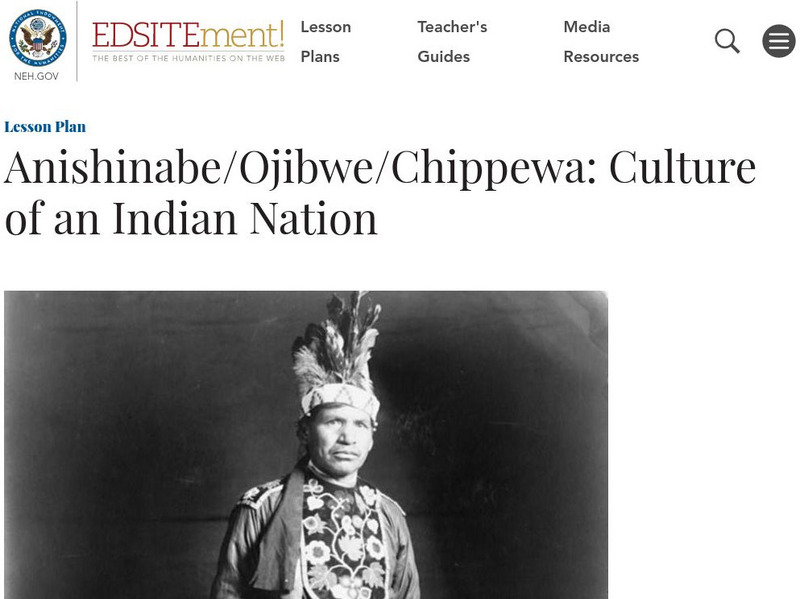
Neh: Edsit Ement: Anishinabe Ojibwe Chippewa: Culture
Though written for grades 3-5, this lesson plan can be easily changed to help students of all ages learn about the Chippewa people. Additional resources provide historical, cultural, and geographical facts concerning this Native American...