Hi, what do you want to do?






Curated OER
The Physics of Sports: An 8th Grade Physical Science Project
Explore the relationship between sports and physics in a cross-curricular lesson. Middle and high schoolers prepare a multimedia presentation based on a chosen sport. They answer five physics vocabulary questions about how the laws of...

G. Turrell
Science Activity 2: Light & Sound
Little learners experiment with sunlight and map out how light travels. Using a mirror and slotted card, they find out about items that can reflect or absorb the light. They experiment with a variety of materials to find out how light...

MENSA Education & Research Foundation
Roller Coaster Mania!
Raise the energy level of your physical science class with this exciting hands-on activity. Applying their knowledge of kinetic and potential energy and Newton's laws of motion, young engineers use foam tubing and marbles to create...

Discovery Education
School of Rock
Why do rocks break down over time? Learners explore this concept by simulating physical and chemical weathering of different types of rocks. They use an abrasive to demonstrate physical weathering and acid to demonstrate chemical...

Texas State Energy Conservation Office
Investigation: Conservation of Energy
By rolling marbles down a six-foot length of track, physical scientists determine how much energy is lost to heat. It is recommended that you opt for the foam pipe insulation track because more friction slows the marble, allowing...

National Nanotechnology Infrastructure Network
Wet Etching in Nanofabrication
Chemistry and physics combine forces to benefit nanofabrications. Learners examine the process of wet etching in nanofabrication. Using corrosive substances such as lemon juice and Coca-Cola, they model the etching process. They then...

Curated OER
Relative Age Dating
Modeling dough and paper cutouts in science class? Learn about how relative age dating concepts, like the Law of Superposition and cross-cutting relationships, can be used to describe the formation of sedimentary layers.

Foundation for Water & Energy Education
What is the Water Cycle? Activity B
Curious physical scientists follow a lesson on the properties of water with this lesson on distillation. They observe a miniature water cycle model that filters dirty water into clean water. These two lessons combined are an enriching...

It's About Time
Sounds in Strings
How many of your pupils play an instrument? A musical science lesson will help all of them understand how string instruments work. Young scientists construct a string-and-pulley system to test frequency and pitch. The lesson...

It's About Time
Metals and Nonmetals
Did you know you can melt the metal gallium with just the heat of your hand? Pupils observe and test materials in order to classify them as metal or non-metal. A reading passage and analysis questions wrap up the lesson.

American Chemical Society
Diapers: The Inside Story
There shouldn't be any accidents with this activity! An inquiry-based lesson has learners explore the absorption properties of the gel compound in diapers. After testing its properties, they learn the science of the molecules that make...

Busch Gardens
Create an Invertebrate
What better way for young biologists to learn about invertebrates than by creating their very own? Here, students are assigned a set of invertebrate characteristics and are asked to invent an imaginary ocean animal...

It's About Time
Refraction of Light
Don't shine like a diamond, refract light like a diamond. Young scientists use an acrylic block and a laser light to observe refraction. Advanced scholars figure the sine of the angles of reflection and incidence as well as mastering...

It's About Time
Reflected Light
The lesson allows young scientists to use lasers and mirrors to study reflected light. A reading passage and homework question assess learning, while additional material introduces extension activities.

It's About Time
Volcanic History of Your Community
Did you know there are 20 volcanoes erupting at any given time? Pupils look at various igneous rocks, read local geologic maps, and determine if their area has a history of volcanic activity. A reading passage and analysis questions...

GNS Science
Think like a Geologist: 1
How well do pupils play the role of geologist? Test their abilities in the first installment of a two-part series. Presented with a series of rock formation diagrams, learners write stories to match what they see in the diagrams. The...

Curated OER
The Digestive System
Discover how the human body's digestive system works with a brain and stomach friendly activity. Scholars taste test a variety of foods to find out how they behave once in the mouth. Class members then play a game called Move That...

Teach Engineering
Earthquakes Living Lab: Locating Earthquakes
There are patterns in nearly everything — even earthquakes. Pairs research current earthquakes to see if there are any patterns. They determine the mean, median, and mode of the earthquake data, along with the maximum and...

Prince William Network
The Incredible Journey
Divide your school gym into breeding grounds and non-breeding grounds so that your zoologists can play a game simulating the seasonal migration of shorebirds. Players pick one of the included game cards and follow its directions, which...

National Nanotechnology Infrastructure Network
An Easy (Bake) Approach to an Edible NanoLab
You can make it if you bake it! Young scientists model electronic chip fabrication with an easy bake oven. They create a design to embed in their brownie "chips" and compare their models to wafer production in basic nanotechnology.

Teach Engineering
Inside the DNA
Get your class to take a closer look at DNA. Pupils conduct research to determine the methods used by scientists to analyze the molecular structure of DNA. The class members investigate different types of molecular imaging along with gel...

Teach Engineering
Concentrate This! Sugar or Salt...
Heat up your lessons on boiling points. The resource provides a three-part activity: first, groups find the boiling point of solutions; second, they create boiling point curves for salt and sugar solutions; and third, they mix a solution...
Read Works
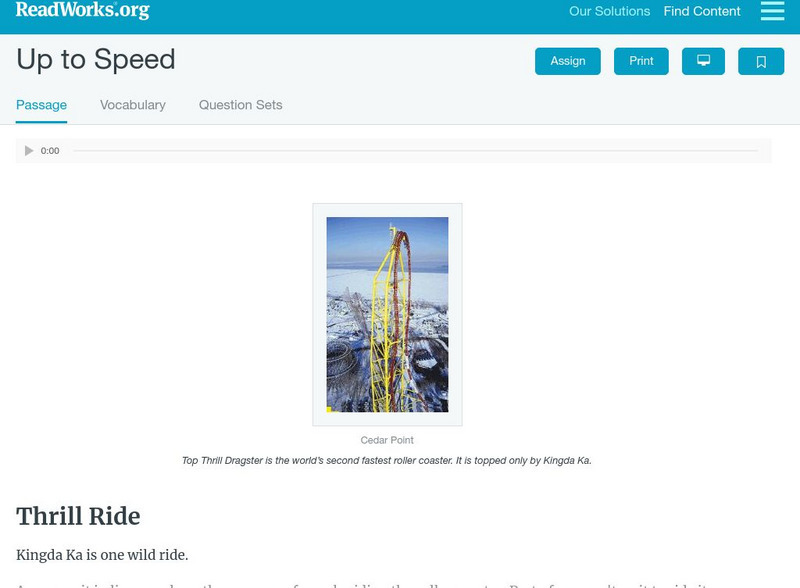
Read Works: Up to Speed
[Free Registration/Login Required] An informational text about the science behind roller coasters, including Kingda Ka, one of the tallest and fastest roller coasters in the world. A question sheet is available to help students build...
Read Works
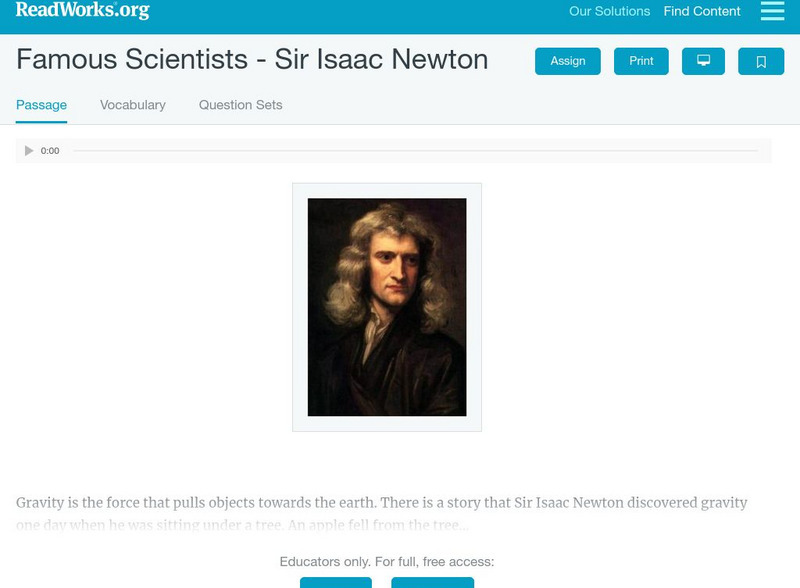
Read Works: Famous Scientists Sir Isaac Newton
[Free Registration/Login Required] This passage is a short biography of Sir Isaac Newton and his discovery of the force of gravity. This passage is a stand-alone curricular piece that reinforces essential reading skills and strategies...