Hi, what do you want to do?






Scholastic
Study Jams! Our Solar System: Inner Planets
Stunning images make up this slide show on the inner planets of our solar system. While visiting Mercury, Venus, Earth, and Mars, viewers also are introduced to the International Space Station and the Spirit Rover on Mars. Follow this...

American Museum of Natural History
Planetary Mysteries
Get to know our little part of the vast universe. Learners read about the common and not-so-common facts about each of the planets in the solar system. The interactive lesson includes a large amount of information as well as a quiz to...

Laboratory for Atmospheric and Space Physics
The Solar Wind Tunnel
The winds of change are blowing in our very own solar system! But what makes some heavenly bodies more affected by solar winds than others? Pupils discover the concept of magnetic forces at work in space in this...

PBS
Earth’s Energy Budget
Is Earth's energy flow a little off balance? Explore our energy budget using a click-through interactive. Scholars discover the many factors that move solar energy around the planet and why the system is no longer in equilibrium.

Scholastic
Study Jams! A Day on Earth
It's good thing that it isn't up to RJ to spin the earth on its axis; he can't even keep a basketball spinning! In this video animation, he and viewers learn about Earth's movements in space. One thing to consider before you use this...

PBS
Why Isn't There an Eclipse Every Month?
Searching for an eclipse activity that sends scholars over the moon? Try an interesting interactive to get their minds active! The resource, part of an extensive Space series from PBS Learning Media, uses modeling and data analysis to...

Laboratory for Atmospheric and Space Physics
Orbit Simulator
Researchers think they have evidence of a new planet deep in our solar system that is the size of Neptune and orbits the sun far beyond Pluto. The orbit simulator shows the orbits of our well-known planets, as well as Pluto and the comet...

American Museum of Natural History
What Do You Know About Astronomy
Develop an understanding of the universe. Learners answer 10 multiple choice questions about several topics in astronomy. Questions contain information about the age of the universe, gravitational attraction, galaxies, planets and comets...

McGraw Hill
Orbital Velocity Interactive
Why does it take Pluto 90,000 days to orbit the sun, but it only takes Mercury 88 days? An interactive lesson helps pupils find a connection between the speed of orbit and distance a planet is from the sun. The simulation allows for...

American Museum of Natural History
What is Astronomy?
Go study the universe. Pupils learn seven aspects about astronomy and astronomers. They begin to learn about constellations; distance and motion between objects; gravity; the electromagnetic spectrum; dark matter and energy; and teams of...

Curated OER
Astronomy 1 Quiz- Online Interactive
In this space science instructional activity, students complete 5 multiple choice questions pertaining to the planets and other space bodies. This is an online interactive quiz. Prior knowledge is assumed.

Curated OER
Curious? Will You Be Eclipsed?
In this "Curious? Will you be eclipsed?" worksheet, 4th graders answer 4 questions interactively about eclipses, then check answers online.

Curated OER
Cosmic Collision
In this cosmic collision worksheet, students explore interactive online website to study about the dynamics of different galaxies. They write short answers to 8 questions that follow.

Curated OER
Sunspots and the Sun's Rotation
In this sun worksheet, students use a Sunspotter to observe the rotation of the sun by identifying the presence of sunspots and watching them rotate over time. Students calculate how many days it takes to see the sunspots they observe in...
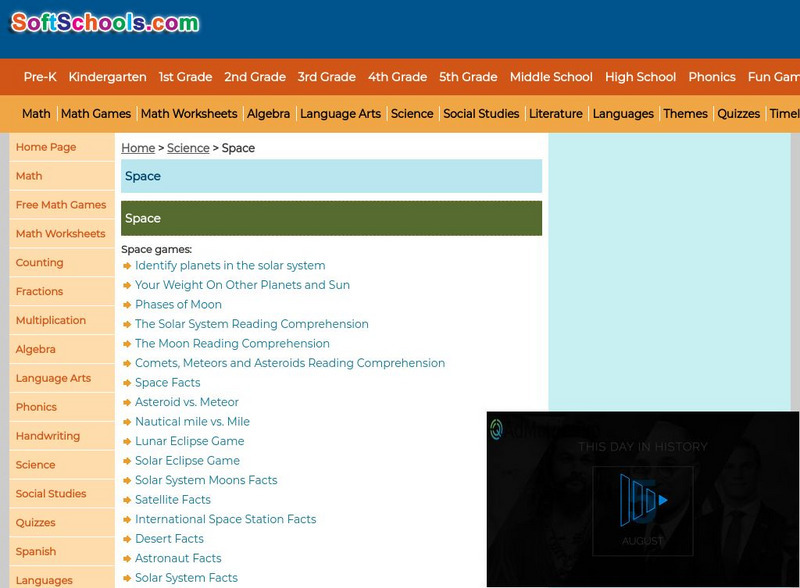
Soft Schools
Soft Schools: Space: Solar System Interactives
Identify the planets in our solar system and discover how much you weigh on another planet with these space interactives.

BBC
Bbc Schools: Ks2 Bitesize: Science: Physical Processes: Earth, Sun, and Moon
Help Sarah Jane and her team put the solar system's planets back in order. Following the activity, read more about the sun, the Earth, and its moon, and then take a quick quiz to check for understanding.
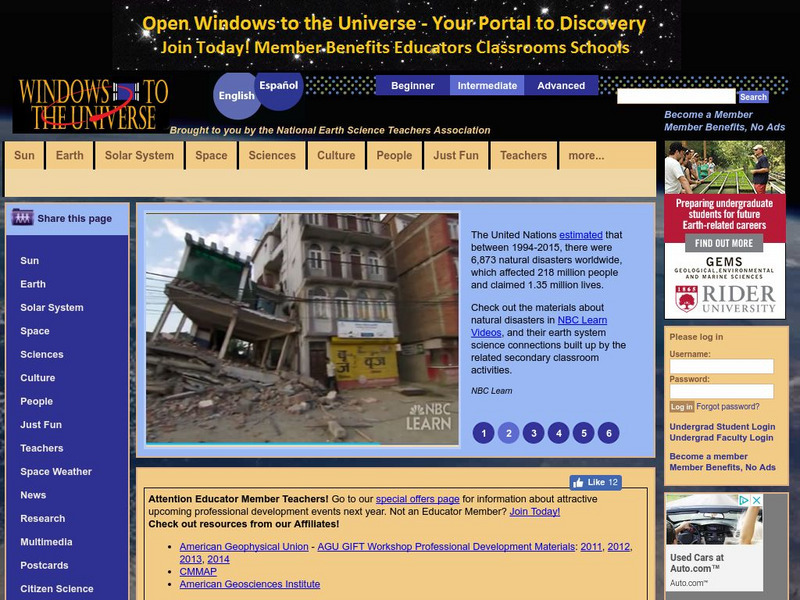
National Earth Science Teachers Association
Windows to the Universe
Windows to the Universe has developed an interactive resource about the earth, space, biological and physical sciences. Content includes information on our planet, the solar system, the universe, myths associated with space, space...
Math Science Nucleus
I. Science Ma Te: Integrating Science, Math and Technology
This site offers a wealth of online textbook-related materials that encourage the discovery of science in the world around us. Enter the site to access material on specific topics. Each section contains reading material (complete with...

Other
Hong Kong Space Museum
Besides an introduction to exhibitions and events at the museum, the site provides a guide to stargazing, an astronomy FAQ, space news, virtual tours (see site map) and research resources (including Chinese-English star and constellation...