Hi, what do you want to do?






Curated OER
Electrical Generators
Students study what an electric generator does and its history. In this energy lesson students complete several experiments including building their own electric generator.

Curated OER
What is the Best Insulator: Air, Styrofoam, Foil, or Cotton?
Students investigate the properties of insulators by attempting to keep a cup of water from freezing, and once it is frozen, to keep it from melting. They conduct the experiment, record and analyze the results, and answer discussion...

Curated OER
The Airplane
Learners demonstrate the Bernoulli Principle, review the influences that affected the Wright Brothers, and make and modify paper airplanes. This amazing lesson plan has an excellent structure, and very clear plans for the students to...

Rochester Institute of Technology
Molecules and Fuel Cell Technology
A fuel cell is where the jailer keeps gas guzzlers. Scholars review chemical reactions, chemical bonds, and chemical structure in order to apply these concepts. Participants construct fuel cell kits, using electrolysis to run the car and...

Teach Engineering
Cell Membrane Color Sheet and Build a Cell Membrane
A cell of another color is still a cell. Pupils color a cell to identify its structures in the fourth segment of a seven-segment series. Groups work together to build a three-dimensional cell membrane segment, which is combined with...

Teach Engineering
How Antibiotics Work
Take two pills and call me in the morning. The first lesson in a short unit of four introduces class members to delivery methods of medicines. The instruction introduces the question of which delivery method is best to get you feeling...

Cornell University
Catapults
Ready, aim, fire! Launch to a new level of understanding as scholars build and test their own catapults. Learners explore lever design and how adjusting the fulcrum changes the outcome.

Teach Engineering
Things That Matter to Flocculants
How does the dirt get out of your drinking water? A hands-on activity introduces the use of flocculants to help clear solid particles out of water. The plan walks learners through the process of setting up an experiment that...

University of Minnesota
Sheep Brain Dissection
Bored with frog and earthworm dissections? Had your fill of fetal pigs? Anatomy students will be intrigued by the sheep's brain, and you will be prepared with guiding questions, extension activities, and pictures as they dissect one —...

University of Minnesota
Virtual Neurons
It's electric! Young anatomists use Virtual Neurons software to build, control, and analyze complex nerve circuits within the body. Colorful and packed with content, class members enjoy interacting with the nervous system...

Columbus City Schools
Making Waves
Learning about waves can have its ups and downs, but a demo-packed tool kit has the class "standing" for more! Learners gain experience with several different wave types, organizing observations and data, and wave...

Curated OER
Spin Me a Story
Students examine the motif of spinning and weaving in myths and folktales. They read various myths, complete a WebQuest, develop a mind map of story elements, and write an original "spider" story.

Curated OER
Inertia
Students conduct a simple inertia demonstration by spinning a hardboiled and raw egg. They push a wagon to demonstrate inertia. They explore Newton's first and second laws of motion.

Curated OER
Ring Around the Rosie
Students examine the concept of angular momentum and its correlation to mass, velocity, and radius. They listen to a teacher-led lecture, conduct an experiment with rotational inertia, angular momentum, and rotation speed by making...

Curated OER
Waste Aggregates and Material Properties
Students define specific waste materials that could be used as aggregate in concrete. In this aggregate and waste lesson plan, students brainstorm on how to incorporate waste in construction and define different aggregate materials.
TeachEngineering
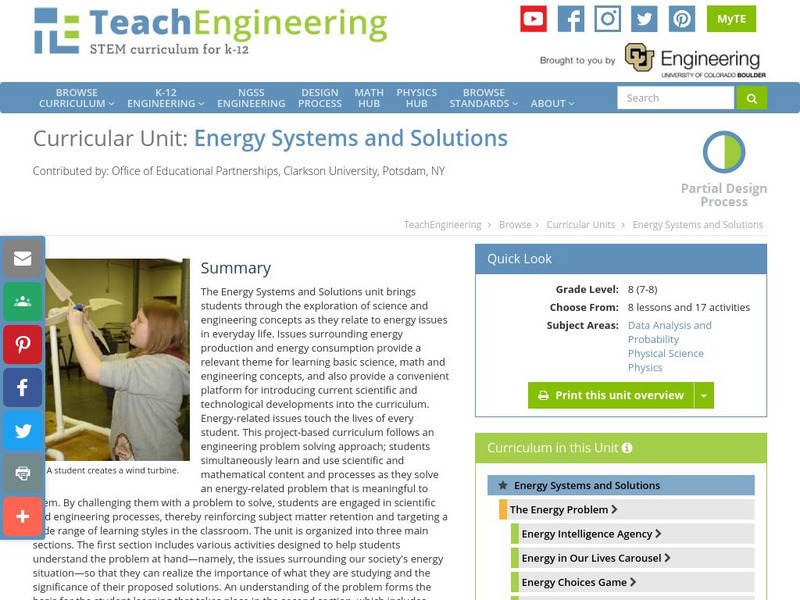
Teach Engineering: Energy Systems and Solutions
The Energy Systems and Solutions unit brings students through the exploration of science and engineering concepts as they relate to energy issues in everyday life. Issues surrounding energy production and energy consumption provide a...

Science Buddies
Science Buddies: Knock Your Blocks Off: The Mechanics of Carnival Games
Why are those "simple" games at the fairs, carnivals, and boardwalks so hard? Is it really lack of skill or coordination or do those concessionaires use some basic laws of science to help them set up the games in their favor? This...
TeachEngineering
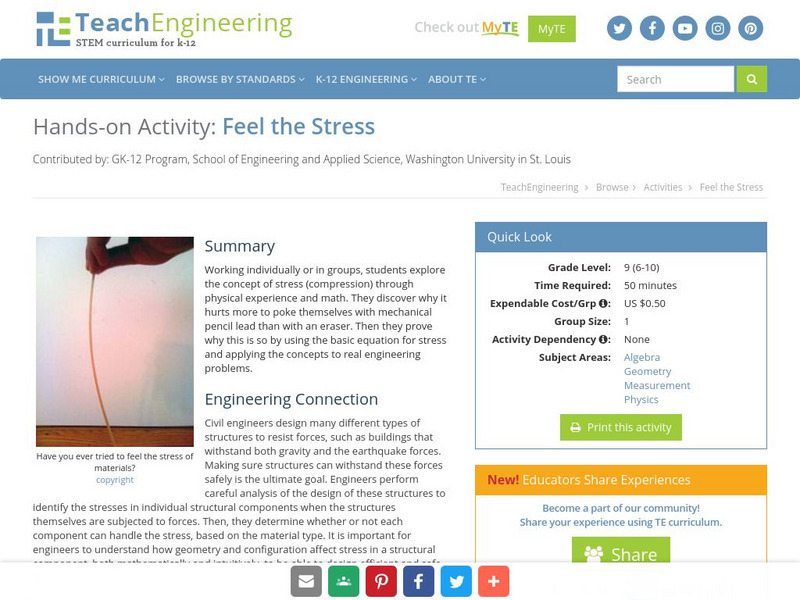
Teach Engineering: Feel the Stress
Working individually or in groups, students explore the concept of stress (compression) through physical experience and math. They discover why it hurts more to poke themselves with mechanical pencil lead than with an eraser. Then they...
TeachEngineering
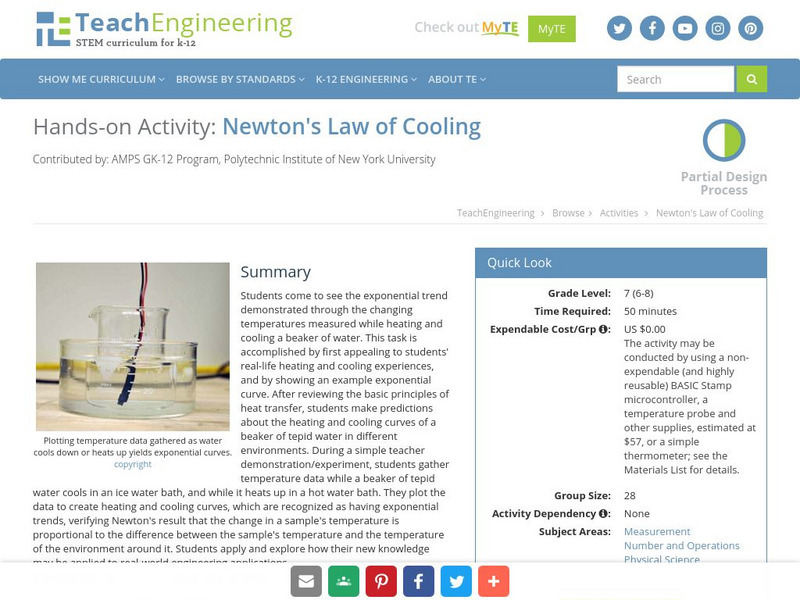
Teach Engineering: Newton's Law of Cooling
Middle schoolers come to see the exponential trend demonstrated through the changing temperatures measured while heating and cooling a beaker of water. This task is accomplished by first appealing to students' real-life heating and...

Science Struck
Science Struck: How to Rebuild a Hydraulic Cylinder
Describes the basic structure of a hydraulic system and what is involved in rebuilding a hydraulic cylinder. It presents three different problem scenarios and strategies for repairing the cylinder.
TeachEngineering
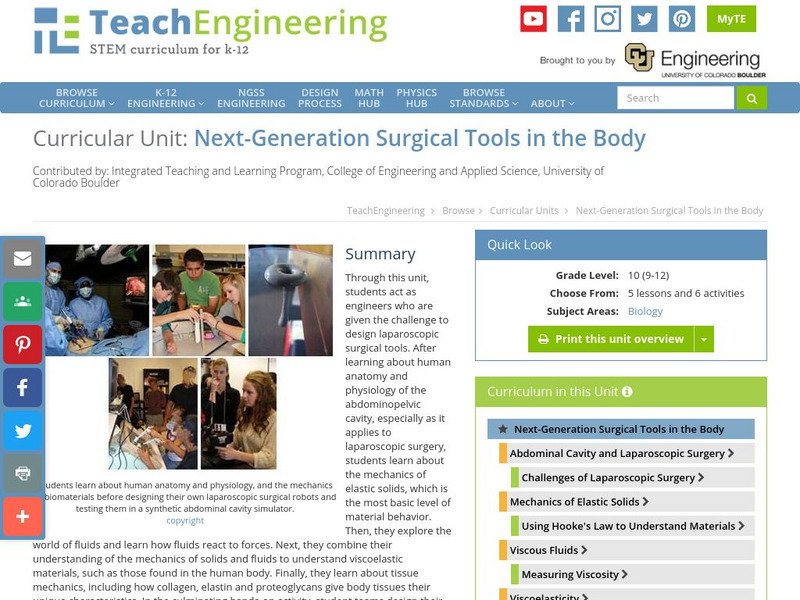
Teach Engineering: Next Generation Surgical Tools in the Body
Through this unit, students act as engineers who are given the challenge to design laparoscopic surgical tools. After learning about human anatomy and physiology of the abdominopelvic cavity, especially as it applies to laparoscopic...
TeachEngineering
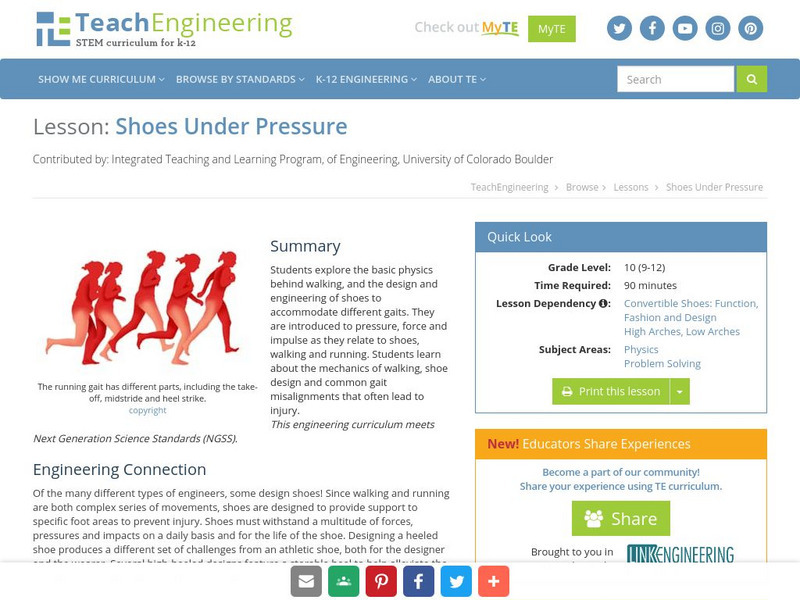
Teach Engineering: Shoes Under Pressure
Students explore the basic physics behind walking, and the design and engineering of shoes to accommodate different gaits. They are introduced to pressure, force and impulse as they relate to shoes, walking and running. Students learn...
TeachEngineering
Teach Engineering: Couch Potato or Inertia Victim?
Students design a simple behavioral survey, and learn basic protocol for primary research, survey design and report writing. Note: The literacy activities for the Mechanics unit are based on physical themes that have broad application to...
TeachEngineering
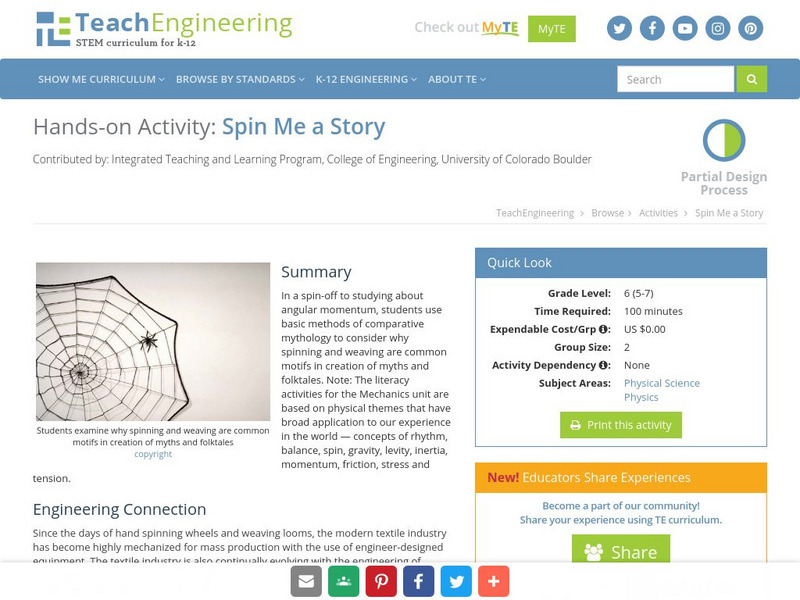
Teach Engineering: Spin Me a Story
In a spin-off to studying about angular momentum, students use basic methods of comparative mythology to consider why spinning and weaving are common motifs in creation myths and folktales. Note: The literacy activities for the Mechanics...