Hi, what do you want to do?






Curated OER
Seeing and Feeling Sound Vibrations
Groups rotate through a series of stations and work with a partner to observe sound waves. Children describe sound in terms of pitch, volume, and frequency. To apply their new knowledge, the class considers how these observations can...

Teach Engineering
The Mighty Heart
Have your class follow the step-by-step directions in this resource to dissect a sheep heart and gain a better understanding of this amazing organ. Working in small groups, pupils look for specific parts of the heart during their...

Teach Engineering
Blood Pressure Basics
Under pressure! The second lesson of the series introduces the class to blood pressure and the impact of high blood pressure on the cardiovascular system. It helps learners make the connection between blood pressure and how the heart...

Teach Engineering
Light Intensity Lab
Let there be light. The last installment of a seven-part series has pupils conduct an experiment on light attenuation through different numbers of transparency sheets. They then relate the results back to how X-rays measure bone density.

Teach Engineering
A Shot Under Pressure
You've got to pump it up! Using the equations for projectile motion and Bernoulli's Principle, class members calculate the water pressure in a water gun. The pupils collect data on the number of pumps and distance traveled in order...

Teach Engineering
Flame Test: Red, Green, Blue, Violet?
Let the true colors shine through. Pupils conduct a flame test to identify an unknown element. Class members calculate and prepare specific molarity solutions of three chemicals. Using their observations of the colors emitted, they...

Teach Engineering
How Antibiotics Work
Take two pills and call me in the morning. The first lesson in a short unit of four introduces class members to delivery methods of medicines. The instruction introduces the question of which delivery method is best to get you feeling...

Teach Engineering
Bone Mineral Density Math and Beer's Law
Hop into a resource on Beer's Law. A PowerPoint presentation introduces Beer's law as part of calculating bone density from X-ray images in the sixth instructional activity in the series of seven. Individuals work on practice problems...

Teach Engineering
May the Magnetic Force Be with You
Class members use mathematics in order to better understand magnetic forces and their interaction on charged particles. After a demonstration of the interaction between a magnet and an electron beam using a CRT computer monitor,...

Rice University
Intermediate Algebra
Algebra concepts are all wrapped up in one nice bow. The resource combines all the concepts typically found in Algebra I and Algebra II courses in one eBook. The topics covered begin with solving linear equations and move to linear...

Teach Engineering
Properties of Mixtures vs. Solutions: Mix It Up!
Now it becomes crystal clear why the unit is called Mixtures and Solutions. The fifth installment of a six-part unit explores mixtures and solutions. After viewing a demonstration on mixing pebbles with water, salt with water, and...

Teach Engineering
Alloy Advantage
Mix it up by using an intriguing resource that teaches young metallurgists that alloys are a metal mixture. They learn about the advantages of using alloys over pure metals and investigate titanium alloys as an example to finish the...

Curated OER
Silly Semi-Solids
Students create a polymer out of glue, water, and borax. They discuss the resulting substance and perform several experiments with it.

Teach Engineering
Kidney Stone Crystallization
No one likes kidney stones, but they are very interesting to learn about. The last installment of a three-part unit has learners experiment with different chemicals to see which one inhibits the growth of calcium oxalate crystals (which...

Curated OER
TE Activity: Yeast Cells Respire, Too (But Not Like Me and You)
Student observe and quantify the respiration that occurs in yeast-molasses cultures. They complete an effective experiment in order to examine how to think critically about the results.
TeachEngineering
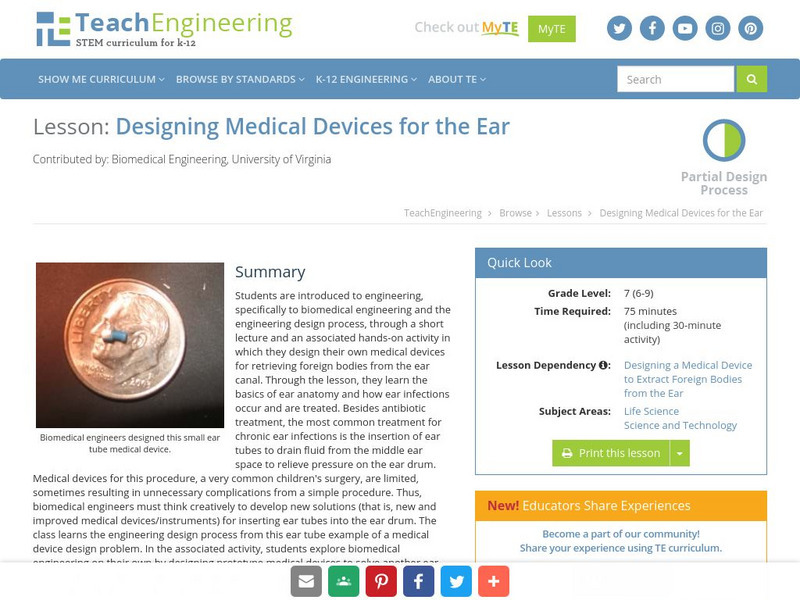
Teach Engineering: Designing Medical Devices for the Ear
Students are introduced to biomedical engineering and the engineering design process through a short lecture and an activity in which they design their own medical devices for retrieving foreign bodies from the ear canal. They learn...
TeachEngineering
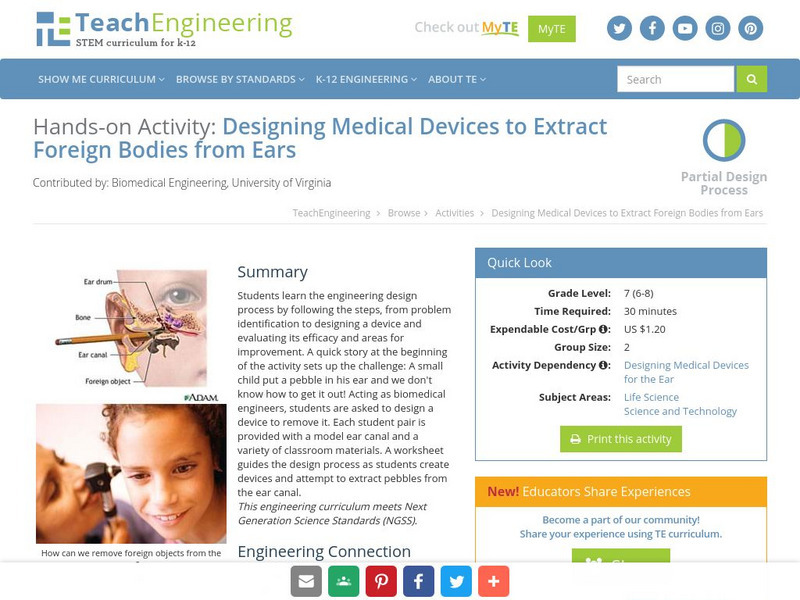
Teach Engineering: Designing a Medical Device
Students learn the engineering design process by following the steps, from problem identification to designing a device and evaluating its efficacy and areas for improvement. A quick story at the beginning of the activity sets up the...

TeachEngineering
Teach Engineering: Teaching the Engineering Design Process
Students follow the steps of the engineering design process (EDP) while learning about assistive devices and biomedical engineering. They first go through a design-build-test activity to learn the steps of the cyclical engineering design...
TeachEngineering
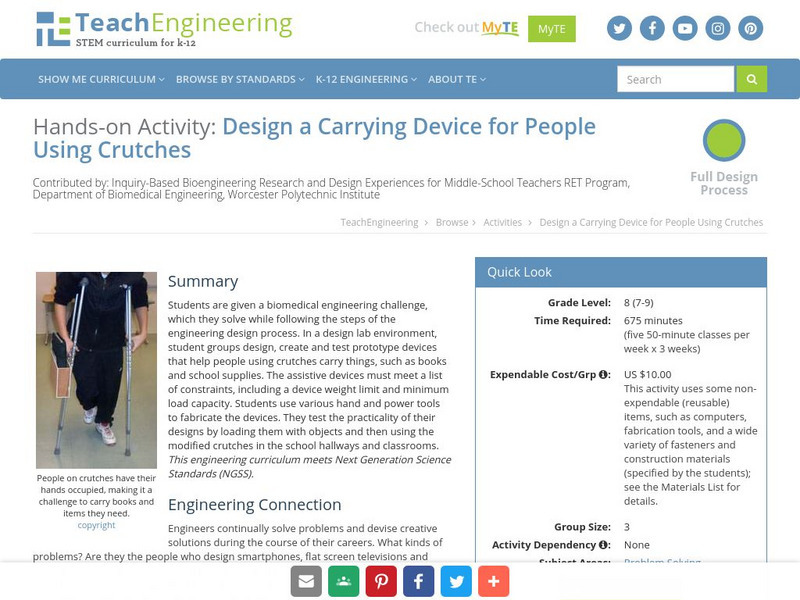
Teach Engineering: Design a Carrying Device for People Using Crutches
Students are given a biomedical engineering challenge, which they solve while following the steps of the engineering design process. In a design lab environment, student groups design, create, and test prototype devices that help people...
TeachEngineering
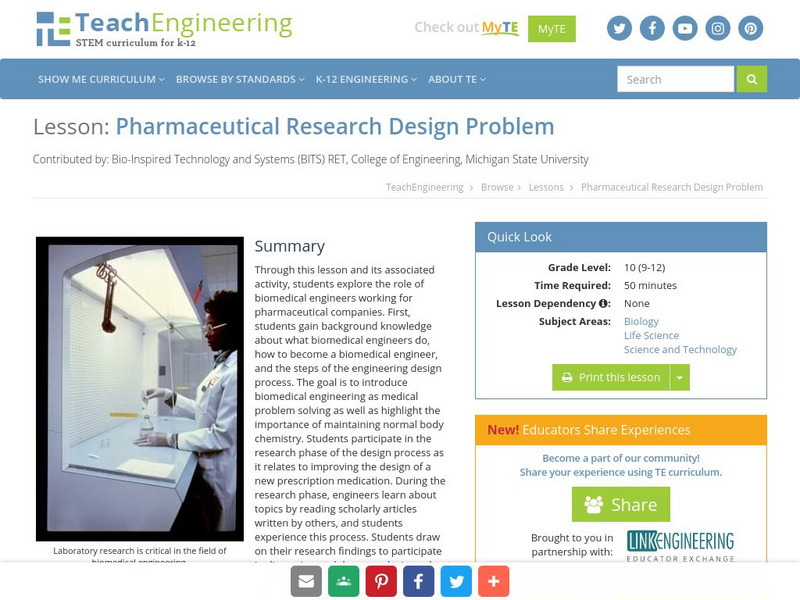
Teach Engineering: Pharmaceutical Research Design Problem
Through this lesson and its associated activity, students explore the role of biomedical engineers working for pharmaceutical companies. First, students gain background knowledge about what biomedical engineers do, how to become a...
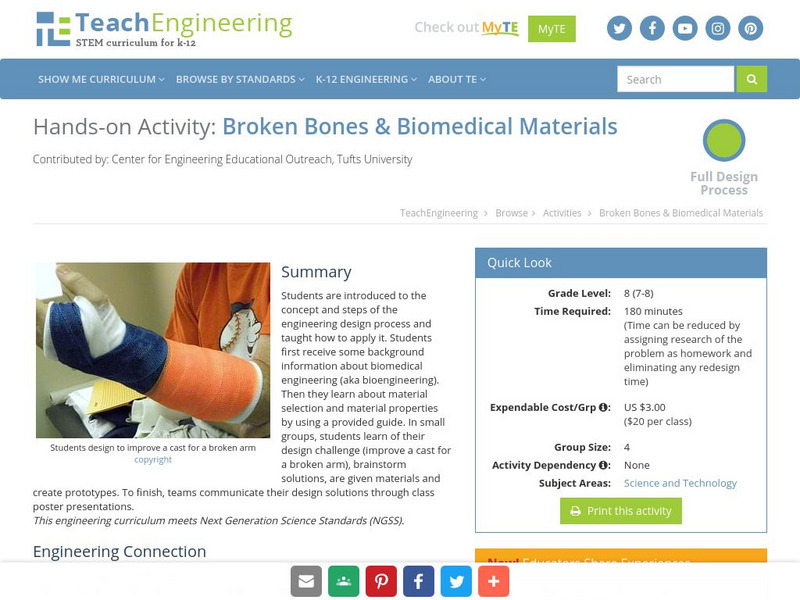
TeachEngineering
Teach Engineering: Broken Bones
The purpose of this activity is to introduce students to the concept of the engineering design process and to teach them how to apply it. In "Broken Bones," students will explore the steps of the engineering design process. They will...
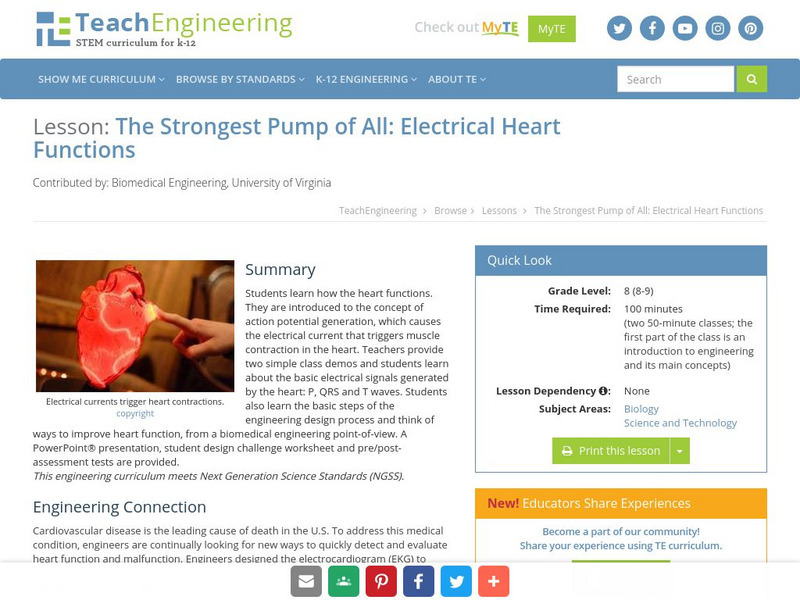
TeachEngineering
Teach Engineering: The Strongest Pump of All
For this lesson the students will learn how the heart functions. Students will be introduced to the concept of action potential generation. The lesson will explain how action potential generation causes the electrical current that causes...
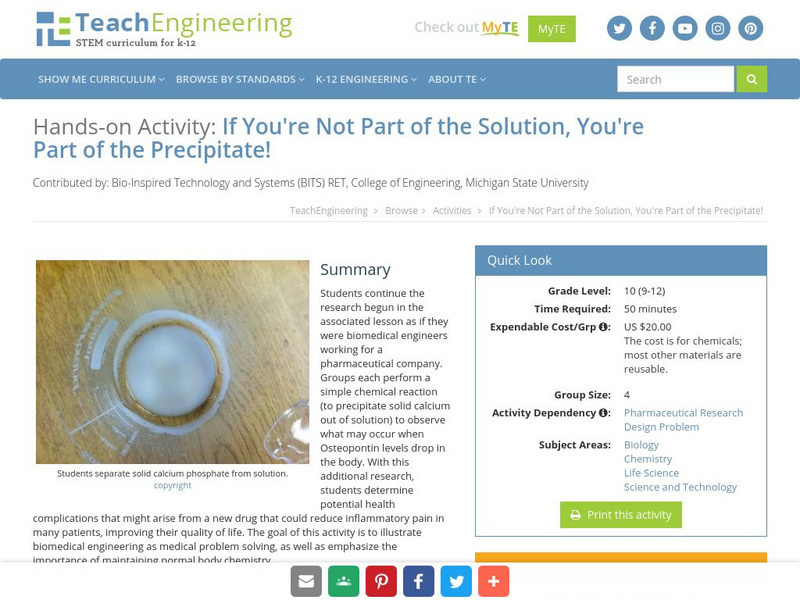
TeachEngineering
Teach Engineering: If You're Not Part of the Solution!
Students continue the research begun in the associated lesson as if they were biomedical engineers working for a pharmaceutical company. Groups each perform a simple chemical reaction (to precipitate solid calcium out of solution) to...
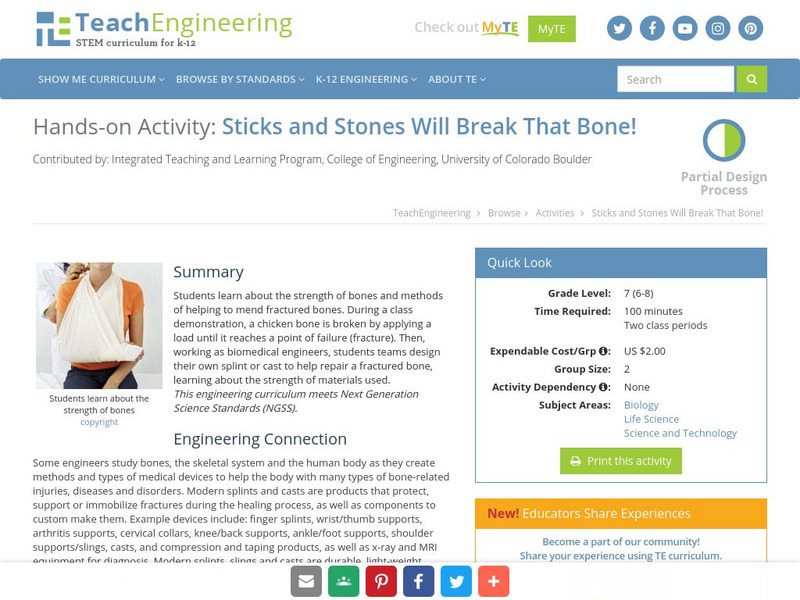
TeachEngineering
Teach Engineering: Sticks and Stones Will Break That Bone!
Students learn about the strength of bones and methods of helping to mend fractured bones. During a class demonstration, a chicken bone is broken by applying a load until it reaches a point of failure (fracture). Then, working as...