Hi, what do you want to do?






101 Questions
Electric Bill
A brilliant resource is at your disposal. Future consumers investigate and discuss an electric bill. Given only partial information, they estimate the monthly bill. They then consider how tiered pricing will affect the bill.

Teach Engineering
Building a Piezoelectric Generator
In pairs, learners build a piezoelectric generator from readily available electric components in the second and final installment of the two-part series. Tapping the piezoelectric element produces enough electricity to light an LED....

Teach Engineering
Efficiency of a Water Heating System
Tired of waiting for hot water? Groups of three determine the efficiency of an electric water-heating device. They calculate the amount of energy it takes to heat the water and the theoretical amount of energy required to heat the water....

Teach Engineering
Watt Meters to Measure Energy Consumption
It used watt amount of energy? This resource investigates the power usage of small household appliances. Using a watt meter, groups measure the actual wattage used by an appliance and then calculate the energy used daily.

Teach Engineering
Ice, Ice, PV!
Knowing the temperature coefficient allows for the calculation of voltage output at any temperature. Groups conduct an experiment to determine the effects of temperature on the power output of a solar panel. The teams alter the...

NOAA
Climate, Weather…What’s the Difference?: Make an Electronic Temperature Sensor
What's the best way to record temperature over a long period of time? Scholars learn about collection of weather and temperature data by building thermistors in the fourth installment of the 10-part Discover Your Changing World series....

Teach Engineering
Start Networking!
Class members create their own social networks by collecting signatures before graphing the interactions with their fellow classmates. The degree distribution of the simulated social network is determined by calculating the degree of...

Teach Engineering
Lighting in My Classroom Survey
How much energy does it take to light a room? Class members calculate the total wattage it takes to light the classroom. Through calculations, responsible scientists determine the cost of energy for the year, then figure out...

Teach Engineering
Household Energy Audit
Do you have an energy hog in your home? Individuals pick at least one room at home to determine the amount of energy the appliances consume. Using that information, pupils fill out a worksheet to determine the cost of running each...

Teach Engineering
Catching the Perfect SAR Waves!
Zero in on an interesting resource involving radar technology. Groups construct a radar sensing unit and learn to calibrate the system. Using the radar system and the Pythagorean Theorem, they calculate distances between objects.

American Chemical Society
The Energy Efficiency of Heating Water
Can a small change in laboratory procedures save energy? Scholars test three different methods for heating water in a science lab. Then, they calculate the energy efficiency for each and compare them to determine which uses the least...

Teach Engineering
Ramp and Review (for High School)
Rolling for momentum. As part of a study of mechanical energy, momentum, and friction, class members experiment rolling a ball down an incline and having it collide with a cup. Groups take multiple measurements and perform...

Bowland
You Reckon?
Sometimes simple is just better. A set of activities teaches young mathematicians about using plausible estimation to solve problems. They break problems down to simpler problems, use rounding and estimation strategies, and consider...

Teach Engineering
Concentrating on the Sun with PVs
Concentrate to determine the best reflector design. Pairs use the engineering design process to build a reflector to increase the current output of a photovotaic panel. Teams arrive at a final design and present it to the class along...

US Environmental Protection Agency
Mapping Greenhouse Gas Emissions Where You Live
After investigating the US Environmental Protection Agency's climate change website, your environmental studies students discuss greenhouse gas emissions. They use an online interactive tool to look at data from power production...

Teach Engineering
Quantum Dots and Colors
Introduce teams to quantum dot solutions with an activity that has them expose solutions to a blacklight, observe the colors, and take measurements. Groups graph the data and analyze the dependence between particle size and...

US Department of Energy
Geothermal Energy
With Earth Day quickly approaching, as well as many science fairs, why not challenge your class to investigate geothermal energy or other renewable energy resources? There are five driving questions explored in depth here, as well as...

It's About Time
Renewable Energy Sources - Solar and Wind
There has been a huge solar energy spill! Let's go outside to play in it. This lesson includes multiple experiments showcasing solar and wind energies. Scholars build a solar heater and an anemometer before testing the results. The...

Trash For Teaching
The Light-House Project
Groups work together to design a lighthouse, from designing and drawing the wiring diagram, to creating prototypes of the switch and circuit, to envisioning and building a scale model along with a blueprint. By including different...
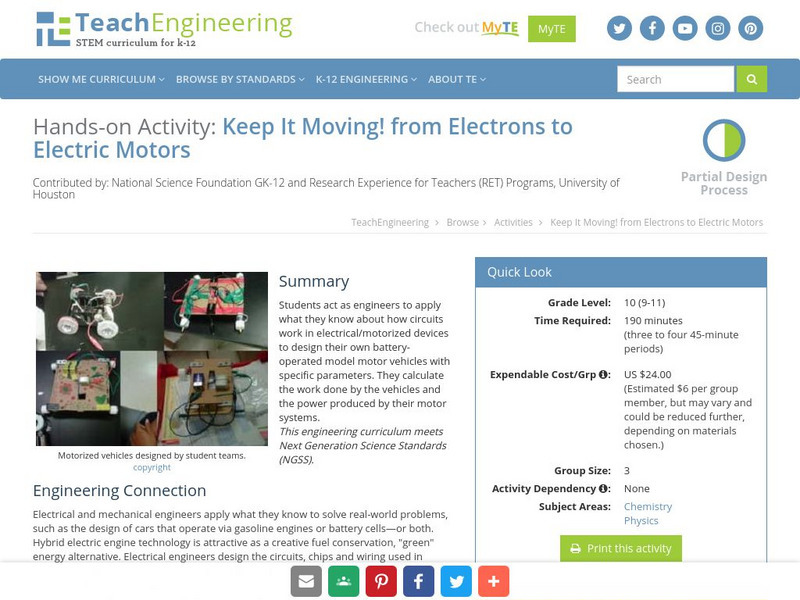
TeachEngineering
Teach Engineering: Keep It Moving! From Electrons to Electric Motors
Students act as engineers to apply what they know about how circuits work in electrical/motorized devices to design their own battery-operated model motor vehicles with specific paramaters. They calculate the work done by the vehicles...
Science Buddies
Science Buddies: How Does the Intensity of Light Change With Distance?
How far would you have to travel so that the light of the full sun would provide "daylight" no brighter than twilight on Earth? This project describes a method to verify the inverse square law: how light, sound, electrical signals, and...
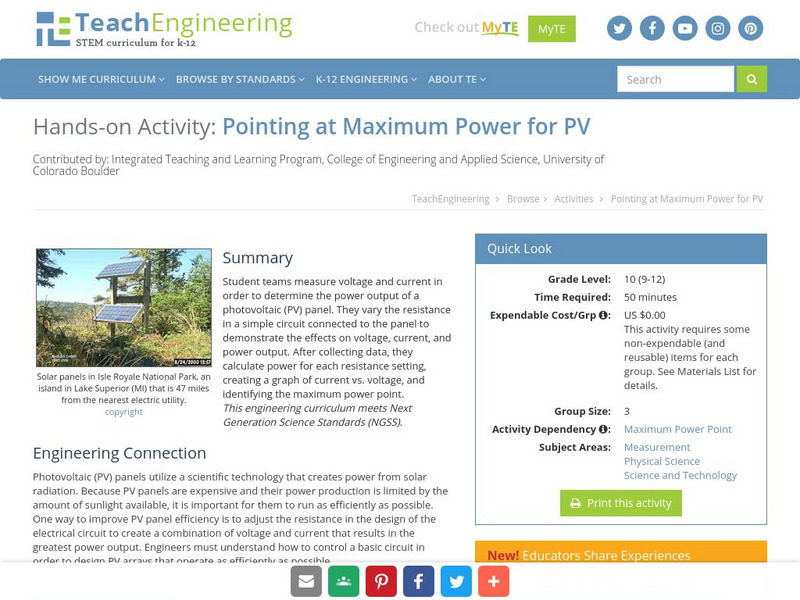
TeachEngineering
Teach Engineering: Pointing at Maximum Power for Pv
Student teams measure voltage and current in order to determine the power output of a photovoltaic (PV) panel. They vary the resistance in a simple circuit connected to the panel to demonstrate the effects on voltage, current, and power...
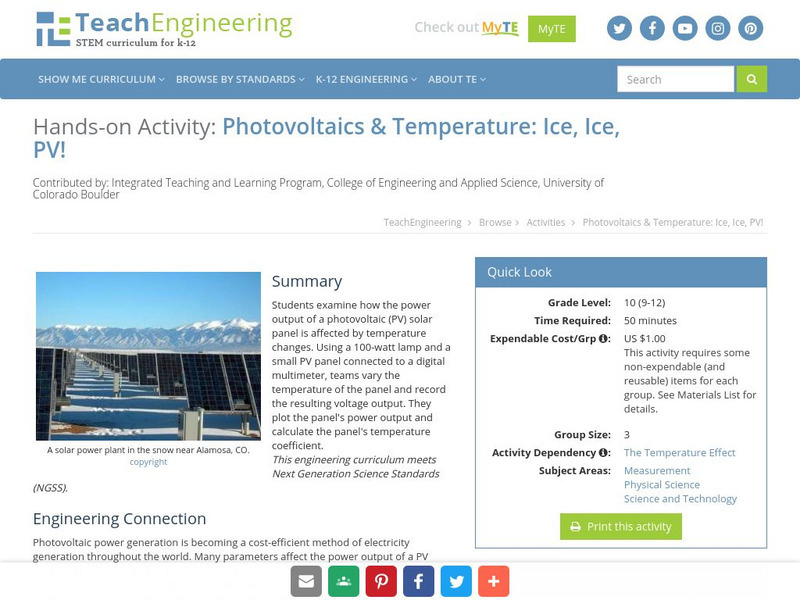
TeachEngineering
Teach Engineering: Ice, Ice, Pv!
Students examine how the power output of a photovoltaic (PV) solar panel is affected by temperature changes. Using a 100-watt lamp and a small PV panel connected to a digital multimeter, teams vary the temperature of the panel and record...
TeachEngineering
Teach Engineering: Can You Resist This?
This lab demonstrates Ohm's law as students set up simple circuits each composed of a battery, lamp and resistor. Students calculate the current flowing through the circuits they create by solving linear equations. After solving for the...