Hi, what do you want to do?






Columbus City Schools
Magnificent Mendeleev: An Elemental Tale
Discover how the periodic table tells the story of its elements. Learners begin by studying the makeup of several mixtures. Their analysis leads to a discussion of elements and the periodic table. As they dig deeper, they understand the...

Aquarium of the Pacific
Lego Molecules
Young scientists construct an understanding of molecular compounds in this hands-on science lesson. Using LEGO® to model the atoms of different elements, students build molecules based on the chemical formulas of common compounds.

Royal Society of Chemistry
Common Compounds
Can your young chemists identify the most commonly used chemicals in the lab? Introduce the class to the go-to substances in most middle and high school chemistry experiments with an interactive. The resource offers timely feedback as...

Royal Society of Chemistry
Compounds Ending in 'ate'
Tackle polyatomic ions with Sudoku-like games! Nomenclature novices practice identifying the names and constituents of carbonate compounds with a series of puzzles. Scholars can use the resource online or as a worksheet, thanks to the...

Royal Society of Chemistry
Elements 1
The periodic table can be a little overwhelming to young scientists. Meet your class' worries head on by introducing the table in a game. Individuals test their knowledge of the names and symbols of common elements, then use deductive...

Royal Society of Chemistry
Acids and Alkalis
Is your acid-base chemistry lesson plan a little ho-hum? Spice things up with puzzles! Young chemists manipulate facts about acids and bases to solve a series of interactive puzzles. The activity combines content knowledge and...

Royal Society of Chemistry
Alkalis and Salts
Gamification is an educational sensation! Young scientists build their acid-base vocabulary skills through a series of puzzles focused on bases and the salts they form. The challenging activity comes complete with a printable version and...

Columbus City Schools
To Measure its Mass or Volume?
Atoms, elements, and molecules, oh my! Teaching the fundamentals of chemistry to curious sixth graders has never been easier to accomplish. Here is a resource that pulls together everything needed to get them off to a good start,...

Columbus City Schools
ABC: Acid Base Chemistry
Bubble, bubble, boil and trouble! What causes common substances like baking soda and vinegar to react the way they do? Welcome your junior chemists to the wonders of acid-base chemistry using a comprehensive and fun...

Santa Monica College
Single and Double Displacement Reactions
If you aren't part of the solution, you are part of the precipitate! Young chemists learn about single and double displacement reactions including precipitation reactions, neutralization reactions, and gas forming reactions. They perform...

Royal Society of Chemistry
Alloys
What are alloys, and why do we use them? Through a series of interactive puzzles, scholars examine the components and uses of several common alloys. The accompanying teacher's resources provide support in using the lesson, printable...

Agriculture in the Classroom
Six Kinds Do It All
Teach young engineers that all machines, no matter how complicated or complex, are made up of just six simple devices with this hands-on physical science lesson. Using the included templates, students first create paper models of...

Royal Society of Chemistry
Shapes of Molecules—Distortion from the Pure Geometry
Ready to introduce the realities of molecular geometry to chemistry pupils? Use a logic-based interactive! Perfect as individual practice, the puzzles explore the bond angles and repulsions present in three common molecular shapes.

Pingry School
Replacement of Hydrogen by a Metal
As the most abundant element on the earth, hydrogen requires no replacement. Yet scholars learn to replace hydrogen with a metal to liberate the hydrogen gas. A simple procedure and data table include the necessary information and...

Rensselaer Polytechnic Institute
Molecules to the Max!—Educators Resource Guide
From molecules to nanotubes, an engaging unit explores the world of tiny science. Fifteen hands-on experiments and lessons engage young scientists as they learn chemistry. Discussions, worksheets, and data analysis reinforce the concepts...

Mr. E. Science
An Introduction to Matter
What's the matter? Gas, solid, liquid, or plasma. The presentation covers how to describe and identify matter, changes in matter, types of matter, measuring matter, particles of matter, Democritus, and John Dalton's Atomic Theory.

Mr. E. Science
Chemical Reactions
Once I told a chemistry joke, but there was no reaction. Get young chemists involved in changes and reactions with a presentation that begins with physical and chemical changes and chemical reactions. It moves on to chemical...

Inside Mathematics
Winning Spinners
Winning a spin game is random chance, right? Pupils create a table to determine the sample space of spinning two spinners. Individuals determine the probability of winning a game and then modify the spinners to increase the probability...
Scholastic
Scholastic: Study Jams! Science: Matter: Elements & Compounds
A video and a short quiz on elements, how they combine through chemical reactions to make compounds, and how to write the chemical formulas for water and salt.

CK-12 Foundation
Ck 12: Fifth Grade Science: Physical Science: Types of Matter
[Free Registration/Login may be required to access all resource tools.] Discusses elements, atoms, compounds, molecules, and crystals. Looks at mixture and different types of them.
Scholastic
Scholastic: Study Jams! Science: Matter: Periodic Table
A video and a short quiz on the periodic table of elements and how it is organized.
CK-12 Foundation
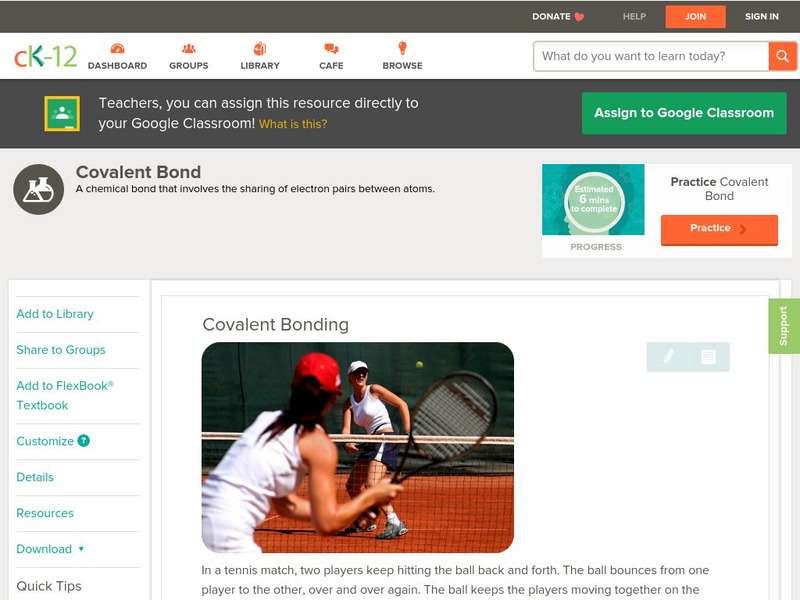
Ck 12: Physical Science: Covalent Bonding
[Free Registration/Login may be required to access all resource tools.] Definition of covalent bond, the compounds and elements they make up, and why they form.
BBC
Bbc: Gcse Bitesize: Chemistry (Single Science)
This site lists the topics and lessons available for Chemistry. The topics include Particles; Elements, compounds and mixtures; Chemical reactions, Predicting and identifying reactions and products, organic chemistry, and more.
Ducksters
Ducksters: Chemistry for Kids: Organic Chemistry
Kids learn about organic chemistry including the importance of carbon, organic molecules, compounds, hydrocarbons, synthesis, and functional groups.